


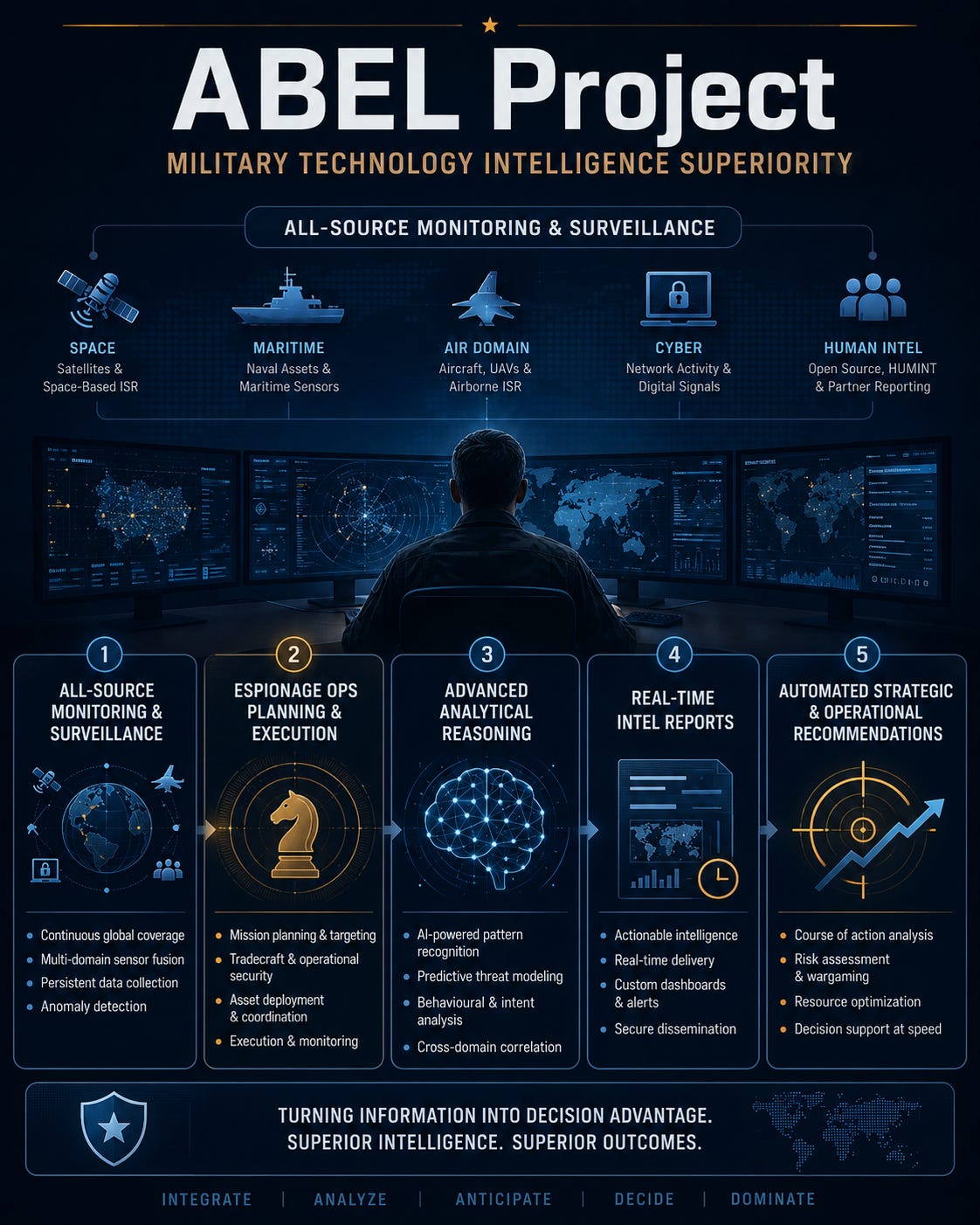
Military technology intelligence is not a peripheral function.
It is a strategic capability.
It has been, and continues to be, one of the decisive factors for:
• Strategic security.
• National competitiveness.
• Technological sovereignty.
• Defense innovation.
• High-tech industrial advantage.
• Corporate resilience.
And yet, in many organizations, it remains underdeveloped.
It is not always properly inserted into:
• Innovation practices.
• Strategic planning.
• R&D decision-making.
• Technology management.
• Defense industrial policy.
• Corporate intelligence systems.
That is a mistake.
In a world where technological advantage determines operational advantage, intelligence about technology is no longer optional.
It is infrastructure.
It is doctrine.
It is anticipation.
It is decision superiority.
1. Why military technology intelligence matters
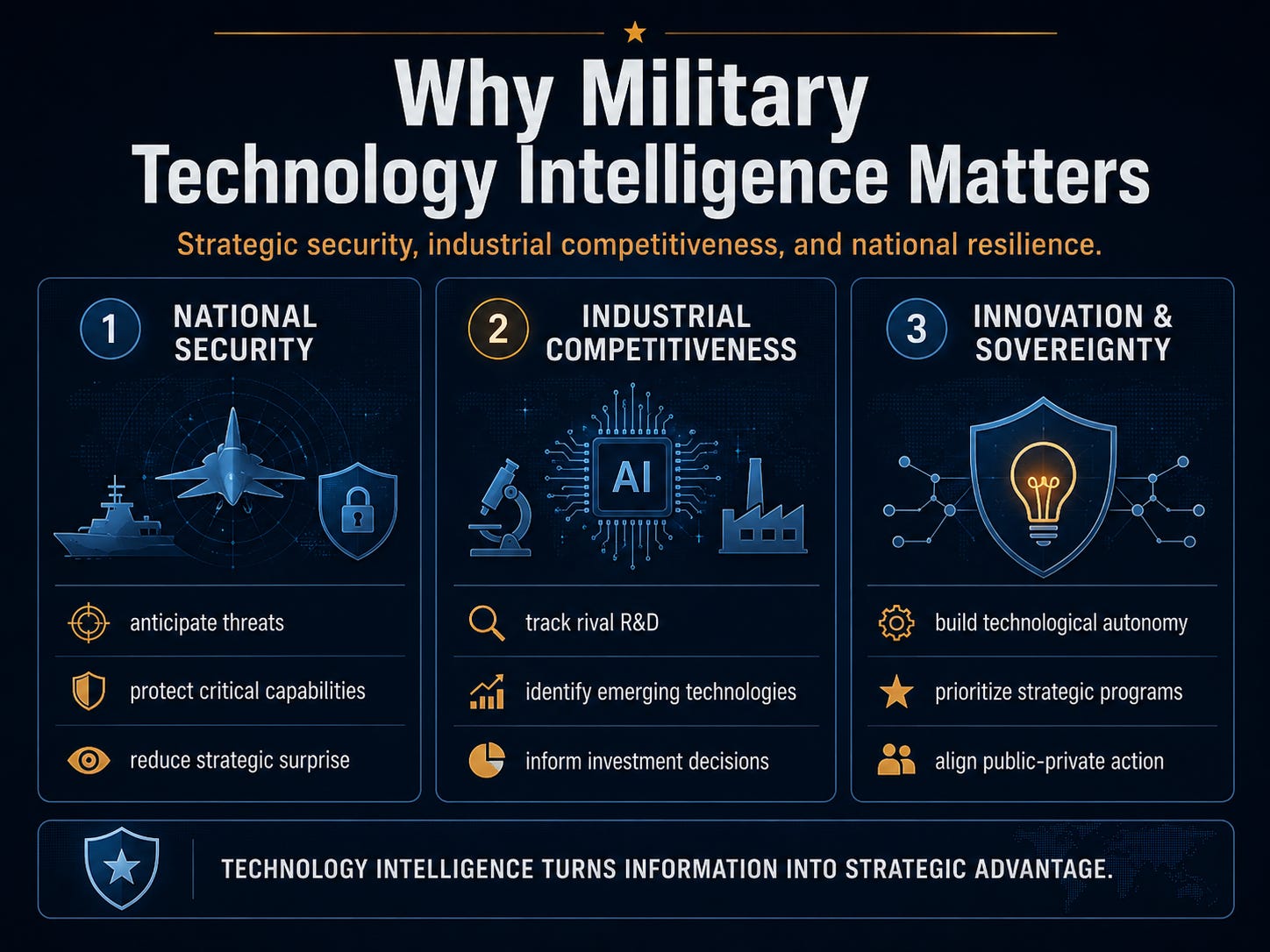
Military technology intelligence sits at the intersection of:
• Defense.
• Innovation.
• Industrial competitiveness.
• National security.
• Strategic foresight.
• Technological sovereignty.
Its purpose is not merely to collect information about technologies.
Its purpose is to understand:
• Which technologies are emerging.
• Who is developing them.
• What capabilities they enable.
• How fast they can be deployed.
• Which actors control them.
• Which vulnerabilities they create.
• Which opportunities they open.
• Which risks they impose on our own systems.
This is especially important for organizations working in:
• Defense.
• Cybersecurity.
• Aerospace.
• Artificial intelligence.
• Robotics.
• Autonomous systems.
• Critical infrastructure.
• Sensing technologies.
• Dual-use innovation.
• High-tech services.
In these environments, technological ignorance is not a knowledge gap.
It is a strategic vulnerability.
2. From competitive intelligence to technology intelligence
The application of intelligence methods to the business technology field has a clear precedent.
One of the most important early experiences was the work of Jan Herring, a former CIA officer who helped Motorola build a formal competitive intelligence capability in the 1980s.
That episode is important because it showed something that remains true today:
companies do not lose only because they lack technology.
They lose because they fail to understand the technological moves of others.
They fail to:
• Detect weak signals.
• Interpret adversarial innovation.
• Connect market shifts with technical capabilities.
• Anticipate strategic discontinuities.
• Protect their own technological position.
• Convert information into decision advantage.
In the case of Motorola, technology intelligence was not just a reporting activity.
It was a decision-support function.
It helped the organization understand technological competition, assess adversarial movement, and align strategic action.
That lesson is now more relevant than ever.
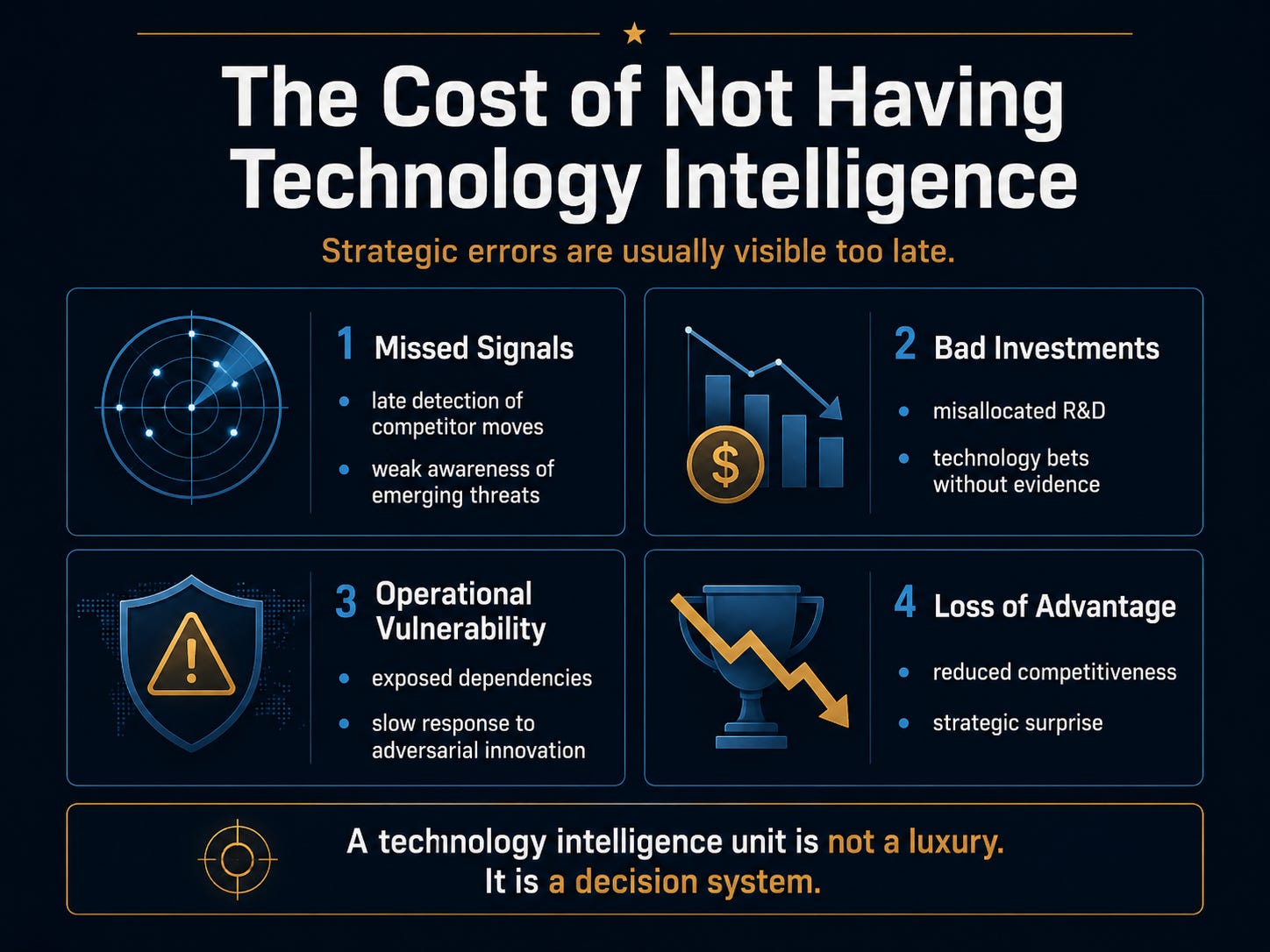
3. The cost of not having technology intelligence
After more than thirty years working in this field as a technologist, one conclusion becomes difficult to avoid:
many strategic errors and economic losses could have been avoided if organizations had implemented a serious technology intelligence capability.
Not a newsletter.
Not a market report.
Not a superficial monitoring service.
A real capability.
That means:
• A methodology.
• A cell.
• A unit.
• A department.
• A doctrine.
• A continuous intelligence production process.
Many services currently available in the market provide low-value information.
They describe what is visible, but they do not infer what matters.
They report events, but they do not generate intelligence.
They monitor news, but they do not identify capabilities.
They summarize information, but they do not support strategic decisions.
That is not enough.
Technology intelligence must answer questions that matter:
• What is the adversary actually capable of doing?
• Which technologies will change the balance of power?
• Which R&D lines are strategically decisive?
• Which suppliers, platforms, patents, laboratories, teams, or ecosystems reveal future capability?
• Which technologies expose our own vulnerabilities?
• Which investments must be accelerated, protected, abandoned, or redirected?
Without this capability, organizations operate with delayed awareness.
And delayed awareness is usually expensive.
4. From intentions to capabilities
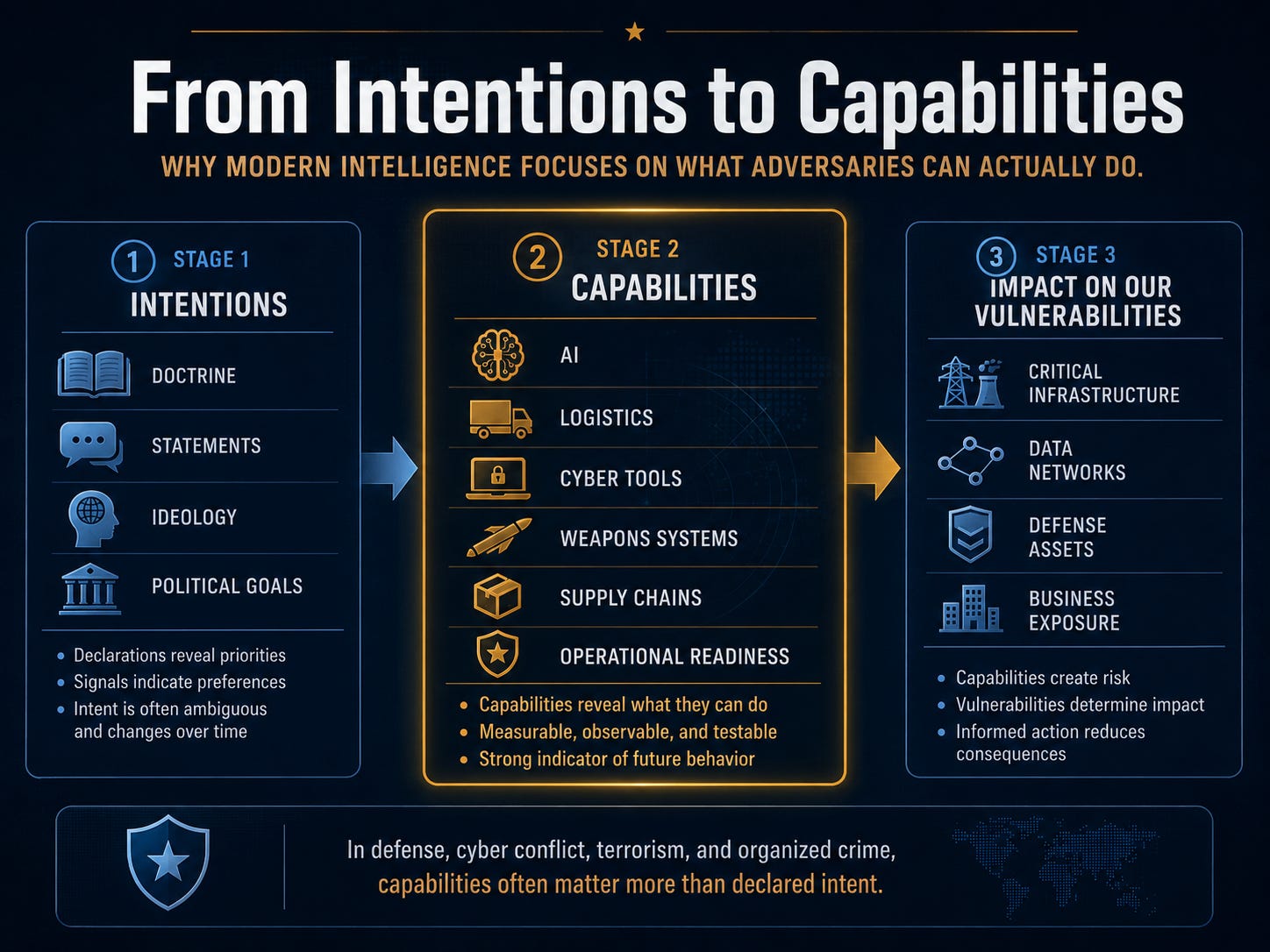
Traditional intelligence often focused on intentions.
What does an actor want?
What are its declared objectives?
What are its political goals?
What does it say it will do?
Those questions still matter.
But in technological competition, they are no longer sufficient.
The central question is increasingly different:
What can the actor actually do?
Capabilities matter because they are:
• Observable.
• Measurable.
• Testable.
• Operationally consequential.
• Harder to fake than intentions.
• More useful for strategic planning.
Intentions can be hidden.
Intentions can change.
Intentions can be deceptive.
Capabilities are harder to fake.
A country, company, terrorist organization, criminal network, or military force becomes strategically relevant when it possesses the capacity to act.
That capacity may be:
• Technological.
• Logistical.
• Operational.
• Organizational.
• Financial.
• Industrial.
• Scientific.
• Cybernetic.
This shift is visible across multiple domains.
In cybersecurity, intentions matter less than:
• Access.
• Tooling.
• Persistence.
• Infrastructure.
• Exploit capacity.
• Operational readiness.
In terrorism and organized crime, intentions matter less than:
• Networks.
• Financing.
• Logistics.
• Technical competence.
• Operational security.
• Deployment capability.
In defense, intentions matter less than:
• Platforms.
• Sensors.
• Autonomy.
• AI integration.
• CBRN knowledge.
• Space assets.
• Electronic warfare capacity.
• Industrial depth.
In corporate competition, intentions matter less than:
• Patents.
• Talent.
• Models.
• Compute.
• Datasets.
• Partnerships.
• Supply chains.
• Speed of deployment.
Modern intelligence must therefore prioritize capabilities.
Not only what actors say.
What they can build.
What they can deploy.
What they can scale.
What they can weaponize.
What they can use against our vulnerabilities.
5. AI as a strategic capability
Artificial intelligence has become one of the clearest examples of this transformation.
AI is not simply another technology.
It is a capability multiplier.
It affects:
• Decision-making.
• Intelligence analysis.
• Cyber operations.
• Logistics.
• Surveillance.
• Autonomous systems.
• Knowledge production.
• Simulation.
• Command-and-control.
• Scientific discovery.
• Industrial competitiveness.
This is why national AI strategies have become central to geopolitical and economic competition.
The United States Executive Order on Maintaining American Leadership in Artificial Intelligence, issued in February 2019, explicitly framed AI leadership as important for economic and national security.
That framing is correct.
The strategic technological planning of AI capabilities, both for a country and for a company, will become one of the key elements of organizational power.
The question will not be simply:
Who uses AI?
The real questions will be:
• Who controls the best AI capabilities?
• Who integrates them into operations?
• Who protects them from adversarial acquisition?
• Who combines them with intelligence production?
• Who applies them to decision superiority?
• Who understands the AI capabilities of competitors and adversaries?
AI strategy without technology intelligence is incomplete.
Because the value of AI does not come only from internal adoption.
It also comes from knowing how AI changes the competitive and adversarial landscape around us.
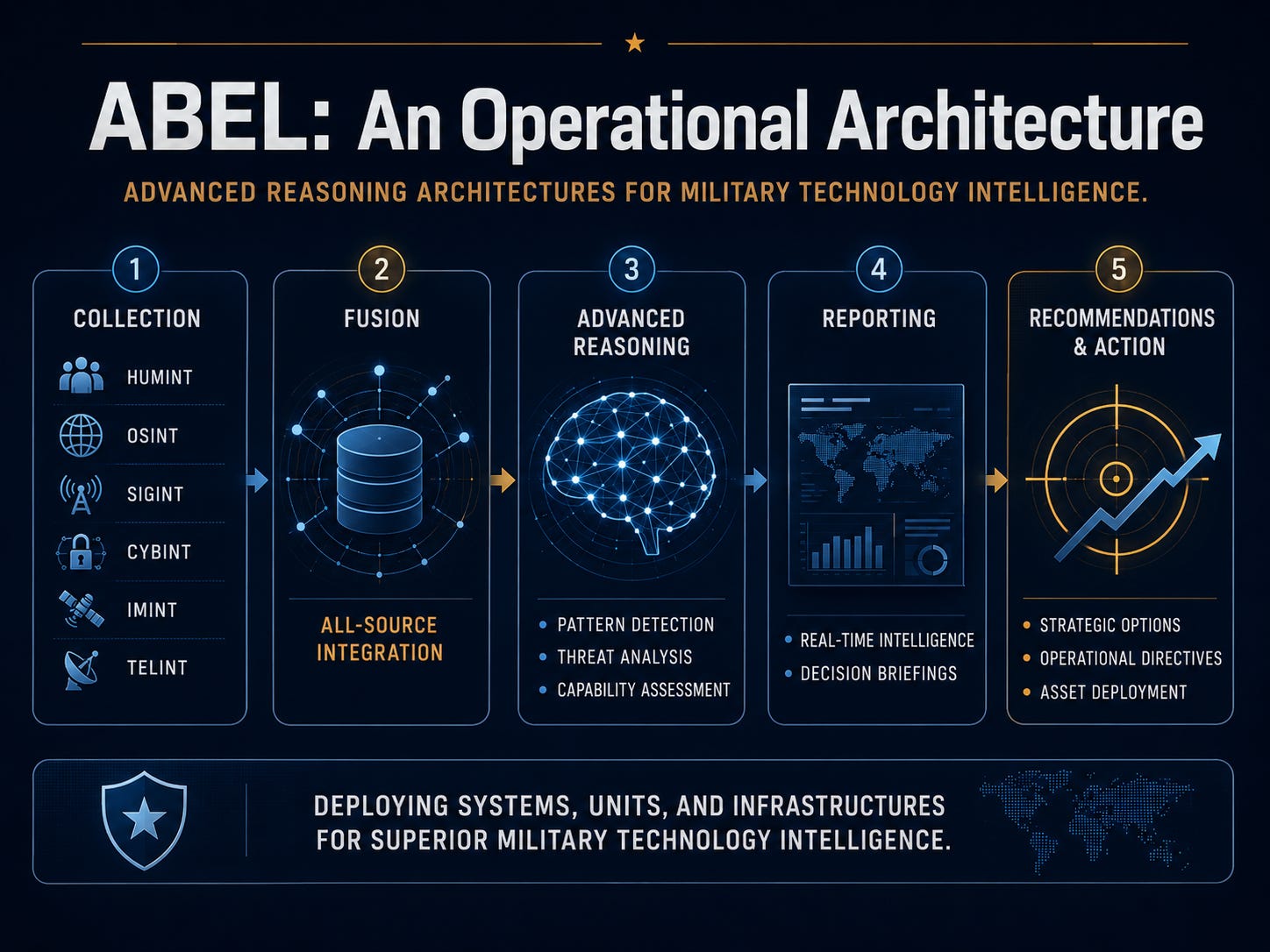
6. Military technology intelligence as an operational system
Military technology intelligence must be understood as an operational system, not as an isolated analytical product.
It requires:
• All-source monitoring.
• Surveillance of technological ecosystems.
• Human intelligence.
• Open-source intelligence.
• Signal and cyber intelligence.
• Patent and scientific monitoring.
• Supplier and industrial mapping.
• R&D tracking.
• Adversarial capability assessment.
• Scenario construction.
• Advanced analytical reasoning.
• Real-time intelligence reporting.
• Strategic and operational recommendations.
The objective is to transform fragmented information into actionable intelligence.
Not information for curiosity. Information for decision.
Not data accumulation. Capability assessment.
Not passive observation. Strategic anticipation.
7. ABEL Project
ABEL is a project aimed at deploying military technology intelligence systems, units, and infrastructures.
Its foundation is the integration of:
• Advanced reasoning architectures.
• Military technology intelligence doctrine.
• All-source monitoring and surveillance.
• Analytical methodologies.
• Capability assessment models.
• Operational reporting systems.
• Strategic recommendation engines.
• Human-supervised intelligence workflows.
The purpose of ABEL is not merely to observe technological change.
The purpose is to convert technological change into:
• Operational awareness.
• Strategic foresight.
• Decision advantage.
• Capability anticipation.
• Risk reduction.
• Technological superiority.
ABEL is designed for environments where technology determines superiority:
• Defense.
• Cybersecurity.
• Aerospace.
• AI.
• Autonomous systems.
• Critical infrastructure.
• Dual-use innovation.
• Strategic industry.
• National security.
In these domains, technology intelligence must become a permanent capability.
Not occasional.
Not reactive.
Not decorative.
Permanent.
Structured.
Operational.
8. The new discipline of superiority
Military technology intelligence is not only about knowing what exists.
It is about understanding what is becoming possible.
That is the decisive point.
The most important signals are often not yet visible as finished systems.
They appear first as:
• Research programs.
• Procurement decisions.
• Scientific publications.
• Patents.
• Hiring patterns.
• Industrial partnerships.
• Supplier movements.
• Test ranges.
• Prototypes.
• Simulation environments.
• Doctrine changes.
• Unexpected budget allocations.
A mature military technology intelligence system must connect those signals.
It must infer capability from fragments.
It must understand:
• How technology becomes doctrine.
• How doctrine becomes procurement.
• How procurement becomes deployment.
• How deployment becomes operational advantage.
• How operational advantage creates vulnerability for others.
This is why advanced reasoning architectures are essential.
The intelligence problem is no longer only collection.
It is interpretation under uncertainty.
It is reasoning across incomplete signals.
It is anticipation before confirmation.
9. Closing
Technology has become the primary vector of strategic development.
For nations.
For companies.
For military organizations.
For criminal and terrorist actors.
For industrial ecosystems.
For geopolitical competitors.
The consequence is clear: technology intelligence must move to the center of strategic planning.
Organizations that lack this capability will:
• Detect threats too late.
• Invest in the wrong technologies.
• Misunderstand adversarial capabilities.
• Expose their own vulnerabilities.
• Confuse information with intelligence.
• Lose strategic initiative.
ABEL is conceived as a response to that gap.
A project for military technology intelligence superiority.
A project for advanced reasoning applied to technological competition.
A project for transforming information into decision advantage.
Because in the age of technological conflict, superiority will not belong only to those who possess technology.
It will belong to those who understand it first.
Who interpret it better.
Who anticipate its consequences.
And who act before the strategic window closes.