

There is a form of intelligence work that is often misunderstood.
It is not mind reading.
It is not magic.
It is not manipulation.
It is the disciplined observation of signals.
For experienced field operators, trained intelligence professionals, investigators, negotiators, interrogators, high-performing salespeople, and even skilled fraudsters, reading the intentional, emotional, and behavioral state of a person is often almost automatic.
They observe language, tone, rhythm, posture, micro-expressions, gaze, hands, clothing, objects, routines, inconsistencies, reactions, silences, and contextual shifts.
They do not observe isolated signs. They observe patterns.
And over time, those patterns become a dynamic profile.
What does this person want?
What do they fear?
What are they hiding?
What do they need?
What is their emotional state?
What are their vulnerabilities?
What type of pressure affects them?
What type of approach would create affinity?
What type of approach would trigger distance, resistance, or threat?
This is not about invading privacy.
It is about structured interpretation of observable behavior.
The problem becomes much harder when the subject is not an ordinary person in a normal context, but an elusive opponent: an intelligence officer, a criminal, a terrorist, a lone actor, a white-collar psychopath, a hostile political actor, a military adversary, or a corporate opponent.
In those cases, intuition is not enough.
We need computational reasoning systems.
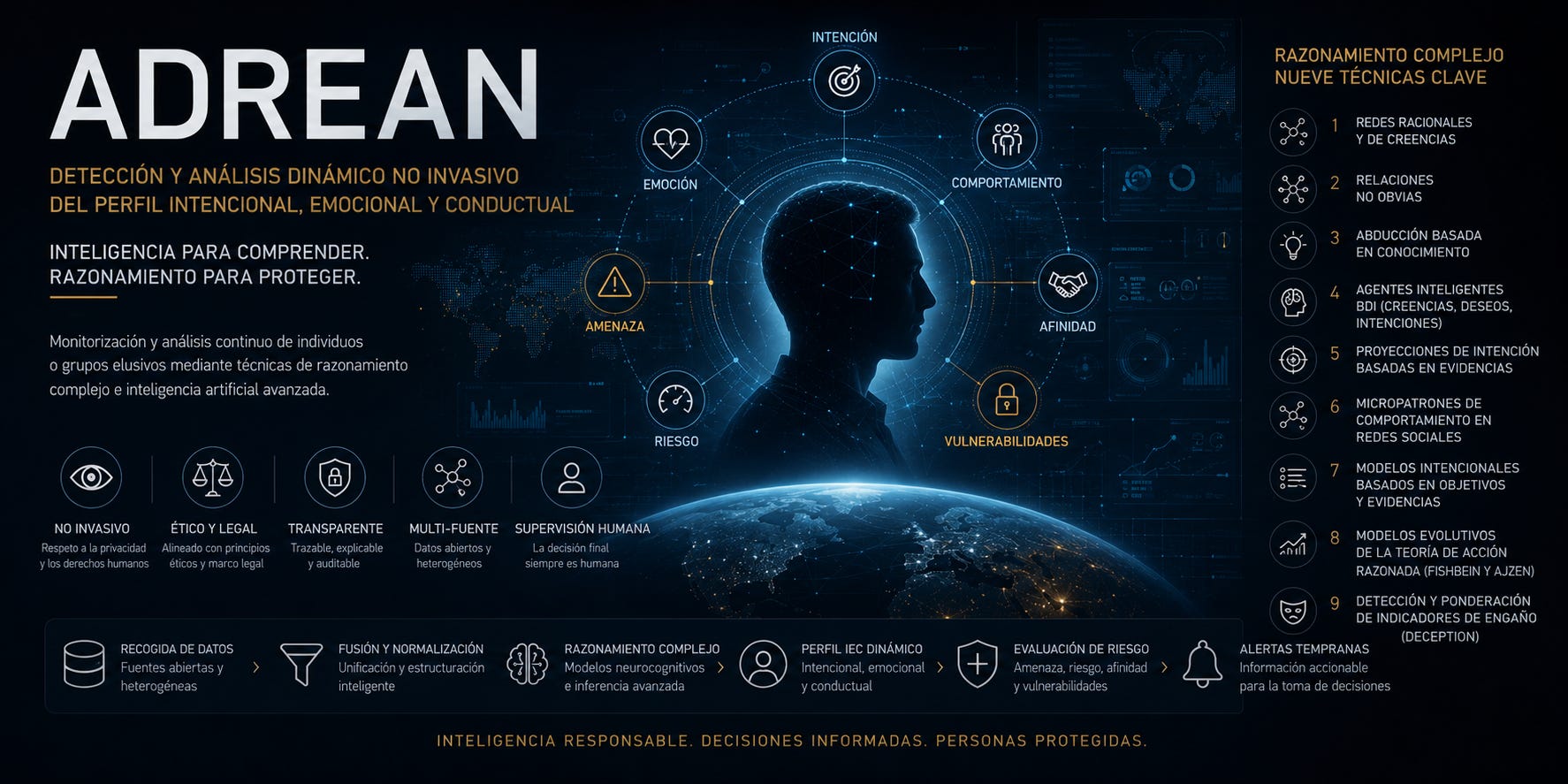
That is the conceptual domain of ADREAN: a project for continuous, non-invasive monitoring, analysis, and early warning of dynamic intentional, emotional, and behavioral profiles of elusive individuals or groups.
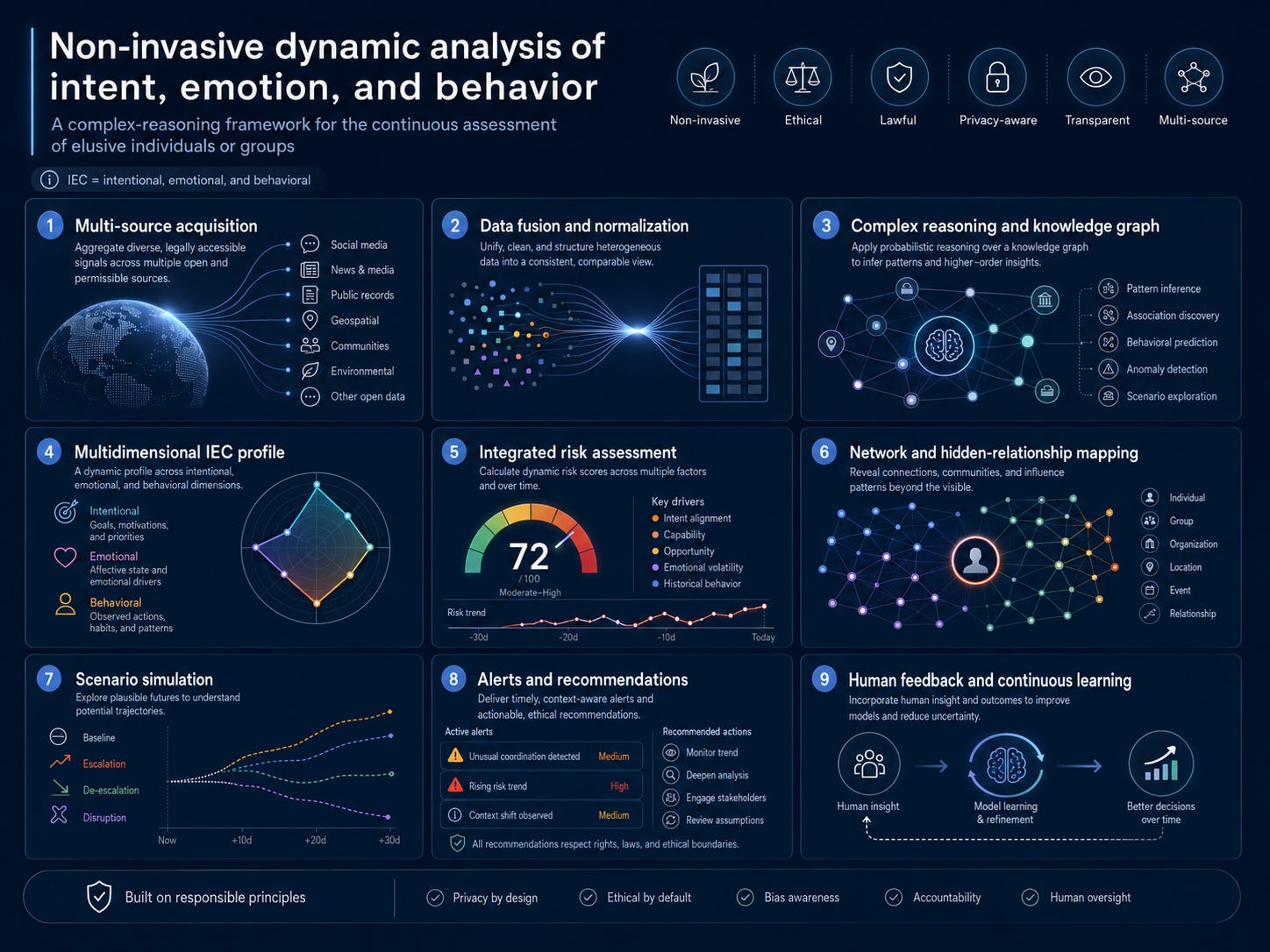
Figure 1 — Non-invasive dynamic analysis of IEC.
ADREAN is conceived as a responsible, multi-source, privacy-aware framework for continuous assessment of intentional, emotional, and behavioral profiles.
TL;DR
Human operators can often infer intention, emotion, and behavior through experience, observation, and trained intuition.
But elusive opponents require something more robust.
ADREAN explores how complex reasoning systems can support non-invasive analysis of IEC profiles:
Intentional: goals, motives, priorities, planning, alignment.
Emotional: stress, volatility, affective state, fear, affinity, empathy.
Behavioral: actions, routines, communication patterns, anomalies, adaptation.
The objective is not to violate privacy or automate suspicion.
The objective is to structure weak signals into evidence-based, human-supervised profiles that support early warning, risk assessment, and responsible decision-making.
1. The experienced operator sees patterns
A well-trained field operator does not need science fiction to “read” a person.
The work is more mundane and more difficult.
It is based on observation, context, repetition, comparison, and inference.
Several domains converge:
psycholinguistics
phonetics
diachronic behavioral models
synchronic behavioral models
factual, perceptual, and representational triggers
facial micro-expressions
posture
hand movement
gaze
clothing
surrounding objects
open, semi-open, or closed interviews
inconsistencies between words, tone, and action
contextual reaction patterns
Combined intelligently, these signals can help build what we call a dynamic IEC profile: intentional, emotional, and behavioral.
The profile is not static.
It changes over time.
It depends on context.
It depends on pressure.
It depends on relationship, opportunity, perceived threat, and emotional state.
A person is not one profile.
A person is a changing system of intentions, emotions, and behaviors.
That is why the analysis must be dynamic.
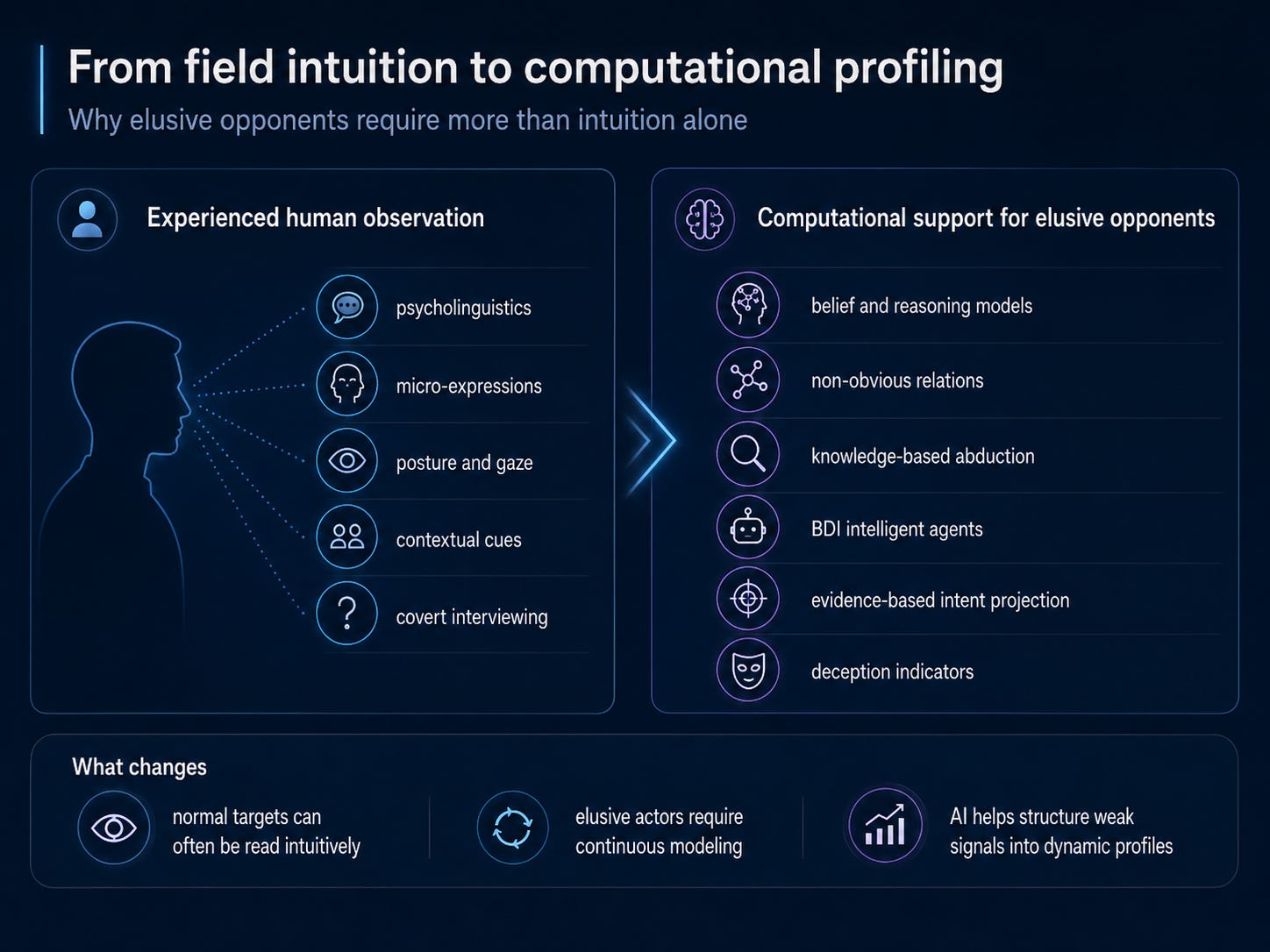
Figure 2 — From field intuition to computational profiling.
Experienced human observation can infer patterns from language, expression, posture, gaze, and context. Elusive opponents require computational support to structure weak and ambiguous signals over time.
2. The uncomfortable side of human expertise
With years of practice, this form of perception becomes almost automatic.
That can be useful.
It can also be uncomfortable.
A trained operator may detect incongruence where others see sincerity. They may perceive hostility behind politeness, fear behind confidence, manipulation behind charm, or emotional instability behind formal composure.
This can create a kind of cognitive unease.
Knowing too much about the intentional and emotional reality of people around you is not always pleasant.
Good salespeople and skilled deceivers often possess a crude version of this ability. They may not know the terminology. They may not know the science. But through intuitive reasoning, they detect leverage, desire, insecurity, resistance, and opportunity.
Their conclusions are often less precise than those of a trained professional.
But they can be effective.
The difference is structure.
Intuition can detect.
Structure can explain.
Computational reasoning can scale, test, and continuously update the analysis.
3. Why elusive opponents are different
Ordinary people can often be read through relatively accessible behavioral signals.
Elusive opponents are different.
They hide intent.
They manage appearance.
They manipulate perception.
They create false trails.
They adapt to observation.
They use compartmentalization.
They may operate through proxies, intermediaries, coded routines, or fragmented signals.
They may deliberately produce noise to obscure intention.
This applies to many categories of difficult subjects:
spies
criminals
terrorists
lone actors
white-collar psychopaths
hostile political actors
military opponents
adversarial corporate actors
covert influence operators
radicalized micro-networks
In these cases, the analyst rarely has a clean picture.
The available signals are partial, distributed, weak, contradictory, or intentionally distorted.
The goal is not certainty.
The goal is better inference under uncertainty.
This is where neurocognitive computational models and complex reasoning systems become valuable.
They help transform dispersed indicators into dynamic, evidence-based profiles.
4. The IEC profile
The IEC profile integrates three dimensions.
Intentional
This dimension evaluates what the person or group appears to want.
It includes:
goals
motives
planning
priorities
opportunity perception
target alignment
commitment to action
Emotional
This dimension evaluates affective and emotional state.
It includes:
stress
volatility
fear
confidence
anger
frustration
empathy
emotional exhaustion
emotional escalation
Behavioral
This dimension evaluates observable action patterns.
It includes:
routines
deviations
communication style
coordination patterns
risk behavior
concealment behavior
adaptation
anomalies
The value of IEC analysis is that it does not reduce a person to one signal.
It integrates intention, emotion, and behavior into a dynamic model.
A threat is not only what someone says.
It is what they want, how they feel, what they do, how they adapt, and how those dimensions change over time.
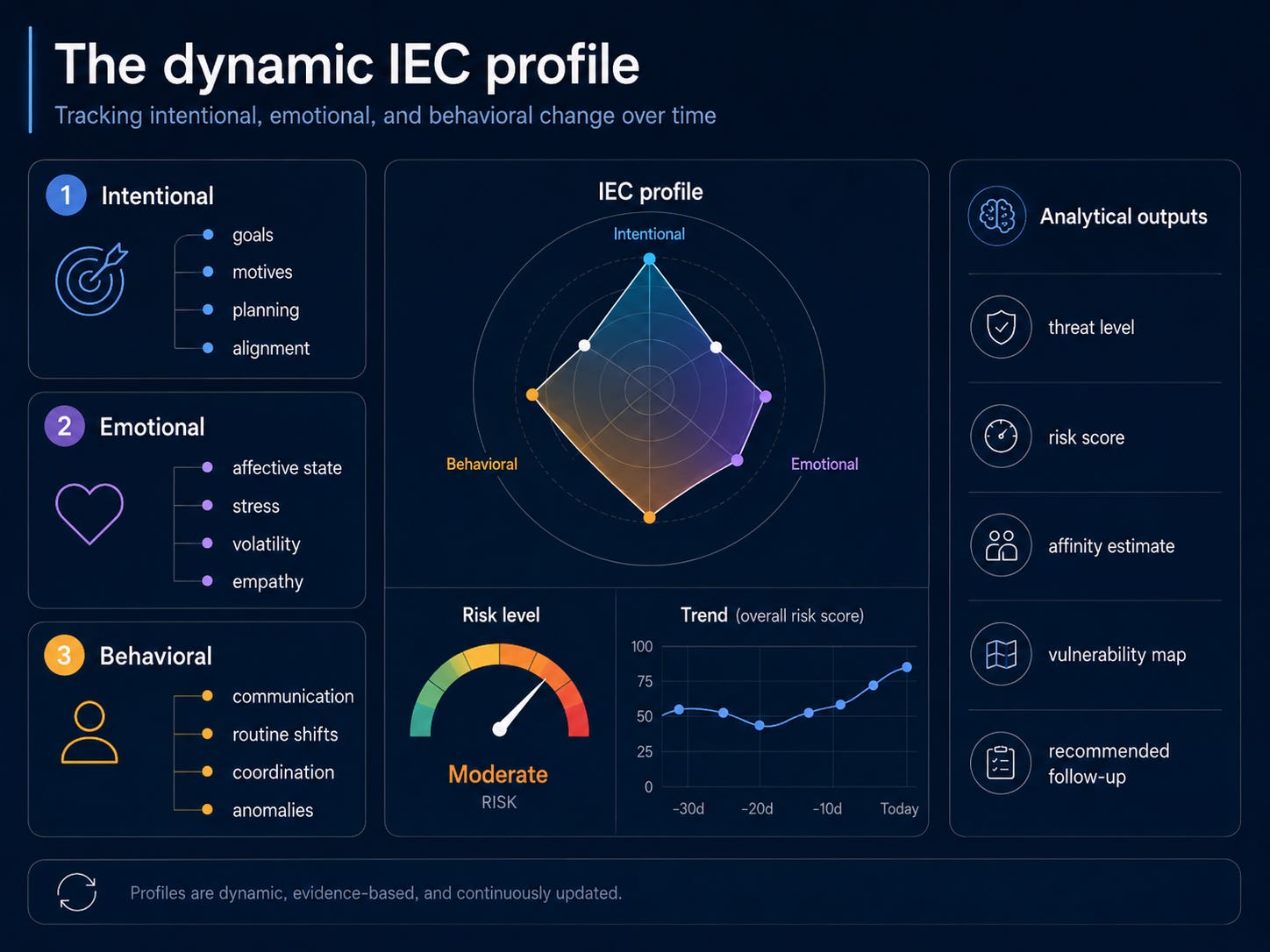
Figure 3 — The dynamic IEC profile.
IEC profiling tracks intentional, emotional, and behavioral dimensions over time, producing analytical outputs such as threat level, risk score, affinity estimate, vulnerability map, and recommended follow-up.
5. ADREAN: from weak signals to early warning
ADREAN is conceived as an advanced AI and complex reasoning framework for the continuous monitoring and analysis of elusive individuals or groups.
Its purpose is not mass surveillance.
Its purpose is structured, responsible, non-invasive analysis based on lawful, ethically governed, multi-source information.
The system must be:
non-invasive
lawful
ethical
privacy-aware
transparent
multi-source
bias-aware
human-supervised
The objective is early warning.
Not punishment.
Not automatic accusation.
Not behavioral determinism.
Early warning means detecting changes in risk, intent, emotional volatility, deception indicators, network behavior, and scenario probability before events become irreversible.
The system should help analysts ask better questions:
Is the subject’s intent changing?
Is emotional volatility increasing?
Are behavioral routines shifting?
Are hidden relationships emerging?
Are deception indicators accumulating?
Are there non-obvious links between people, events, and entities?
Is the current risk trend stable, escalating, or decreasing?
Which signals are diagnostic and which are noise?
Which hypothesis best explains the available evidence?
This is not mind reading.
It is structured inference.
6. The reasoning stack
The ADREAN concept is based on several computational techniques.
1. Rational and belief networks
These models represent competing beliefs, assumptions, interpretations, and probabilities. They help reason about what a subject may believe, how those beliefs may change, and how belief structures influence action.
2. Non-obvious relations
Many relevant links are not explicit. They appear through indirect association, timing, repeated co-presence, shared intermediaries, unusual communication patterns, or behavioral correlation.
3. Knowledge-based abduction
Abduction is inference to the best explanation. It is essential when evidence is incomplete, ambiguous, or inconsistent.
4. BDI intelligent agents
BDI models — beliefs, desires, and intentions — help simulate possible internal states and action tendencies of individuals or groups.
5. Evidence-based intent projection
Intent cannot be assumed. It must be inferred from evidence, context, observed behavior, and plausible objectives.
6. Social-media micropatterns
Small behavioral signatures across digital environments can indicate shifts in attention, stress, coordination, affiliation, concealment, or escalation.
7. Goal-and-evidence intention models
These models connect observed actions with possible objectives, helping analysts distinguish noise from meaningful directionality.
8. Evolving reasoned-action models
Inspired by the Theory of Reasoned Action associated with Fishbein and Ajzen, these models track how attitudes, norms, perceived control, and intention evolve over time.
9. Deception indicators
Deception analysis detects and weighs cues associated with inconsistency, concealment, narrative control, overacting, omission, contradiction, and strategic ambiguity.
Together, these techniques form the computational basis for dynamic IEC profiling.
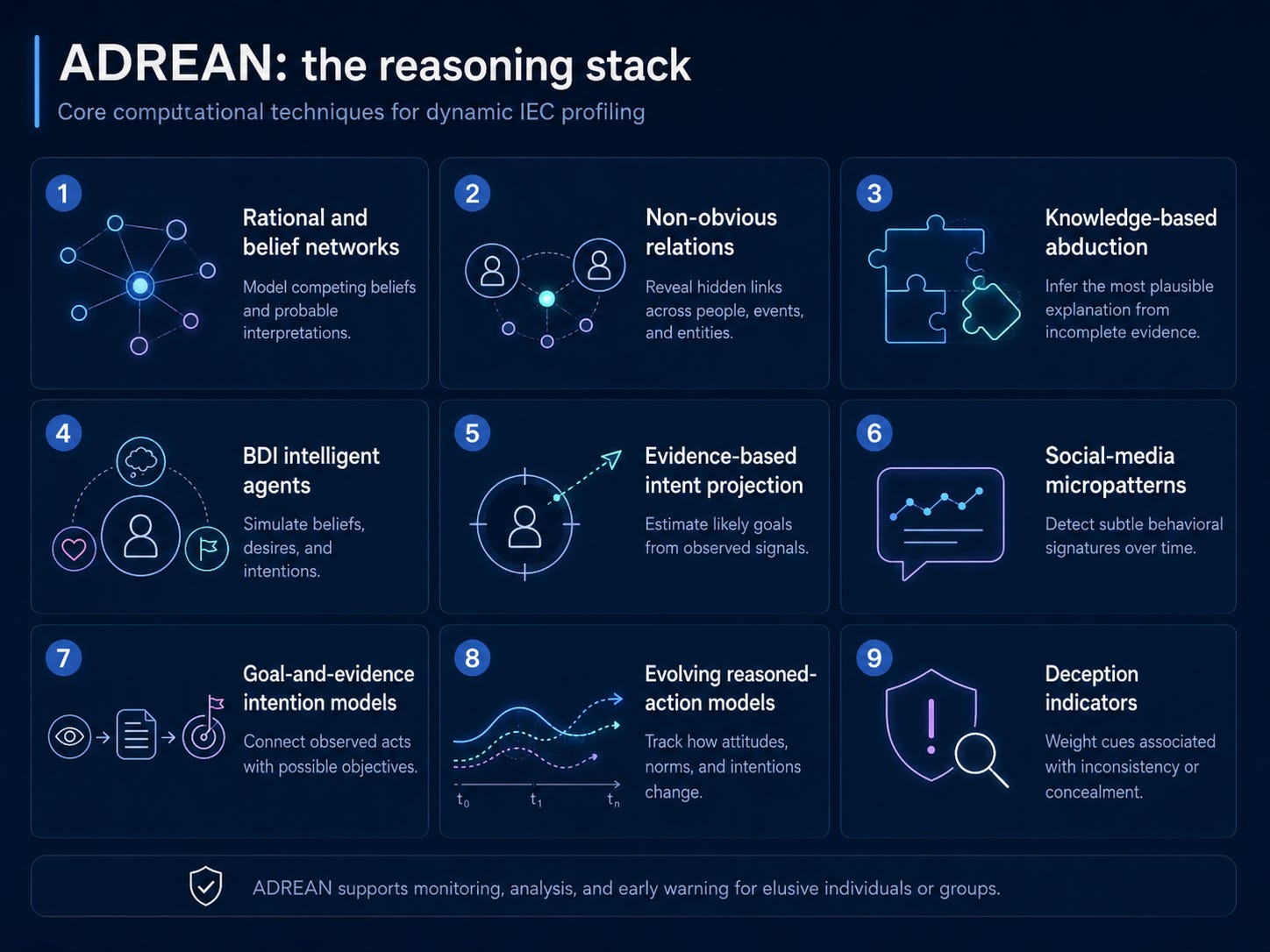
Figure 4 — ADREAN: the reasoning stack.
ADREAN combines rational and belief networks, non-obvious relation detection, knowledge-based abduction, BDI agents, evidence-based intent projection, social-media micropatterns, goal-and-evidence models, evolving reasoned-action models, and deception indicators.
7. The role of complex reasoning
Why not use a simple machine-learning classifier?
Because the problem is not simple classification.
Elusive behavior is adaptive.
It is context-dependent.
It is often deceptive.
It involves sparse data, hidden motives, shifting incentives, and incomplete evidence.
A purely statistical model may detect correlations.
But IEC analysis requires structured reasoning.
It must combine:
probabilistic inference
abductive reasoning
knowledge graphs
temporal analysis
behavioral modeling
deception detection
scenario simulation
expert feedback
human validation
The objective is not to replace the analyst.
The objective is to augment the analyst’s reasoning process.
A good system should not say: “This person is dangerous.”
It should say:
these signals have changed
these hypotheses are plausible
these indicators support escalation
these indicators contradict escalation
these links require validation
these uncertainties remain unresolved
these scenarios should be monitored
these recommendations require human review
This is a very different philosophy.
It is not automated suspicion.
It is disciplined analytical support.
8. Non-invasive by design
The ethical boundary is central.
A system like ADREAN must be designed around responsible principles from the beginning.
That means:
use lawful sources
avoid invasive data collection
respect privacy
prevent discrimination
maintain human oversight
preserve auditability
document uncertainty
distinguish evidence from inference
prevent automated punitive decisions
allow challenge, review, and correction where applicable
The most dangerous analytical systems are those that hide uncertainty behind confident outputs.
In IEC analysis, uncertainty must remain visible.
A risk score without explanation is not intelligence.
A profile without evidence is not analysis.
An alert without human review is not responsible early warning.
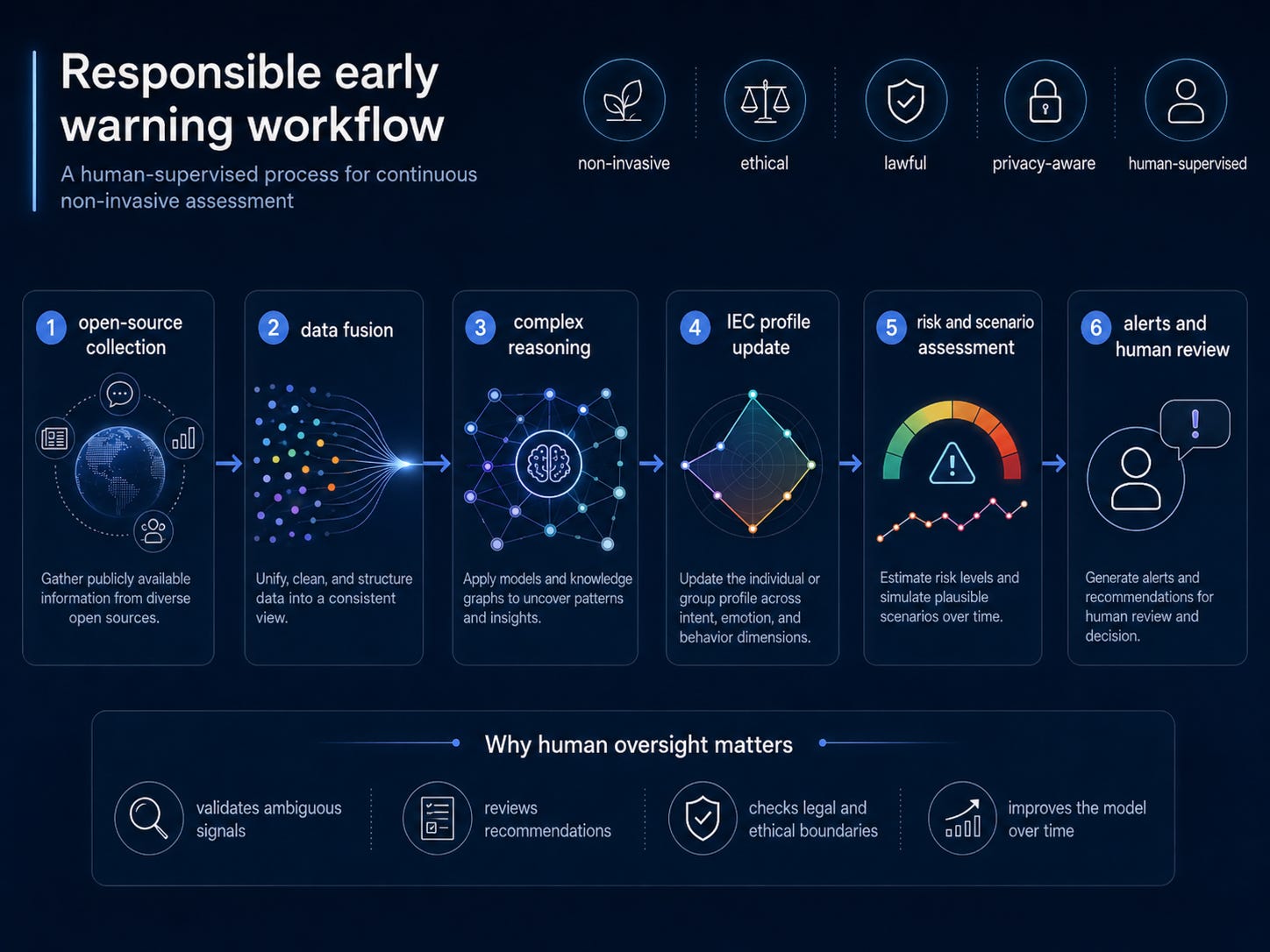
Figure 5 — Responsible early warning workflow.
A responsible IEC system should collect lawful open-source information, fuse and normalize data, apply complex reasoning, update the IEC profile, assess risk and scenarios, and generate alerts for human review.
9. What ADREAN should produce
The output of ADREAN should not be a simplistic label.
Not “good” or “bad.”
Not “safe” or “dangerous.”
Not “ally” or “enemy.”
The output should be a structured analytical picture.
That picture may include:
intentional profile
emotional profile
behavioral profile
risk score
threat level
affinity estimate
vulnerability map
deception indicators
hidden-relationship map
scenario probabilities
confidence levels
evidence traceability
recommended follow-up
uncertainty register
This is important.
The system must not pretend to know more than it knows.
It must help the analyst understand what is known, what is inferred, what is uncertain, and what should be observed next.
10. The strategic value
The strategic value of dynamic IEC analysis is not only defensive.
It can support:
threat assessment
early warning
counterintelligence
criminal intelligence
insider-risk analysis
negotiation preparation
source evaluation
hostile-network monitoring
radicalization risk assessment
corporate security
strategic influence analysis
protective intelligence
crisis prevention
But the same capability can be misused.
That is why the ethical architecture is not optional.
A system that reads behavioral signals without governance becomes a surveillance weapon.
A system that structures weak signals under human oversight can become a responsible intelligence tool.
The difference is design.
11. Final thought
Reading the mind is not the right metaphor.
The mind remains private.
What can be analyzed are signals, patterns, relationships, inconsistencies, changes, and evidence.
Human intuition can detect some of them.
Field experience can interpret more.
But elusive opponents require continuous, structured, computationally assisted reasoning.
This is the purpose of ADREAN.
To transform weak, distributed, and ambiguous signals into dynamic, evidence-based, human-supervised profiles of intention, emotion, and behavior.
Not to replace judgment.
To make judgment better.
Not to invade privacy.
To reason responsibly from what can be lawfully and ethically observed.
Not to predict people as machines.
To understand risk as a changing human and organizational phenomenon.
The future of intelligence will not be built only on data collection.
It will be built on complex reasoning.
And complex reasoning begins when we stop looking for isolated signs and start modeling dynamic systems.