


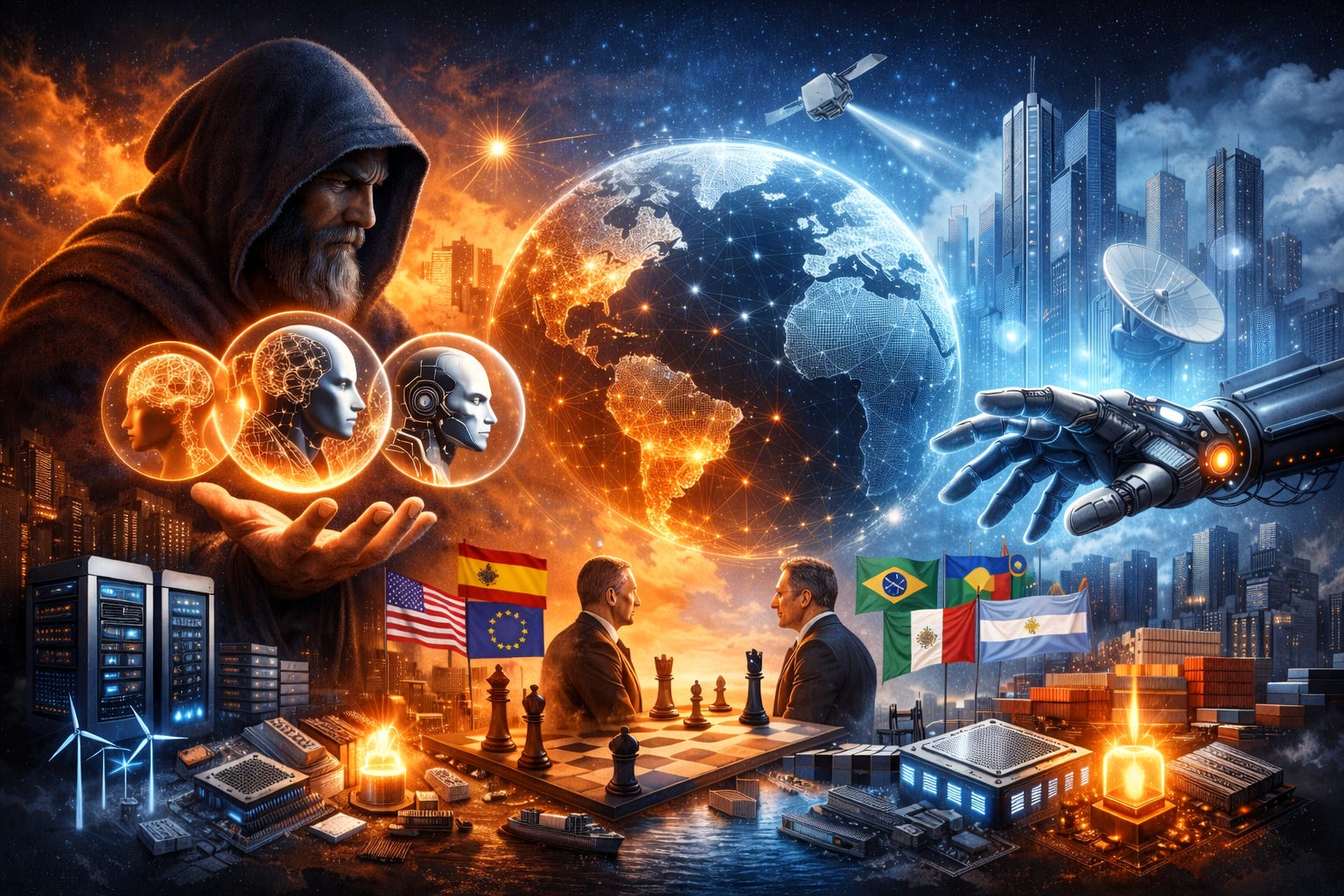
This is a slightly different Daneel Olivaw publication: The Druid’s signature appears alongside other heavyweight authors, making it a genuinely choral piece, and no less interesting for it. You can read the full article in El Confidencial via the original link
Andrés Pedreño Muñoz and Luis Martín “The Druid” (president and VP of WarMind Labs) join the distinguished signature of Ramón Casilda Béjar in El Confidencial, Spain’s leading digital newspaper.
1) The frame: 2026 as a geoeconomic stress-test
The authors open with an explicit warning: forecasting the world economy is always risky, but doing so in 2026 is even more fragile because the baseline assumptions are “complex and multiple,” driven by geopolitical uncertainty and AI-led technological acceleration reshaping the economic and business map.
Their geopolitical diagnosis is blunt: a world increasingly fragmented into antagonistic blocks, with alliances being reconfigured and trade, sanctions, and tech policy becoming structural features of competition, not episodic noise.
2) The central claim: AI is no longer a trend… it is infrastructure
A key pivot in the piece is the shift from “AI as promise” to “AI as infrastructure”, a general-purpose capability that spreads horizontally across sectors, like electricity or the internet, and becomes a durable source of competitive advantage.
The article frames AI adoption as moving beyond task automation toward process redesign, new services, and a reconfiguration of value chains—hence its expected impact on productivity, innovation, work organization, and international competitiveness.
3) Power concentrates around three scarce assets
The authors argue that AI is reordering economic power because advantage is concentrating around three critical assets:
Data
Talent
Compute capacity (advanced chips, data centers, and energy)
In this reading, the “AI race” is simultaneously industrial and geostrategic, binding semiconductors, cloud, cybersecurity, defense, quantum, and robotics into the same competitive chessboard.
The implication is that trade policy and tech sanctions are now baked into the structure of rivalry, with downstream effects on supply chains and resilience strategies.
4) Europe, Latin America, and the resilience premium
One of the most distinctive threads is the EU–Latin America angle. The authors describe an EU seeking to de-risk and diversify, leaning on Latin America and the Caribbean for resources, geography, and supply-chain relocalization potential.
They also emphasize Europe’s existing advantage in trade architecture: the EU has agreements with 27 of 33 CELAC countries, covering ~98% of the region, versus ~44% for the US and ~14% for China.
But the strategic warning is internal as much as external: Europe must avoid a posture that merely “manages risk” while failing to build enough sovereign capability in infrastructure, talent, and innovation.
5) What Luis Martín “The Druid” adds (and why it feels familiar here)
Even inside a broader economic/geopolitical essay, there are several passages that read as The Druid’s intellectual fingerprint highly consistent with the Daneel Olivaw thesis that capability in high-stakes environments is engineered, not wished into existence.
A) A maturity diagnosis, not a hype story
The piece rejects both complacency and panic: it argues we are still far from “systematic AI” across society and organizations, and frames today’s stage as roughly 2 out of 10 on an evolution scale, learning through failures and successes, with uneven results so far.
B) A forward model: “Dual intelligent ecosystems”
The article sketches a trajectory toward autonomous systems integrated synergistically with human intelligence, forming what it calls “dual intelligent ecosystems”, new socio-economic models and “human-artificial” capability growth with exponential adaptation potential.
This is very “Druid”: not AI-as-chatbot, but AI as organizational substrate, a system-level change in how societies perceive, decide, and act.
C) A Renaissance governance requirement (human-centered, or else)
The closing warning is unusually stark for an economics column: the authors insist this revolution must be guided by a human-centered, “Renaissance” approach, with power structures integrating humanists, technologists, and economists—otherwise the risks include severe social breakdown, “de-anthropomorphization,” and even self-destruction.
That final note also aligns with Daneel’s recurring emphasis on governance under adversarial pressure: systems must be designed so progress is controllable, auditable, and aligned with human outcomes—not merely powerful.
Closing
Read this piece as a map of AI shifting from technology to geoeconomic gravity: it changes what nations optimize for (resilience, compute, talent), how blocs compete (sanctions and industrial policy as defaults), and where regions like Europe and Latin America can still create asymmetric advantage—if they turn access and agreements into real capability.