

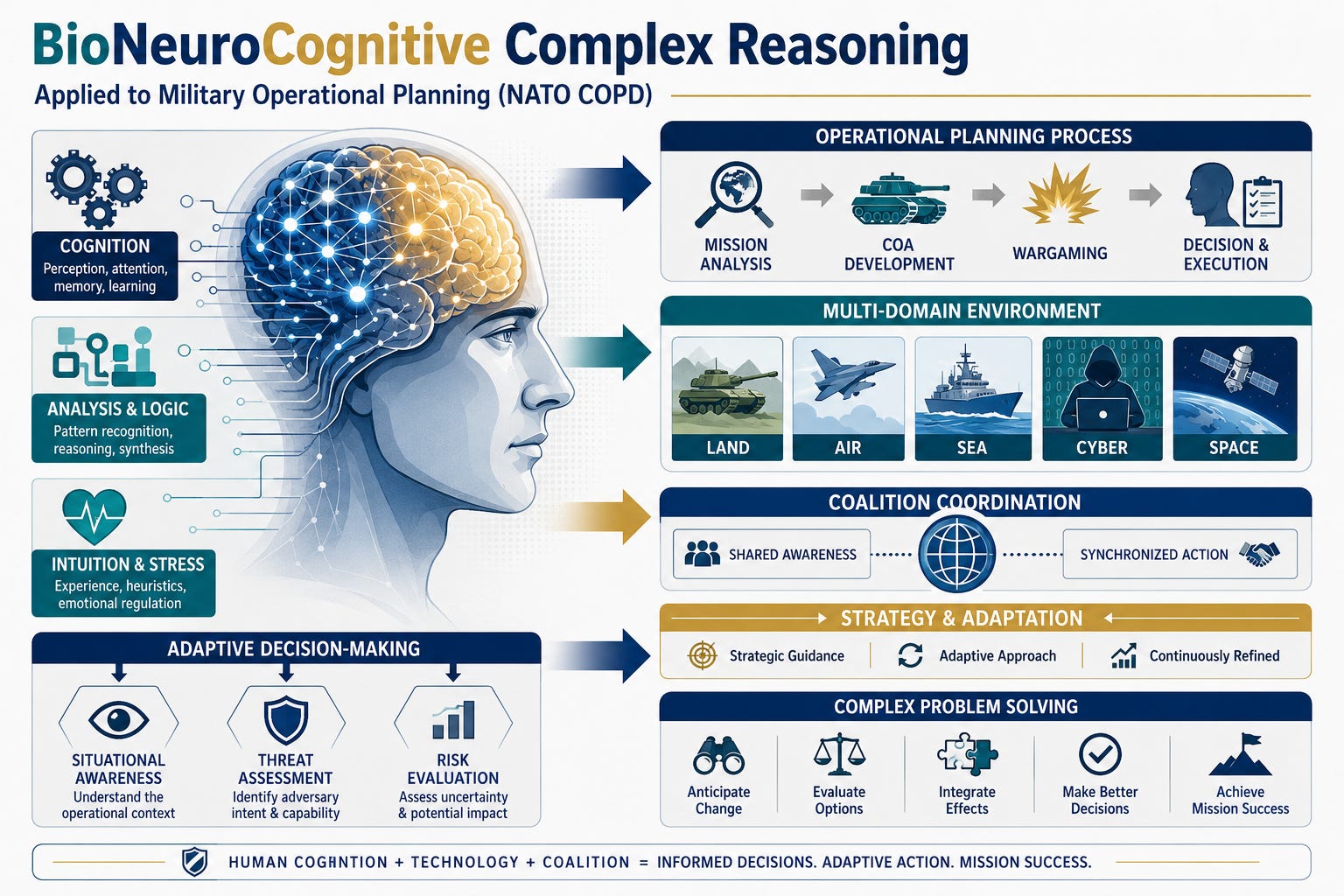
I am sharing here a brief extract from the design and deployment project of an advanced BioNeuroCognitive Complex Reasoning System intended to support the improvement of NATO military operational planning systems.
The objective is not merely to add artificial intelligence to existing planning workflows.
The objective is deeper.
It is to improve the quality, speed, traceability, coherence, evidentiary support, and explainability of military operational planning across all its phases, while maintaining human command responsibility, legal control, doctrinal alignment, and operational accountability.
Modern military planning is increasingly exposed to extreme complexity: multi-domain operations, compressed decision windows, hybrid threats, legal constraints, logistical uncertainty, intelligence volatility, changing objectives, and the need to coordinate political, strategic, operational, and tactical layers.
In that context, AI should not function as a decorative assistant or as a generic document generator.
It must become a reasoning support architecture.
That is the core of the project we are developing at WarMind Labs.
The planning problem
Military operational planning is not a simple administrative sequence.
It is a structured reasoning process under uncertainty.
Each planning phase must transform objectives, constraints, intelligence, resources, risks, legal conditions, operational experience, and command intent into coherent courses of action.
This requires continuous reasoning about:
Objectives
Means
Constraints
Risks
Legal limits
Operational feasibility
Intelligence assumptions
Alternative scenarios
Command priorities
Resource availability
Time pressure
Expected effects
Possible second-order consequences
The difficulty is not only producing a plan.
The difficulty is producing a plan that is coherent, justified, adaptable, legally compliant, operationally feasible, and traceable.
This is where current planning systems often reveal structural limitations. They may store information, support workflows, produce documentation, or assist coordination, but they do not always provide the depth of reasoning needed to justify and continuously adapt decisions in complex operational environments.
Common AI support needs across NATO Operational Planning
Across all phases of NATO Operational Planning, we have identified a set of common AI support needs.
These needs are not peripheral. They are central to the modernization of military planning.
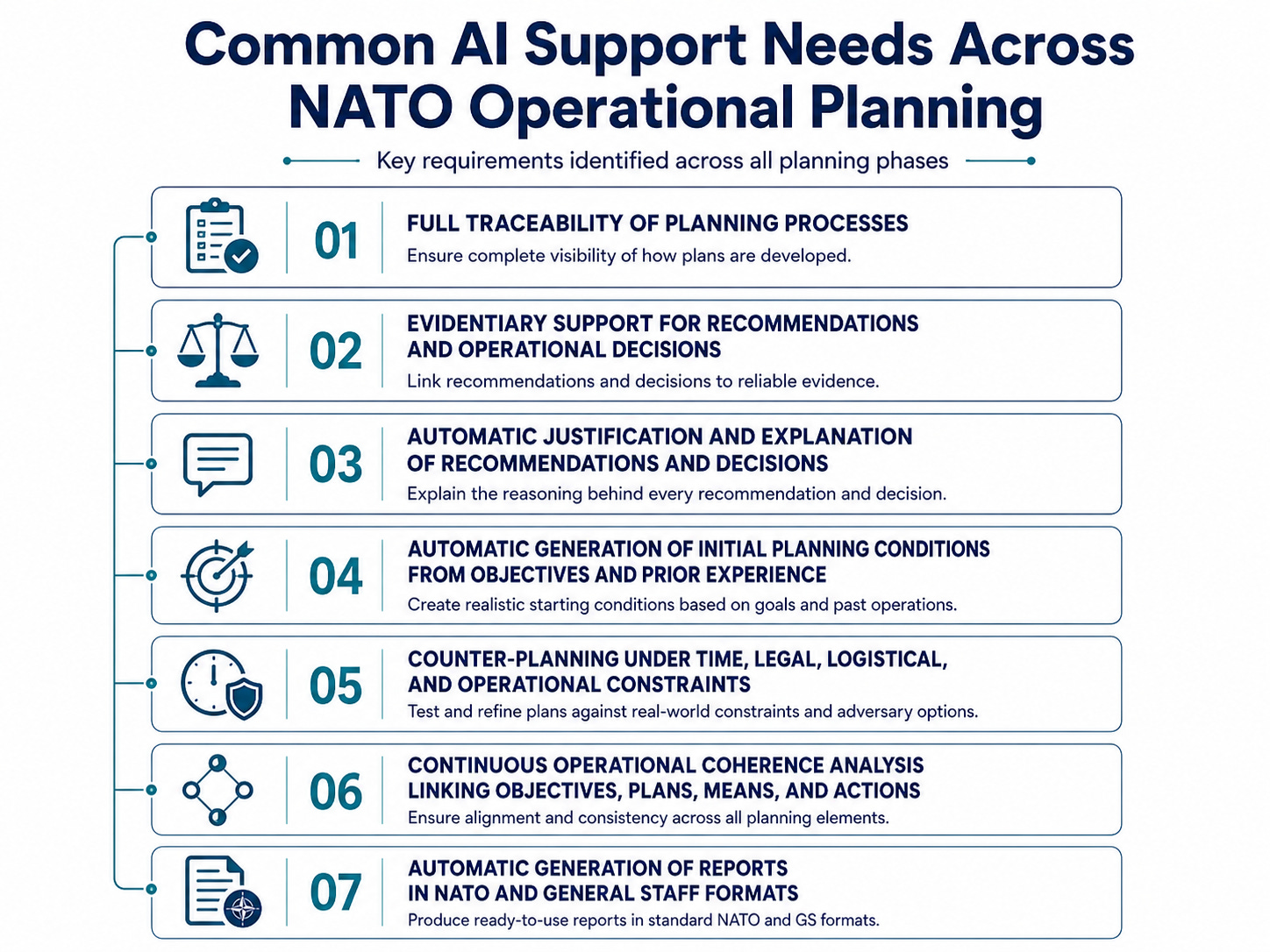
1. Full traceability of planning processes
Every relevant process included in each planning phase should be traceable.
This means understanding:
What was considered
Which assumptions were used
Which evidence was available
Which alternatives were evaluated
Which recommendations were generated
Which decisions were made
Which actors or systems contributed to each step
Why a specific planning path was selected
Traceability is essential for command responsibility, lessons learned, operational review, auditability, and continuous improvement.
2. Evidentiary support for recommendations and decisions
Operational recommendations and decisions should not appear as isolated outputs.
They must be supported by evidence.
A planning support system should be able to connect each recommendation to the intelligence, doctrine, operational constraints, prior experience, simulated scenarios, legal conditions, and reasoning sequences that justify it.
This is especially important in environments where decisions may have strategic, political, legal, and human consequences.
An AI system that cannot show the evidentiary basis of its recommendation is not sufficient for military planning.
3. Automatic justification and explanation
Military planners do not only need recommendations.
They need explanations.
A useful system must be able to explain:
Why a recommendation was produced
Which assumptions were used
Which evidence supports it
Which constraints limit it
Which risks it introduces
Which alternatives were considered
Why some alternatives were rejected
What would change the recommendation
This is one of the central differences between generic AI assistance and complex reasoning support.
Planning requires justified knowledge, not fluent output.
4. Automatic generation of initial planning conditions
One of the recurring problems in planning is the blank page problem.
When a new operational objective is defined, planners must generate the initial planning conditions, identify relevant precedents, establish assumptions, define constraints, and structure the first analytical space.
An advanced reasoning system should be able to generate initial planning conditions from:
Operational objectives
Prior experience
Real or simulated situations
Lessons learned
Strategic studies
Operational records
Doctrine
Manuals
Intelligence inputs
Legal and logistical constraints
This does not replace planners.
It accelerates the initial cognitive structuring of the planning problem.
5. Counter-planning under constraints
Operational planning rarely unfolds in ideal conditions.
Objectives change. Time compresses. Intelligence evolves. Resources become unavailable. Legal constraints become decisive. Logistics impose limits. The enemy adapts. Friendly and enemy orders of battle shift. Political priorities may expand or restrict what is operationally possible.
For that reason, the system must support counter-planning capabilities.
It should help planners reason against changes such as:
Time constraints
Legal constraints
Logistical constraints
Changes in friendly order of battle
Changes in enemy order of battle
Variation or expansion of objectives
New operational intelligence
Changes in resource availability
Changes in operational risk
Changes in rules of engagement
This capability is essential for adaptive planning.
A plan is not enough.
The planning system must help reason about how the plan breaks, adapts, or evolves.
6. Continuous operational coherence analysis
A military plan must remain coherent across objectives, plans, means, and actions.
This is a major reasoning challenge.
The system must continuously analyze whether:
The objectives remain aligned with the plan
The means are sufficient for the objectives
The proposed actions are consistent with the means
The operational design remains feasible
The selected COA remains coherent under changing conditions
The plan violates constraints, assumptions, or legal boundaries
The intended effects remain connected to the operational logic
This can be understood as a permanent objectives-plans-means-actions coherence analysis.
The goal is to detect incoherence before it becomes operational failure.
7. Automatic generation of reports in NATO and General Staff formats
Planning systems must also support the automatic generation of structured reports and other informational elements in NATO and General Staff formats.
This is not merely a documentation function.
If properly designed, automatic report generation becomes a way of preserving reasoning structure.
Reports should not simply summarize outputs. They should reflect evidence, assumptions, decisions, recommendations, uncertainties, alternatives, and operational logic.
The document becomes a reasoning artifact.
Expected impact
The expected impact of this type of system is significant.
In Phase I, we estimate that operational planning time may be reduced by up to 40%.
In Phase II, with more mature automation, integration, learning, and reasoning capabilities, planning time may be reduced by up to 70%.
These reductions are not based on the idea of replacing planners. They are based on reducing friction in the planning process, accelerating knowledge retrieval, improving initial structuring, automating justification support, and enabling faster scenario comparison.
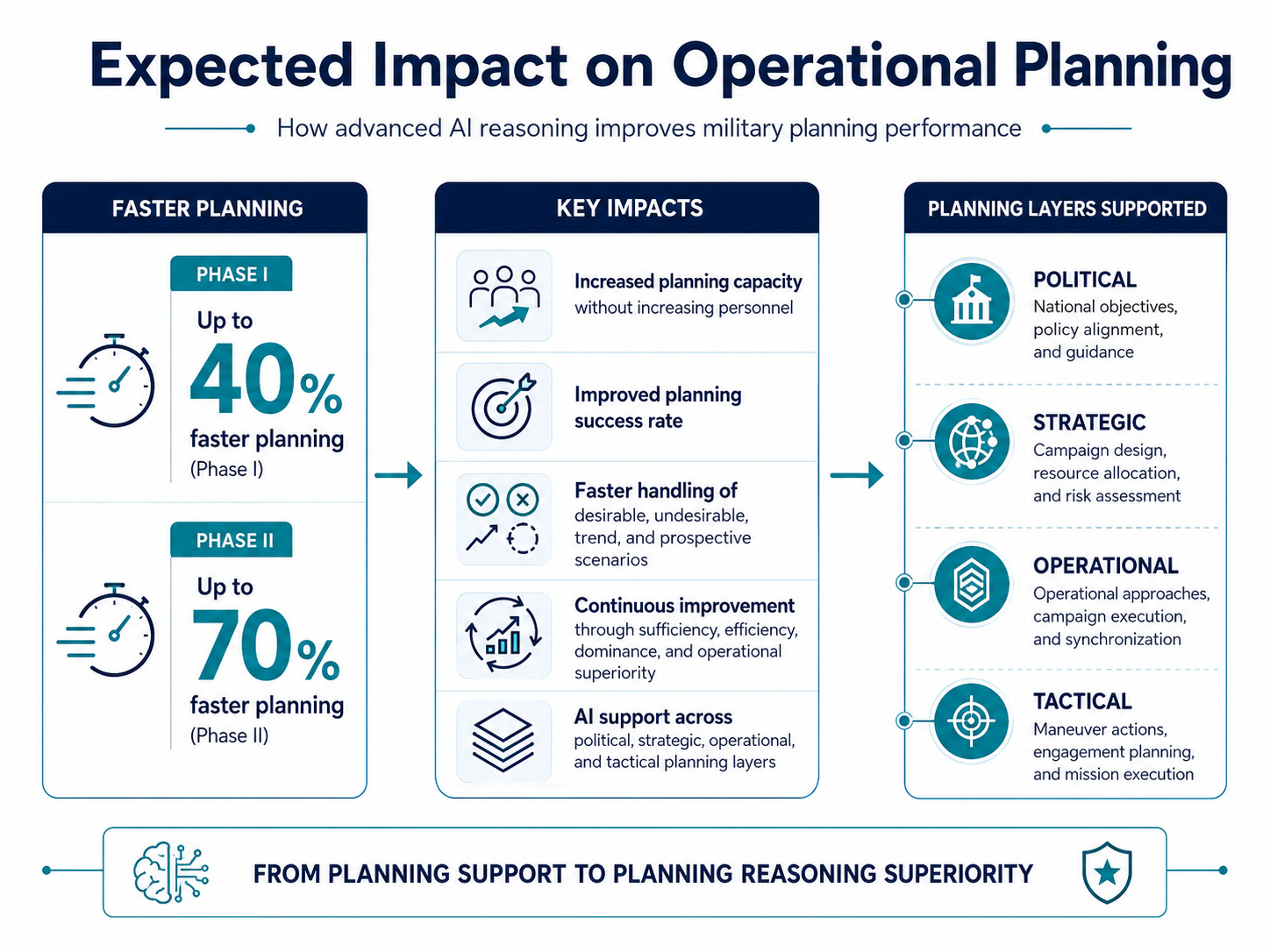
The expected benefits include:
Optimization of operational planning processes
Significant reduction of planning time
Increased planning capacity without increasing personnel
Improved planning success rates
Movement toward a more process-free planning model
Faster assimilation of contrasting operational scenarios
Better use of desirable, undesirable, trend, and prospective scenarios
Continuous improvement based on sufficiency, efficiency, dominance, and operational superiority
Application of AI across all layers of military planning
This last point is especially important.
AI support should not be limited to technical or tactical layers. It should support military planning across:
Political planning
Strategic planning
Operational planning
Tactical planning
Each layer has different constraints, timescales, risks, and decision structures. But all of them require reasoning.
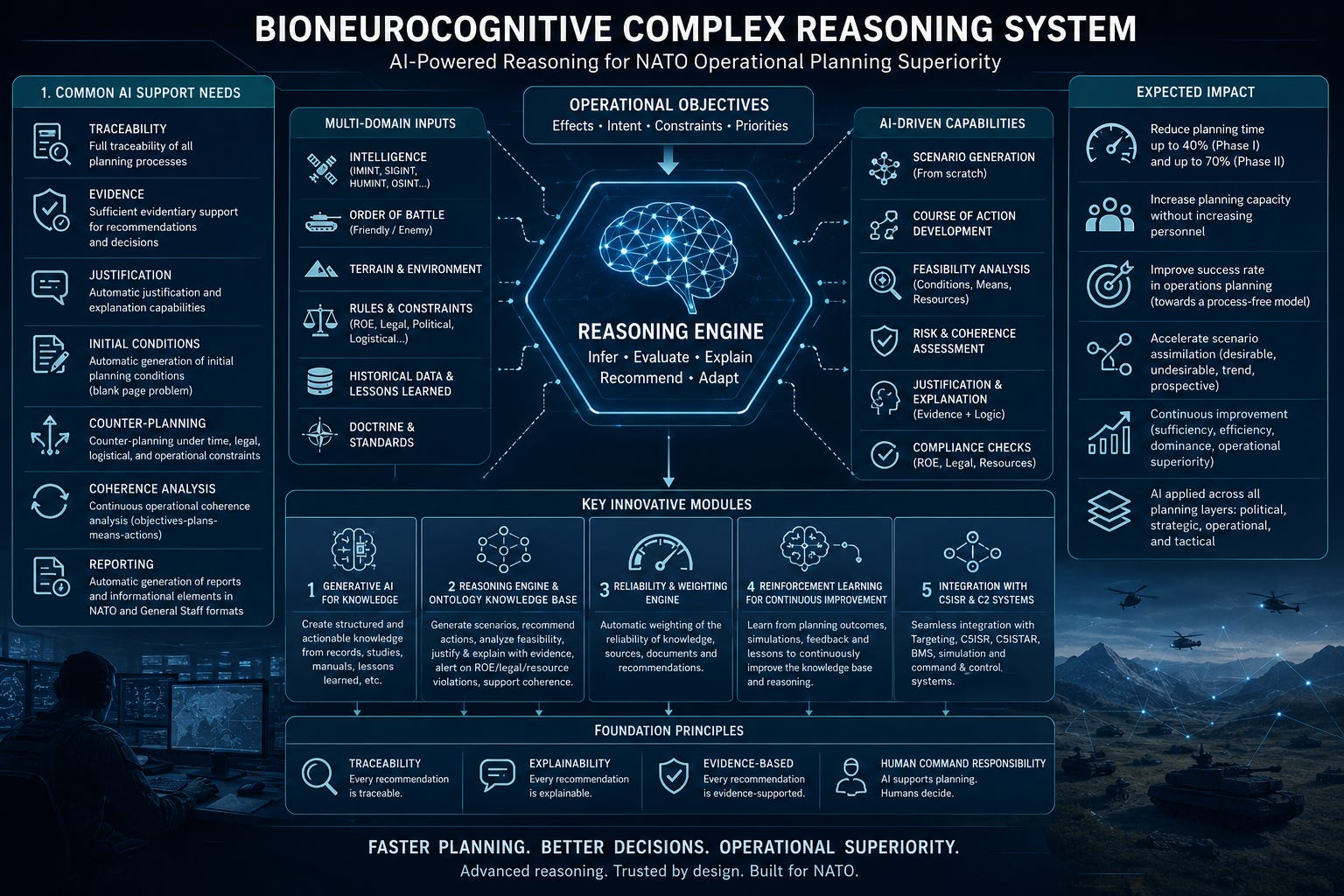
Key innovative modules of the system
The system we are developing through this R&D project includes several key innovative modules.
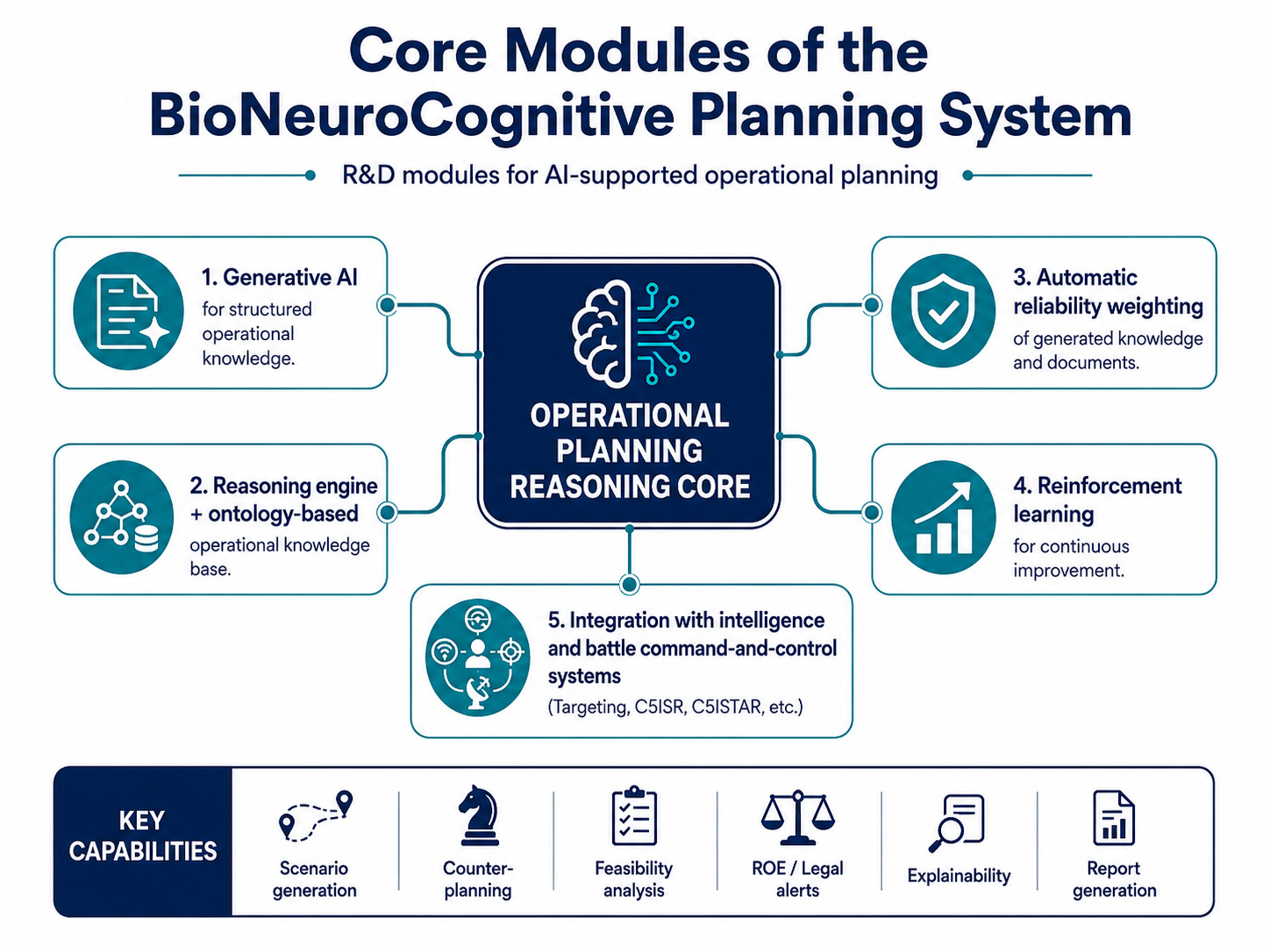
1. Generative AI for structured and actionable operational knowledge
The first module is a generative AI system for the automatic creation of structured and actionable knowledge from existing operational materials.
These may include:
Operational records
Strategic studies
Lessons learned
Operating manuals
Doctrine
Planning archives
Simulation outputs
Prior campaign analysis
General Staff documentation
The objective is not merely summarization.
The objective is to transform existing materials into structured operational knowledge that can be searched, reasoned over, reused, validated, and connected to planning processes.
2. Reasoning engine and operational ontology-based knowledge base
The second module is the core of the system.
It consists of a reasoning engine and an operational ontology-based knowledge base.
This module must be capable of:
Generating initial operational scenarios from scratch
Working from established objectives and operational constraints
Supporting counter-planning when objectives or constraints change
Recommending actions in the processes of each planning phase
Analyzing the feasibility of decisions, conditions, and actions
Justifying recommended actions with evidence and logic
Explaining the reasoning path behind each recommendation
Alerting to potential violations of Rules of Engagement
Alerting to potential violations of applicable legal frameworks
Alerting to resource limitations affecting a Course of Action
Supporting operational coherence analysis
Connecting objectives, means, plans, actions, and expected effects
This is the difference between an AI assistant and an operational reasoning system.
The reasoning engine does not merely produce text.
It supports structured military thought.
3. Automatic weighting of reliability
The third module concerns reliability.
Operational planning depends on knowledge of varying quality. Some knowledge is doctrinally established. Some is derived from intelligence. Some comes from simulations. Some comes from prior experience. Some comes from automatically generated documents. Some is uncertain, incomplete, or context-dependent.
The system must therefore support automatic weighting of:
Reliability of generated knowledge
Reliability of source materials
Confidence in automatically generated content
Evidentiary strength behind recommendations
Degree of uncertainty
Operational relevance
Timeliness
Consistency with doctrine and constraints
This is essential because AI-generated knowledge should not be treated as equally reliable by default.
A military planning system must know not only what it says, but how strongly it should be trusted.
4. Reinforcement Learning for continuous improvement
The fourth module is a Reinforcement Learning System for continuous improvement of the operational knowledge base.
The purpose is to allow the system to improve through use, feedback, simulation, evaluation, lessons learned, and operational review.
This does not mean uncontrolled autonomous learning.
In military planning, learning must be governed, validated, constrained, and auditable.
The objective is to improve the knowledge base and reasoning processes in relation to:
Sufficiency
Efficiency
Dominance
Operational superiority
Planning accuracy
Scenario handling
Resource coherence
Legal and doctrinal compliance
Recommendation quality
Explanatory quality
The system should learn from planning outcomes, simulations, red-team feedback, expert evaluation, and operational lessons.
5. Integration with intelligence and command-and-control systems
The fifth module is integration.
An operational planning reasoning system cannot remain isolated.
It must integrate with intelligence and battle command-and-control systems, including systems related to:
Targeting
C5ISR
C5ISTAR
Operational intelligence
Battle command and control
Simulation environments
Scenario generation
Lessons learned systems
Operational reporting systems
This integration is necessary because planning is not an isolated staff activity. It is connected to intelligence, command, control, communications, computers, cyber, surveillance, reconnaissance, targeting, and operational execution.
A planning system that cannot connect to this ecosystem will remain partial.
From process support to reasoning superiority
The central contribution of this project is the movement from planning process support to planning reasoning superiority.
Traditional systems tend to support workflows.
Advanced AI systems may generate text, summaries, templates, or recommendations.
But BioNeuroCognitive Complex Reasoning Systems should go further.
They should help planners reason across:
Objectives
Constraints
Courses of Action
Risks
Legal conditions
ROEs
Intelligence assumptions
Operational feasibility
Resource sufficiency
Enemy adaptation
Friendly capabilities
Scenario evolution
Expected effects
Alternative futures
Planning coherence
The objective is not to remove human planners from the process.
The objective is to make human planning faster, more coherent, more explainable, more evidence-based, and more adaptive.
A system for accountable military AI
Military AI must be accountable.
That requires more than human supervision in abstract terms.
It requires technical and methodological mechanisms that make recommendations traceable, explainable, auditable, and evidence-supported.
For that reason, the system must be designed around four principles:
Traceability
Every planning recommendation should be connected to evidence, assumptions, constraints, and reasoning paths.Explainability
The system should explain why it recommends a specific action or planning option.Evidentiary support
Recommendations must be grounded in doctrine, intelligence, prior experience, simulation, legal constraints, and operational logic.Human command responsibility
AI supports planning, but human authorities remain responsible for judgement, authorization, and command.
This is the appropriate role of AI in NATO operational planning.
Not autonomous command.
Not opaque automation.
Reasoning support for responsible military decision-making.
Toward faster and better NATO Operational Planning
The future of NATO Operational Planning will require systems capable of compressing planning time without degrading planning quality.
This is difficult.
Speed often reduces rigor.
Automation often reduces transparency.
Information abundance often increases cognitive overload.
AI-generated content often creates a false impression of coherence.
The challenge is therefore to design systems that increase speed while also increasing justification, traceability, reliability, and operational coherence.
That is precisely the role of advanced BioNeuroCognitive Complex Reasoning Systems.
They can help planners move faster because they structure the planning space.
They can help planners reason better because they connect objectives, constraints, evidence, and actions.
They can help planners adapt faster because they support counter-planning and scenario comparison.
They can help commanders trust outputs more appropriately because they provide justification, confidence, and evidentiary traceability.
Final note
The project we are developing at WarMind Labs aims to provide advanced AI support for the improvement of NATO military operational planning systems.
The expected result is a new class of planning support architecture: one that combines generative AI, ontology-based operational knowledge, complex reasoning engines, evidentiary weighting, reinforcement learning, and integration with intelligence and command-and-control systems.
The objective is not more automation for its own sake.
The objective is better planning.
Faster planning.
More explainable planning.
More evidence-based planning.
More adaptive planning.
And ultimately, stronger operational superiority.
Not merely AI-generated plans.
Traceable operational reasoning.
Not more documents.
Better planning intelligence.
Not faster bureaucracy.
Superior military planning support.