


The analysis of potentially criminal behavior has always lived inside a difficult tension.
On one side, there is the need to anticipate risk.
On the other, there is the obligation to protect rights, privacy, dignity, and due process.
This tension is now becoming one of the central problems of artificial intelligence applied to security, intelligence, and investigation.
The current technological paradigm is based, too often, on more data:
• More surveillance.
• More metadata.
• More behavioral traces.
• More signals.
• More storage.
• More correlation.
But the real innovation challenge may be the opposite.
Not more data. Better reasoning.
Not mass capture. Selective intelligence.
Not opaque prediction. Explainable analytical reasoning.
Not automated suspicion. Human-supervised hypothesis generation.
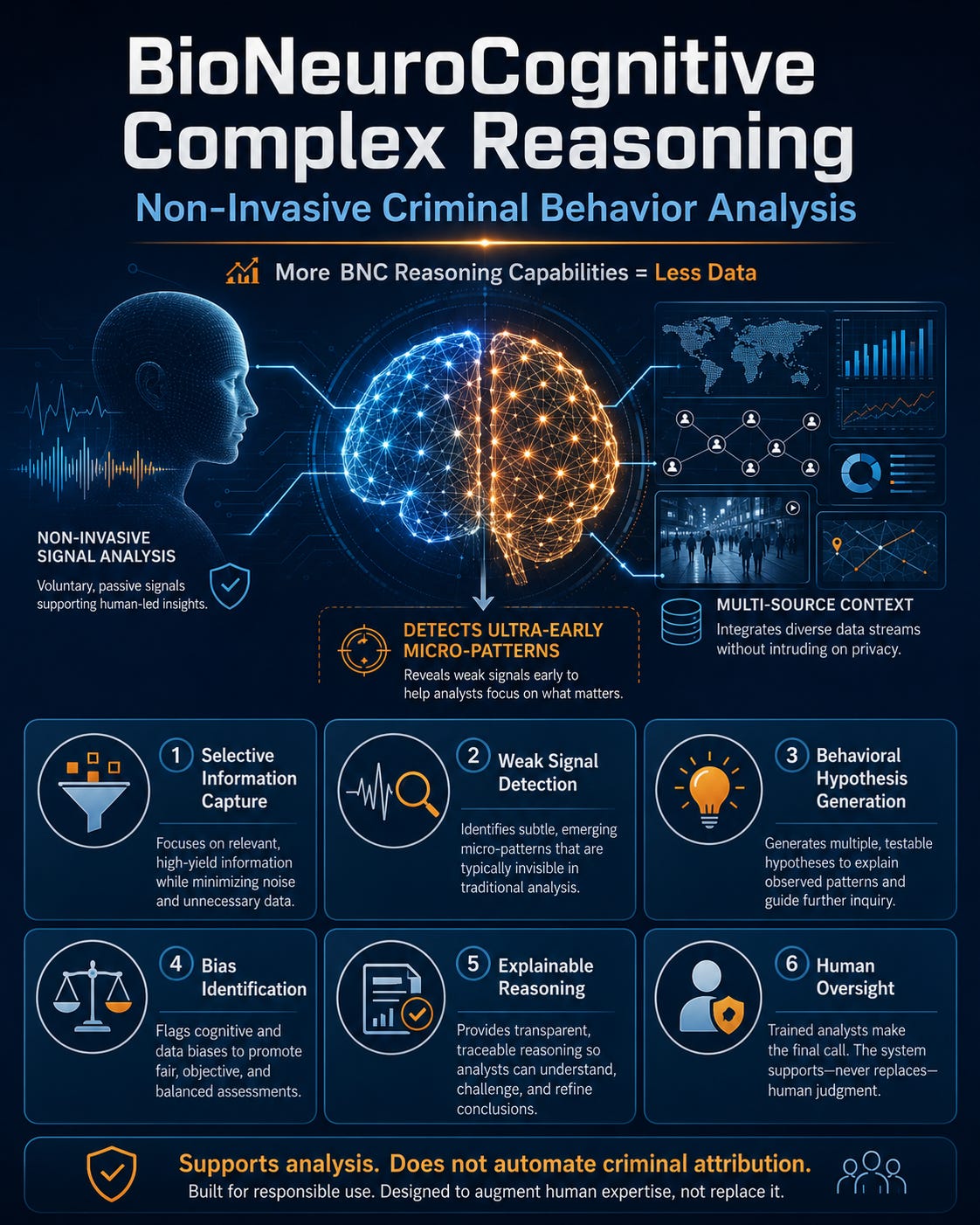
This is the conceptual basis of a BioNeuroCognitive Complex Reasoning System for the non-invasive analysis of potentially criminal behavior.
Its objective is not to declare that a person is criminal.
Its objective is to:
• Detect relevant micro-patterns.
• Generate analytical hypotheses.
• Identify weak signals.
• Support early investigative reasoning.
• Operate under strict legal, ethical, and human control.
1. From behaviorism to criminal investigative analysis
The experimental analysis of behavior has deep roots in behaviorist psychology.
B. F. Skinner’s work, especially The Behavior of Organisms, published in 1938, helped establish the experimental analysis of behavior and the study of operant behavior through consequences, reinforcement, and observable behavioral dynamics.
Later, in the field of law enforcement and security, behavioral analysis became operationally relevant through:
• Criminal investigative analysis.
• Criminal profiling.
• Behavioral threat assessment.
• Intelligence analysis.
• Structured hypothesis testing.
The FBI’s Behavioral Science Unit was one of the institutions that helped develop criminal profiling and behavioral analysis as investigative support. Since the 1970s, behavioral specialists assisted law enforcement agencies by analyzing crime dynamics, offender traits, case linkage, statements, and psycholinguistic indicators.
At the same time, intelligence analysis evolved through structured analytic techniques.
One of the most influential references is Richards J. Heuer Jr., whose work on the psychology of intelligence analysis and Analysis of Competing Hypotheses emphasized the need to:
• Challenge assumptions.
• Compare alternative explanations.
• Reduce cognitive bias.
• Make reasoning more explicit.
• Improve intelligence production.
These traditions matter because they show a continuous evolution:
• From behavior observation.
• To criminal investigative analysis.
• To structured intelligence reasoning.
• To AI-supported analytical systems.
• And now, potentially, to BioNeuroCognitive Complex Reasoning.
2. The problem with the current data paradigm
Today, large internet service providers and digital platforms have made behavioral analysis one of the core elements of their innovation model.
User behavior is analyzed to anticipate:
• Needs.
• Preferences.
• Desires.
• Intentions.
• Risks.
• Purchases.
• Movements.
• Attention patterns.
• Social interactions.
The underlying logic is simple: collect large volumes of behavioral data, detect patterns, and predict future behavior.
That model is powerful, but it is also problematic.
It depends on massive data capture.
It creates privacy risks.
It produces ethical dilemmas.
It may reinforce hidden biases.
It can become opaque.
It can confuse correlation with causation.
It can reduce human behavior to simplified mathematical patterns.
This is especially sensitive when the field is security or criminal behavior analysis.
In this domain, a false positive is not a minor error.
It may affect a person’s liberty, reputation, rights, or treatment by institutions.
That is why any serious system in this field must be built on several principles:
• Data minimization.
• Purpose limitation.
• Explainability.
• Bias identification.
• Human oversight.
• Legal proportionality.
• Auditability.
• Rejection of automated criminal attribution.
The strategic question is therefore clear: how can we apply advanced analytical reasoning when data is scarce, sensitive, legally constrained, ethically problematic, or not available for mass processing?
The answer is not necessarily more data. The answer may be more reasoning.
3. The core thesis
The central thesis is simple:
More BioNeuroCognitive reasoning capabilities = less data dependency.
This does not mean ignoring evidence.
It means using evidence more intelligently.
A mature analytical system should not need indiscriminate mass data collection to produce useful hypotheses.
It should be able to work with:
• Scarce data.
• Fragmented information.
• Weak signals.
• Contextual indicators.
• Behavioral inconsistencies.
• Situational cues.
• Investigative hypotheses.
• Available legal evidence.
• Human expert input.
• Domain-specific constraints.
The difference is architectural.
A conventional data-driven system asks:
How much data can we collect?
A BioNeuroCognitive Complex Reasoning System asks:
Which minimum set of legally obtainable signals is analytically relevant to generate, test, and explain a hypothesis?
That distinction is decisive.
It shifts the system:
• From accumulation to reasoning.
• From mass surveillance to selective intelligence.
• From static modeling to adaptive analysis.
• From opaque scoring to explainable hypothesis generation.
4. Innovation challenge 1: selective information capture
The first innovation challenge is to design a BioNeuroCognitive Complex Analytical Reasoning System with a selective information capture strategy.
The goal is not to collect everything.
The goal is to identify key indicators and evidence.
This requires dynamic analytical-investigative structures that can adapt to the information available at each moment.
Current approaches are often based on:
• Massive data capture.
• Static models.
• Retrospective pattern detection.
• Generalized behavioral categories.
• Large-scale correlation.
But criminal behavior, especially in complex environments, is not static.
It is adaptive.
It is contextual.
It is sometimes concealed.
It may be influenced by stress, fatigue, altered states, social pressure, opportunity, organizational networks, and operational learning.
A better system must reason under uncertainty.
It must be able to ask:
• What information is actually necessary?
• What signal is legally obtainable?
• What evidence is relevant?
• What hypothesis does this indicator support?
• What alternative hypotheses remain open?
• What bias may be affecting the interpretation?
• What cannot be concluded from the available data?
This last question is essential.
An intelligent system must not only say what it thinks.
It must also say what it cannot know.
5. Innovation challenge 2: bias identification and weighting
The second innovation challenge is to eliminate hidden biases in current data analysis processes.
This is not done by pretending that bias does not exist.
It is done by making bias visible, measurable, and accountable.
A BioNeuroCognitive Complex Reasoning System must identify where bias may appear:
• In the data source.
• In the collection process.
• In the interpretation model.
• In the analyst’s assumptions.
• In the historical dataset.
• In the operational context.
• In the institutional objective.
• In the final recommendation.
If biases exist, they must be identified and weighted before any downstream decision is made.
This is one of the major advantages of explicit reasoning architectures.
A black-box model may produce a risk score.
A reasoning architecture should produce an analytical path.
It should show:
• Which signals were considered.
• Which signals were excluded.
• Which hypotheses were generated.
• Which hypotheses were weakened.
• Which assumptions were used.
• Which uncertainties remain.
• Which biases may distort the conclusion.
The objective is not only prediction.
The objective is accountable reasoning.
6. Innovation challenge 3: beyond reductionist analysis
The third innovation challenge is to overcome unidimensional and reductionist analysis.
Many current systems depend heavily on mathematical-causal models that simplify behavior into narrow variables.
That can be useful.
But it is insufficient.
Potentially criminal behavior may emerge from complex combinations of:
• Biological factors.
• Cognitive factors.
• Psychological factors.
• Social factors.
• Operational factors.
• Contextual factors.
• Network effects.
• Environmental pressures.
The relevant signals may be very small.
The triggering patterns may be weak.
The operational context may be unstable.
The individual or group may behave differently under:
• Uncertainty.
• Stress.
• Fatigue.
• Altered states of consciousness.
• Social pressure.
• Economic vulnerability.
• Ideological influence.
• Organizational coercion.
• Criminal opportunity.
• Modus vivendi.
• Modus operandi.
This is where the concept of BioNeuroCognitive Criminal Micro-Patterns of Ultra-Early Warning becomes relevant.
These micro-patterns should not be understood as deterministic indicators of criminality.
They should be understood as early analytical signals that may justify further lawful investigation, contextual assessment, or preventive attention.
That distinction is critical:
• A micro-pattern is not proof.
• A signal is not guilt.
• A hypothesis is not a conclusion.
• A risk indicator is not a legal determination.
• An analytical alert is not a criminal sentence.
The value of the system depends on preserving these distinctions.
7. Innovation challenge 4: justification and explanation
The fourth innovation challenge is to give the tool full justification and explanation capacity across the entire reasoning process.
This is non-negotiable.
In high-impact domains, an AI system must not simply output a result.
It must explain how it got there.
A serious BioNeuroCognitive Complex Reasoning System should be able to explain:
• What information was used.
• Why that information was relevant.
• What reasoning sequence was followed.
• Which hypotheses were generated.
• Which alternatives were considered.
• Which contradictions appeared.
• Which uncertainty remains.
• Which bias controls were applied.
• Which decision requires human validation.
This is especially important in criminal behavior analysis because errors can have severe consequences.
The system must support analysts.
It must not replace responsibility.
It must improve reasoning.
It must not automate suspicion.
It must create transparency.
It must not produce hidden authority.
8. The role of human supervision
Any system applied to potentially criminal behavior analysis must remain human-supervised.
The machine can assist.
The machine can detect weak signals.
The machine can organize information.
The machine can compare hypotheses.
The machine can identify contradictions.
The machine can produce explanations.
But the machine must not become the final authority.
Human analysts, investigators, legal professionals, ethics officers, and institutional authorities must remain responsible for:
• Interpretation.
• Proportionality.
• Validation.
• Legal assessment.
• Ethical control.
• Operational decision-making.
• Final action.
This is not a weakness. It is a safeguard.
A well-designed system should create better human judgment, not remove it.
The objective is augmented analytical intelligence. Not automated criminal judgment.
9. From data accumulation to analytical precision
The dominant technological instinct is to collect more.
But in sensitive domains, collecting more can create more risk.
More data can mean:
• More exposure.
• More bias.
• More legal complexity.
• More false correlations.
• More institutional opacity.
• More temptation to automate decisions that should remain human.
The alternative is analytical precision.
A system based on BioNeuroCognitive Complex Reasoning should aim to reduce unnecessary data dependency by improving:
• Reasoning quality.
• Hypothesis generation.
• Contextual interpretation.
• Bias detection.
• Evidence weighting.
• Explainability.
• Human supervision.
• Legal and ethical alignment.
This is the principle:
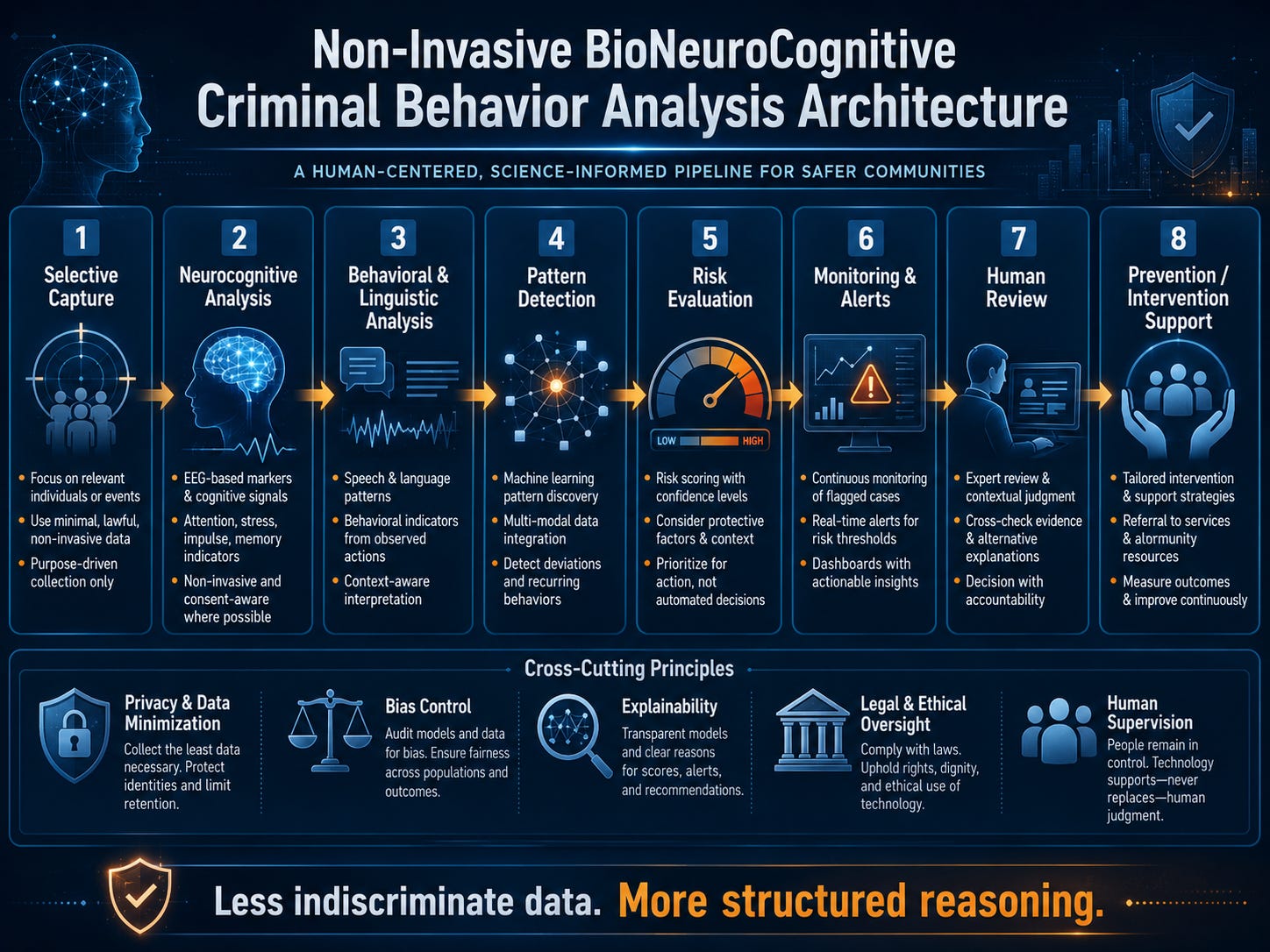
Less indiscriminate data.
More structured reasoning.
Less surveillance logic.
More selective intelligence.
Less black-box prediction.
More explainable analysis.
10. Closing
The future of criminal behavior analysis cannot be based only on mass data collection.
That path is technologically powerful, but ethically fragile.
The better path is more difficult.
It requires:
• Advanced reasoning architectures.
• BioNeuroCognitive models.
• Selective information capture.
• Bias identification.
• Complex analytical structures.
• Explainability.
• Human supervision.
• Legal and ethical discipline.
The central objective is not to know everything about everyone.
The objective is to reason better with the minimum necessary information.
That is the real innovation frontier.
More BNC reasoning capabilities.
Less data dependency.
More analytical precision.
Less invasive collection.
More explainable intelligence.
Less automated suspicion.
Because in this domain, the future should not belong to the systems that collect the most.
It should belong to the systems that reason best.