

At Binomial Consulting & Design S.L., we are modelling a new approach to criminal investigative intelligence based on complex human and artificial reasoning.
We call this model CASIAN-V1.
Its purpose is to support the definition, creation, development, management, review, and operational exploitation of criminal investigation cases through structured reasoning, evidence analysis, and continuous case intelligence.
The basic idea is simple, but important.
Criminal investigative intelligence is not document management. It is not internet search. It is not a chatbot interface. It is not data summarization or conventional Business Intelligence.
It is a much deeper cognitive activity: the systematic formulation of investigative questions and the design of reasoning strategies to answer them through evidence.
What is multi-level criminal investigative intelligence?
Multi-Level Criminal Investigative Intelligence can be understood as the set of human and artificial complex reasoning structures involved in discovering the genesis, current situation, and possible evolution of criminal events and situations.
These are cases that cannot be resolved through simple data retrieval or administrative processing. They require:
Complex investigation
Structured analysis
Evidentiary reasoning
Hypothesis generation
Hypothesis validation
Argumentation
Operational decision-support
In this sense, investigative intelligence is one of the most demanding forms of applied reasoning.
It begins with questions:
What happened?
Who was involved?
How did the event originate?
What evidence exists?
What evidence is missing?
Which sources are reliable?
Which hypotheses explain the facts?
Which hypotheses are contradicted by the evidence?
What is the criminal structure behind the event?
How is the situation evolving?
What can be done to prevent further harm?
These are not merely information-management questions. They are reasoning questions.
That is why an advanced investigative intelligence system must be designed around reasoning, not around storage.
Investigation as a reasoning process
Investigative intelligence is a distinctive part of human and artificial complex reasoning dedicated to the formulation of questions and the development of strategies for finding answers to real-world problems.
In criminal investigation, those problems are usually uncertain, fragmented, adversarial, and incomplete. The investigator rarely begins with a complete picture. Instead, the case emerges from partial evidence, uncertain sources, contradictory signals, hidden actors, false explanations, and time pressure.
This is why the central process of investigative intelligence involves:
Planning
Searching
Identifying
Acquiring
Weighing
Analyzing
Evaluating
Judging evidence
The objective is not only to accumulate information. The objective is to build a defensible understanding of the case.
That understanding must be operationally useful, analytically rigorous, and capable of supporting argumentation, decision-making, and action.
What it is not
It is important to define the boundary clearly.
A system for multi-level criminal investigative intelligence is not:
A document management system
A generic case file repository
A search engine
An internet research assistant
A chatbot interface
A conventional data summarization tool
A Business Intelligence dashboard
A passive archive of reports and evidence
All these tools may be useful around an investigation, but they do not constitute investigative intelligence by themselves.
The core of investigative intelligence is not the possession of information.
The core is the capacity to reason over evidence.
CASIAN-V1 as a model-guided investigative system
CASIAN-V1 is conceived as a multi-level criminal investigative intelligence case-management system guided by automatic complex reasoning models and structures.
In our view, this type of system may represent a significant shift in the way criminal intelligence and criminal investigation are conceptualized.
The reason is straightforward. Current digital systems often help investigators store, search, classify, or retrieve information. CASIAN-V1 is designed to go further. It aims to support the reasoning structure of the investigation itself.
That means helping investigators:
Define the case
Formulate investigative questions
Identify relevant sources
Acquire information
Weigh evidence
Review active lines of inquiry
Prepare analytical products
Support operational action
The system is not intended to replace investigators.
It is intended to augment investigative reasoning.
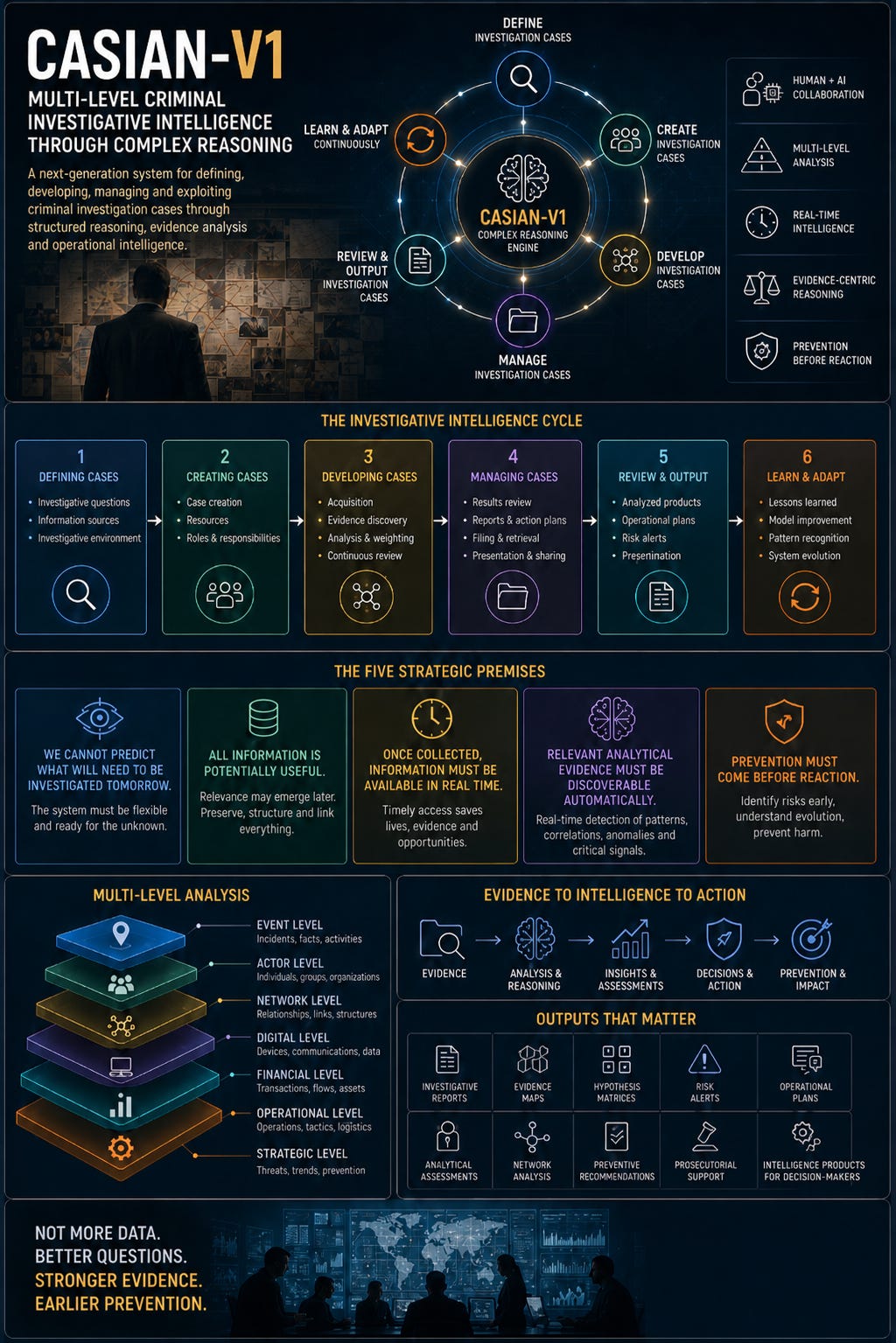
1. Defining investigation cases
The first essential function of CASIAN-V1 is the definition of investigation cases.
A criminal investigation should not begin merely with a file number or a collection of documents. It should begin with a structured definition of the problem to be investigated.
This requires three basic operations:
Identification and coding of investigative questions
The quality of an investigation depends heavily on the quality of its questions. Poor questions produce poor searches, weak evidence structures, and fragile conclusions. Strong questions orient the entire case.Identification and coding of information sources
Sources are not all equal. They differ in origin, reliability, accessibility, legal status, evidentiary value, temporal relevance, and operational sensitivity.Identification of the investigative environment
A case always occurs inside an environment: social, criminal, financial, territorial, digital, institutional, technological, or operational. Understanding that environment is necessary for understanding the case.
At this stage, the system is not merely opening a case.
It is structuring the cognitive space in which the investigation will occur.
2. Creating investigation cases
The second function is the creation of investigation cases.
Once the investigative problem has been defined, the system must help create the operational structure required to work on it.
This includes:
Creating the case
Defining the resources to be used
Identifying the roles involved in the investigation
This may seem administrative, but it is more than administration.
Roles matter because criminal investigations involve different forms of expertise, authority, access, responsibility, and judgement. Analysts, investigators, supervisors, forensic specialists, intelligence officers, legal teams, operational units, and external partners may all participate in different ways.
A reasoning-based system must understand:
What information exists
Who can act on it
Who can validate it
Who can interpret it
Who can authorize actions
Who is responsible for each stage of the investigative process
This is where case management becomes investigative architecture.
3. Developing investigation cases
The third function is the development of investigation cases.
This is where the core reasoning activity becomes visible.
CASIAN-V1 must support:
Establishing case-management criteria
Acquiring information
Discovering evidence
Weighing evidence
Analyzing evidentiary relationships
Continuously reviewing investigative lines and processes
This is essential because investigations evolve.
Initial hypotheses may fail. New evidence may appear. A source may lose credibility. A suspect may change behavior. A criminal network may adapt. A line of inquiry may become irrelevant. A minor detail may become decisive.
Therefore, investigation cannot be treated as a linear process. It must be managed as an adaptive reasoning process.
A complex reasoning system should help answer questions such as:
Which evidence supports each hypothesis?
Which evidence contradicts it?
Which source is most reliable?
Which information requires verification?
Which investigative line is becoming stronger?
Which line is weakening?
Which relationship between facts has not yet been explored?
Which missing evidence would be most valuable?
Which analytical finding is relevant in real time?
Which risk requires immediate operational attention?
This is the level at which artificial reasoning becomes genuinely useful.
Not as a replacement for judgement, but as a disciplined support structure for investigative cognition.
4. Managing investigation cases
The fourth function is the management of investigation cases.
This includes:
Reviewing case results
Preparing case products
Filing cases for temporary or permanent review
Presenting and disseminating investigative findings
The outputs of a criminal investigative intelligence case are not only internal notes.
They may include:
Investigative reports
Analytical assessments
Evidence maps
Hypothesis matrices
Operational action plans
Risk alerts
Preventive recommendations
Prosecutorial support materials
Intelligence products for decision-makers
This phase matters because an investigation is not complete when information has been collected.
It is complete only when the reasoning has been organized, the evidence has been evaluated, the conclusions can be argued, and the resulting products can support action.
A case that cannot be explained is a weak case.
A case that cannot be operationalized is an incomplete case.
Strategic premises
CASIAN-V1 is built on five high-level reasoning premises.
1. We cannot predict what will need to be investigated tomorrow
Criminal environments are dynamic. New crimes emerge, old crimes mutate, technologies are repurposed, actors adapt, and unexpected events create new investigative needs.
A rigid system designed only for known case types will fail.
The system must therefore be flexible enough to support unknown future investigations through adaptable ontologies, open information models, dynamic source integration, configurable reasoning structures, and the ability to create new investigative questions without redesigning the whole system.
2. All information is potentially useful
This does not mean that all information is equally valuable. It means that relevance may emerge later.
A fragment that appears meaningless at the beginning of a case may become decisive after new evidence is discovered. A weak signal may become a pattern. A peripheral actor may become central. A historical event may explain present behavior.
For this reason, an investigative intelligence system must preserve information in ways that allow future recontextualization.
Information should be:
Stored
Structured
Linked
Time-stamped
Sourced
Weighted
Made available for later reasoning
The evidentiary value of information is often not fixed at the moment of acquisition. It changes as the case evolves.
3. Once collected, information must be available in real time
Investigative intelligence is often time-sensitive. Delayed access to information may mean missed arrests, missed prevention opportunities, lost evidence, increased risk to victims, or failure to disrupt criminal activity.
Real-time availability does not mean uncontrolled access.
It means that authorized users and reasoning processes must be able to retrieve, relate, and evaluate relevant information when it is needed.
This requires:
Strong access control
Traceability
Auditability
Security
Role-based governance
In criminal intelligence, information availability and information control must coexist.
4. Relevant analytical evidence must be discoverable automatically in real time
This is where the system becomes more than a case database.
CASIAN-V1 should support automatic detection of relevant evidentiary relationships, including:
Correlations
Contradictions
Temporal patterns
Behavioral anomalies
Network structures
Geospatial relations
Financial links
Communication patterns
Source convergences
The goal is not blind automation.
The goal is investigative acceleration with reasoning discipline.
The system should help investigators discover what is relevant before the case becomes unmanageable. It should surface evidence, not manufacture conclusions. It should generate hypotheses, not impose certainty. It should support judgement, not replace it.
5. Prevention must come before reaction
The priority must be to prevent and avoid crimes before merely reacting to them.
Traditional criminal investigation often begins after harm has occurred. That will always remain necessary. But advanced criminal investigative intelligence should also support prevention.
This means identifying emerging risk patterns, detecting preparatory behaviors, connecting weak signals, understanding criminal ecosystems, and generating early warnings before events escalate.
In this model, investigative intelligence is not only retrospective.
It is anticipatory.
The objective is not mass surveillance.
The objective is lawful, evidence-based, accountable prevention.
Human and artificial reasoning together
CASIAN-V1 is based on a central assumption: criminal investigation will remain a human responsibility, but it can be significantly strengthened by artificial reasoning.
Human investigators bring:
Judgement
Experience
Intuition
Legal understanding
Contextual sensitivity
Ethical responsibility
The ability to interpret ambiguity
Artificial systems can contribute:
Memory
Pattern detection
Graph analysis
Hypothesis tracking
Evidence weighting
Anomaly detection
Real-time retrieval
Source comparison
Continuous review across large volumes of information
The value lies in their integration.
The investigator asks better questions. The system helps structure the search for answers. The investigator evaluates meaning. The system preserves, relates, and tests evidence. The investigator remains responsible. The system strengthens the reasoning process.
Why complex reasoning matters
Criminal investigation is not a simple workflow.
It is an adversarial reasoning environment.
The investigator is often dealing with actors who conceal, distort, fragment, destroy, or manipulate evidence. Criminal networks may use intermediaries, coded language, false identities, digital tools, financial opacity, territorial control, intimidation, or deception.
A system designed only for document management cannot reason about these dynamics.
A complex reasoning system can help model them.
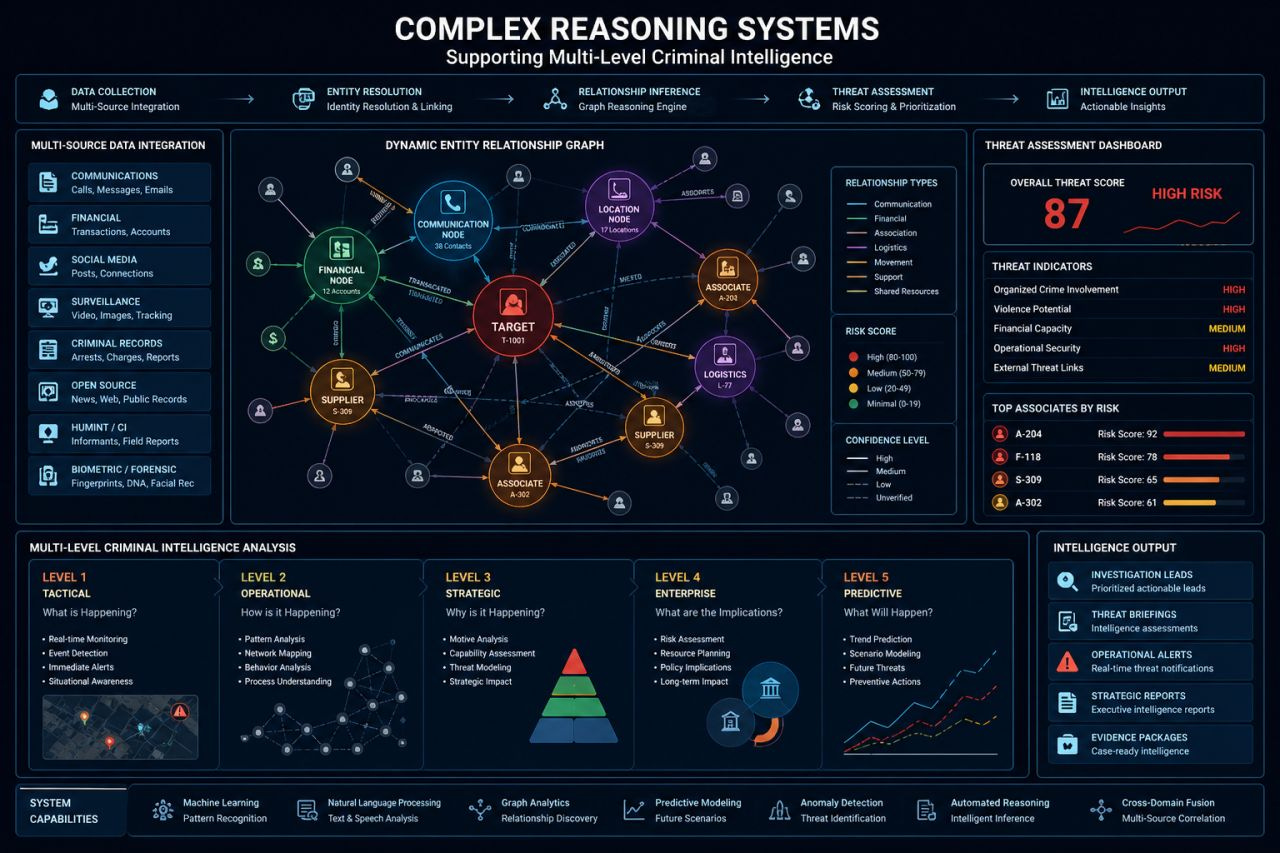
It can represent actors, events, relations, evidence, sources, locations, timelines, hypotheses, risks, and investigative decisions as part of an evolving cognitive structure.
This makes it possible to reason across levels:
Event level
Actor level
Network level
Territorial level
Digital level
Financial level
Operational level
Strategic level
That is why the concept is multi-level.
The crime is not only an event.
It may be the visible expression of a deeper system.
From case files to investigative intelligence systems
The traditional case file is a container.
CASIAN-V1 is conceived as a reasoning environment.
That distinction is decisive.
A container stores material.
A reasoning environment helps interpret it.
A container accumulates documents.
A reasoning environment structures evidence.
A container depends on manual review.
A reasoning environment supports continuous analytical discovery.
A container tells us what has been collected.
A reasoning environment helps us understand what it means.
This is the shift we believe will define the next generation of criminal intelligence and investigation systems.
Toward a new model of criminal investigative intelligence
The future of criminal investigation will not be shaped only by more databases, more documents, or more search tools.
It will be shaped by systems capable of supporting the full reasoning cycle of the investigation:
Defining the case
Creating the investigative structure
Developing evidence
Managing results
Reviewing hypotheses
Preparing reports
Supporting operational plans
Learning from cases
Detecting emerging risks
Preventing crimes before they occur
CASIAN-V1 is our working model for this transformation.
It is an attempt to bring complex reasoning architectures into one of the most demanding domains of public security: criminal investigative intelligence.
As always, I hope this new R&D note on our work at Binomial Consulting & Design S.L. is useful and interesting.
The central idea is simple.
The future of criminal intelligence will not be defined by who stores the most information.
It will be defined by who reasons better over evidence.
Not more data.
Better questions.
Stronger evidence.
Earlier prevention.