

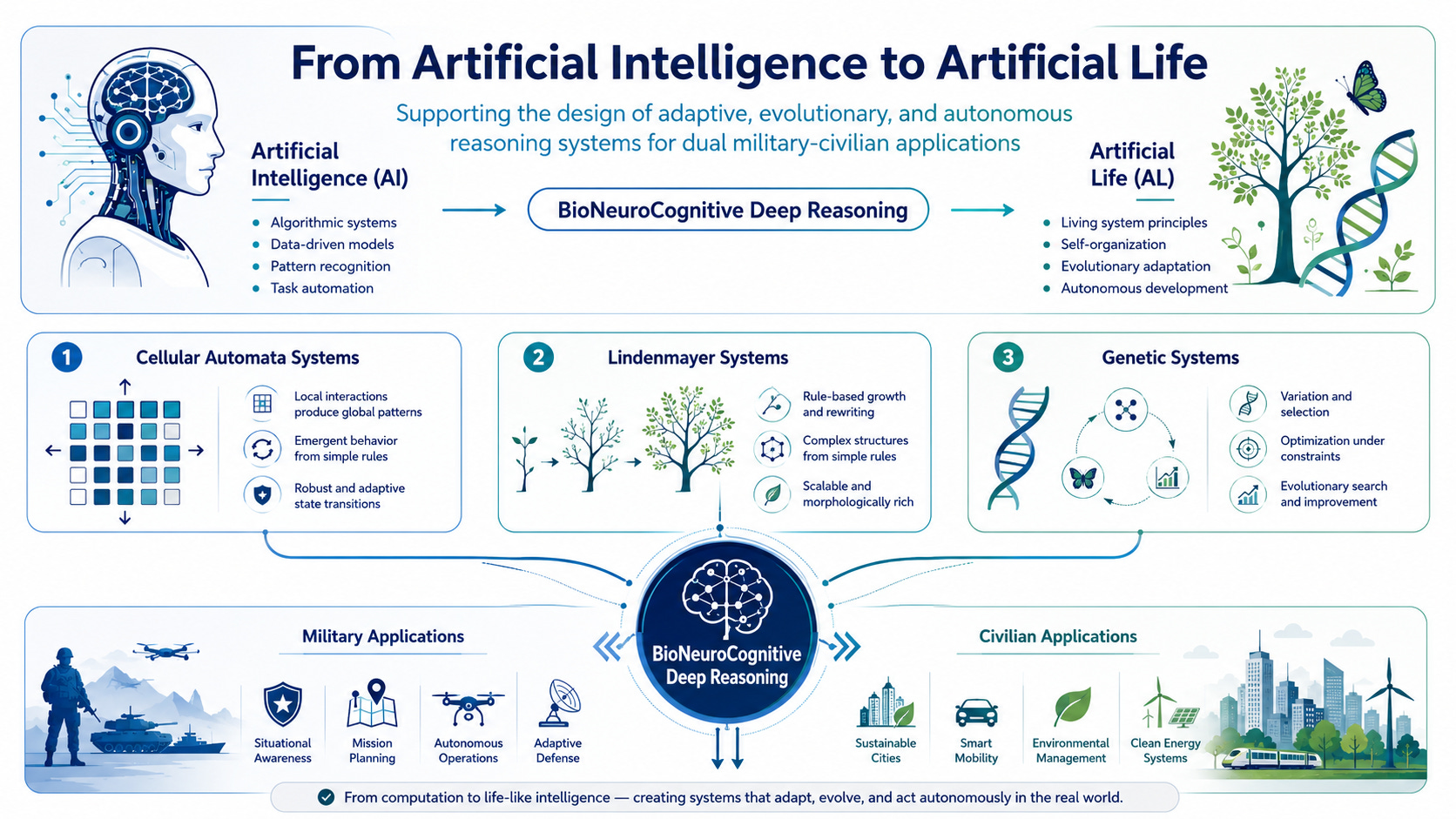
As a researcher and designer of complex reasoning systems based on BioNeuroCognitive principles, I try to approach artificial intelligence from a systemic perspective.
After almost forty years working in AI, with a broad and deep understanding of the discipline, and after nearly a hundred practical experiences in different projects and domains, I can say something that may sound uncomfortable but is increasingly clear to me.
Many current AI models are extraordinarily powerful, but their applicability to certain real-world problems remains complicated, inefficient, and sometimes conceptually insufficient.
This is especially visible in the design of adaptive, evolving, and autonomous systems with dual-use applications. I am referring here to systems capable of supporting AEA Intelligence, Strategy, and Operations Superiority: architectures that understand and predict real-world situations, plan and counter-plan actions according to desirable and undesirable objectives, and generate operational actions capable of changing situations, scenarios, and objectives.
In this context, a discipline that I have studied and experimented with for many years has become increasingly essential to my work.
That discipline is Artificial Life.
Why Artificial Life matters again
Understanding the complexity of the real world, and learning how to influence it, is essentially a problem of understanding life and its deep logic.
The real world is not a static database.
It is not a clean mathematical object.
It is not a sequence of prompts.
It is not a closed causal diagram.
The real world behaves more like a living system: adaptive, unstable, self-organizing, multi-scale, emergent, and often governed by simple rules that generate extraordinarily complex behavior.
This is why Artificial Life matters.
Artificial Life systems can offer design principles and computational strategies that avoid some of the high computational cost, brittleness, and limitations of many current AI models. They are not a replacement for all forms of AI, but they provide a different way of thinking about intelligence, adaptation, evolution, and autonomy.
Where conventional AI often tries to model cognition from the top down, Artificial Life explores how adaptive complexity can emerge from the bottom up.
This distinction is critical.
A system does not need to simulate all human reasoning explicitly in order to produce adaptive, useful, and intelligent behavior.
Sometimes, intelligence emerges from the correct organization of simple interacting rules.
From artificial intelligence to artificial life
Artificial Life was once criticized in ways similar to how early AI was criticized. It appeared speculative, difficult to formalize, biologically inspired but operationally uncertain.
However, from a systemic design perspective, Artificial Life offers a set of principles that are highly relevant for the next generation of complex reasoning architectures.
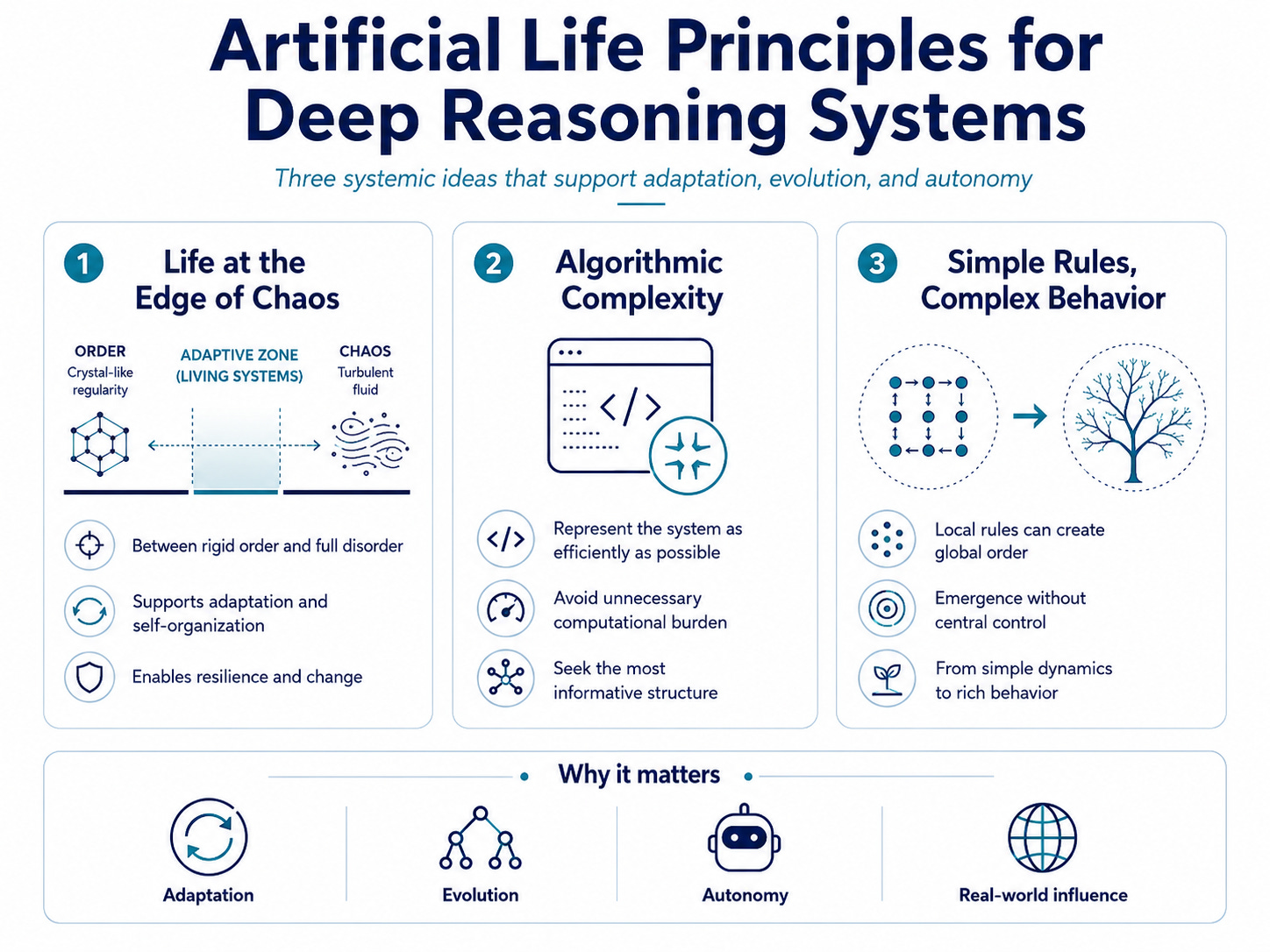
To keep this post accessible, I will focus on three principles that are especially important for my current R&D work.
Life on the edge of chaos
The first principle is associated with Christopher Langton and Norman Packard: the idea of life at the edge of chaos.
The intuition is powerful.
Primordial biological systems may have emerged, adapted, and evolved in a zone between excessive order and excessive disorder.
On one side, there is the world of crystals: rigid, stable, repetitive, highly ordered.
On the other side, there is the chaotic world of gases and turbulent fluids: unstable, unpredictable, without persistent structure.
Life appears in the intermediate zone.
It needs enough order to preserve structure.
It needs enough disorder to adapt, explore, vary, and evolve.
This is highly relevant for intelligence systems.
A system that is too rigid cannot adapt.
A system that is too chaotic cannot preserve identity, coherence, or purpose.
An adaptive intelligence system must live in the productive zone between structure and variation.
That is where self-repair, self-preservation, adaptation, and evolution become possible.
For military, corporate, scientific, environmental, and strategic systems, this principle is not merely philosophical. It is architectural.
The most advanced systems of the future will not be fully static, nor uncontrolled. They will be designed to operate at the edge between stability and transformation.
Algorithmic complexity and optimal representation
The second principle comes from Gregory Chaitin’s work on algorithmic complexity.
In simplified terms, the computational representation of a system should be as optimal as possible. A representation should not be unnecessarily inflated, redundant, or inefficient. The best representation captures the structure of the phenomenon with the minimum necessary complexity.
This principle is particularly important today.
Many current AI systems achieve remarkable results through massive scale. They absorb enormous quantities of data, parameters, energy, and computation. This approach has produced impressive capabilities, but it is not always the most elegant or efficient path for every problem.
In complex real-world domains, especially those involving intelligence, strategy, operations, adaptation, and autonomy, the key issue is not only scale.
It is representation.
A badly represented problem becomes expensive, fragile, and difficult to reason about.
A well-represented problem can become tractable, adaptive, and operationally useful.
This is one of the reasons why I believe BioNeuroCognitive Complex Reasoning architectures must integrate principles from Artificial Life, algorithmic complexity, and systemic modelling.
The objective is not merely to build larger systems.
The objective is to build better representations of living complexity.
Simple rules, complex behavior
The third principle is that complex biological systems are often governed by simple and harmonious rules.
Simple does not mean simplistic.
A simplistic rule destroys complexity.
A simple deep rule generates complexity.
This distinction matters.
Biological systems do not usually operate through enormous centralized instruction manuals. They often rely on local rules, interaction patterns, feedback loops, constraints, gradients, signals, adaptation, reproduction, selection, repair, and emergence.
From a design perspective, this is extremely important.
If we want to create adaptive, evolving, and autonomous systems, we should not always try to encode every possible behavior explicitly. In many cases, we should design rule systems, interaction environments, and evolutionary mechanisms that allow useful behavior to emerge, stabilize, adapt, and improve.
This is where Artificial Life becomes a design philosophy for complex reasoning systems.
Not a metaphor.
A practical source of architectures.
What I call Deep Reasoning Systems
Without intending to establish a new scientific discipline, and speaking only from the perspective of systemic solution design, I use the term Deep Reasoning Systems to refer to architectures that incorporate non-cognitive or non-conventional inferential logics.
These systems are not limited to explicit symbolic reasoning.
They are not limited to statistical generation.
They are not limited to language modelling.
They use systemic approaches capable of adaptation, evolution, and autonomy in two connected tasks:
Understanding the real world.
Influencing the real world.
This is the essential distinction.
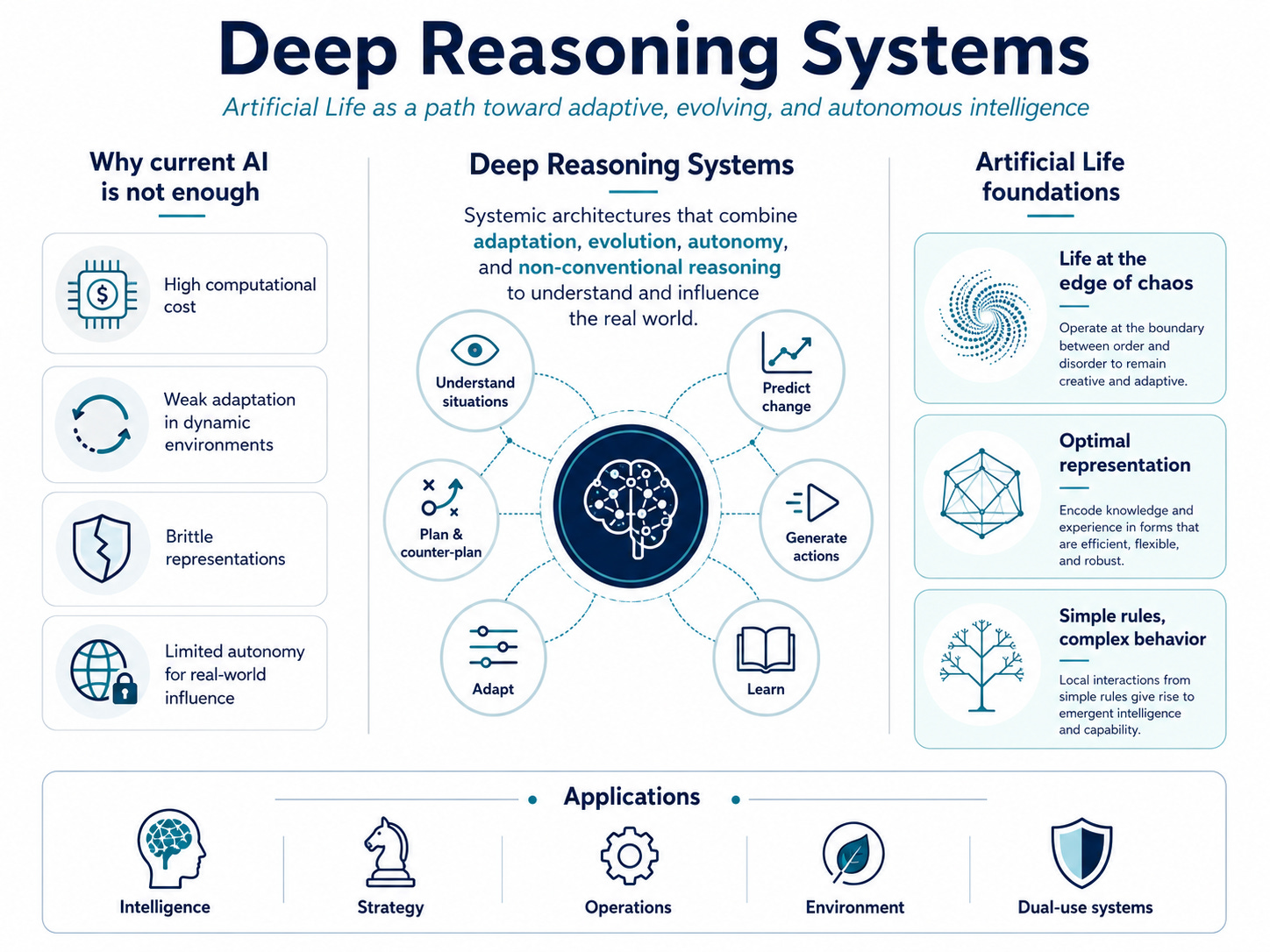
A Deep Reasoning System should not merely answer questions about a situation. It should participate in the dynamic modelling of that situation, detect its possible transformations, identify the rules that govern its evolution, and support actions that can change its trajectory.
In that sense, Deep Reasoning Systems are especially relevant to AEA Intelligence, Strategy, and Operations Superiority Systems.
They may help build systems capable of:
Understanding real-world situations as evolving systems
Predicting changes in scenarios and objectives
Planning actions under uncertainty
Counter-planning when adversaries or conditions change
Generating operational interventions
Adapting to feedback from the environment
Preserving coherence while evolving
Learning from simulated and real situations
Reducing computational waste through better representations
Combining cognitive and non-cognitive forms of intelligence
This is not conventional AI.
It is a deeper systemic approach to reasoning, adaptation, and action.
Artificial Life as a foundation for BioNeuroCognitive architectures
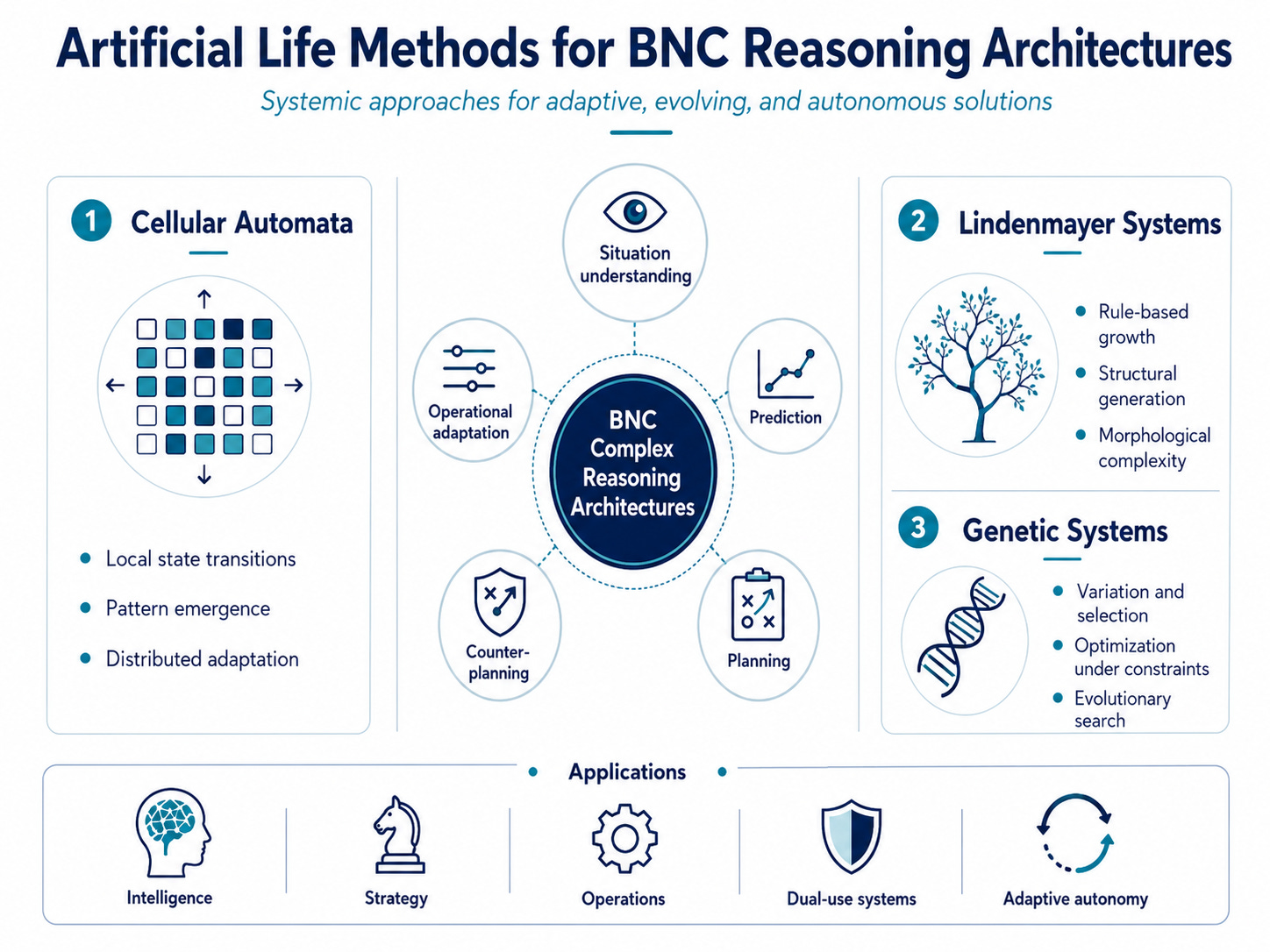
Among the Artificial Life approaches I am exploring in the R&D lines at Binomial Consulting & Design S.L., three are especially relevant.
Cellular Automata
Cellular Automata show how complex global behavior can emerge from simple local rules.
Each cell follows a rule. Each cell interacts with its neighbors. From these local interactions, large-scale patterns emerge.
This is extremely useful for modelling distributed intelligence, battlefield dynamics, environmental systems, social propagation, territorial control, risk diffusion, and multi-agent adaptation.
Cellular Automata are important because they show that complexity does not always require centralized cognition.
Sometimes, complexity emerges from local interaction.
Lindenmayer Systems
Lindenmayer Systems, or L-systems, were originally developed to model biological growth processes, especially plant morphology.
They are based on rewriting rules that generate complex structures through iterative transformation.
From a reasoning architecture perspective, L-systems are interesting because they provide models for growth, branching, structural expansion, and rule-based development.
They help us think about how knowledge structures, operational scenarios, strategic options, and adaptive plans may grow from compact generative rules.
This is particularly relevant when designing systems that must generate and evolve structured possibilities over time.
Genetic Systems
Genetic Systems provide mechanisms for variation, selection, recombination, mutation, adaptation, and optimization.
They are essential for systems that must explore large solution spaces, generate alternatives, test them, preserve successful structures, and discard weak ones.
In AEA systems, genetic approaches can support adaptive planning, counter-planning, scenario evolution, optimization of operational options, and continuous improvement of reasoning architectures.
The key is not to imitate biology superficially.
The key is to extract deep systemic principles from biological adaptation.
Why this matters for real-world intelligence, strategy, and operations
The problems that currently concern me cannot be solved only by better chatbots, larger models, or more fluent text generation.
They require architectures capable of understanding and influencing complex evolving realities.
An AEA Intelligence, Strategy, and Operations Superiority System must not only observe the world. It must reason about the world as a living dynamic system.
It must understand:
How situations emerge
How actors adapt
How objectives mutate
How constraints propagate
How opportunities appear
How threats evolve
How actions change the environment
How scenarios bifurcate
How systems self-preserve or collapse
How simple rules can generate complex consequences
This is where Artificial Life becomes indispensable.
It gives us design principles for systems that do not merely compute over the world, but co-evolve with the complexity they are trying to understand.
Beyond current AI models
Current AI models are powerful, but many of them remain trapped in expensive forms of representation and inference.
They are excellent at generating language, classifying patterns, synthesizing information, and producing plausible outputs.
But adaptive superiority in the real world requires something more.
It requires systems that can evolve.
Systems that can preserve themselves while adapting.
Systems that can generate new operational structures from simple rules.
Systems that can act under uncertainty.
Systems that can reason with incomplete knowledge without collapsing into noise.
Systems that can produce order without becoming rigid.
Systems that can explore variation without becoming chaotic.
This is why Deep Reasoning Systems must integrate Artificial Life principles.
Not as an aesthetic reference.
As an architectural necessity.
Final note
Artificial Life offers a powerful and still underused source of inspiration for the design of next-generation BioNeuroCognitive Complex Reasoning Systems.
The principles of life at the edge of chaos, algorithmic complexity, and simple generative rules provide a deep foundation for adaptive, evolving, and autonomous systems.
Cellular Automata, Lindenmayer Systems, and Genetic Systems are not merely historical curiosities of artificial life research.
They may become essential components of a new generation of reasoning architectures.
Architectures capable of understanding the real world not as a static object, but as a living field of forces, patterns, adaptations, constraints, and transformations.
This is the direction we are exploring at Binomial Consulting & Design S.L.
Not larger models for every problem.
Better systemic representations.
Not only artificial intelligence.
Artificial life as a path toward deep reasoning.
Not just systems that answer.
Systems that adapt, evolve, and act.