

Public health systems are awash in data.
Hospitals produce clinical information.
Municipalities collect local indicators.
Social services observe vulnerable populations.
Digital environments generate behavioral signals.
Institutions publish reports, alerts, and recommendations.
Citizens react emotionally and socially to what they perceive around them.And yet, in moments of real uncertainty, many decision-makers still face the same problem: too much information, not enough intelligence.
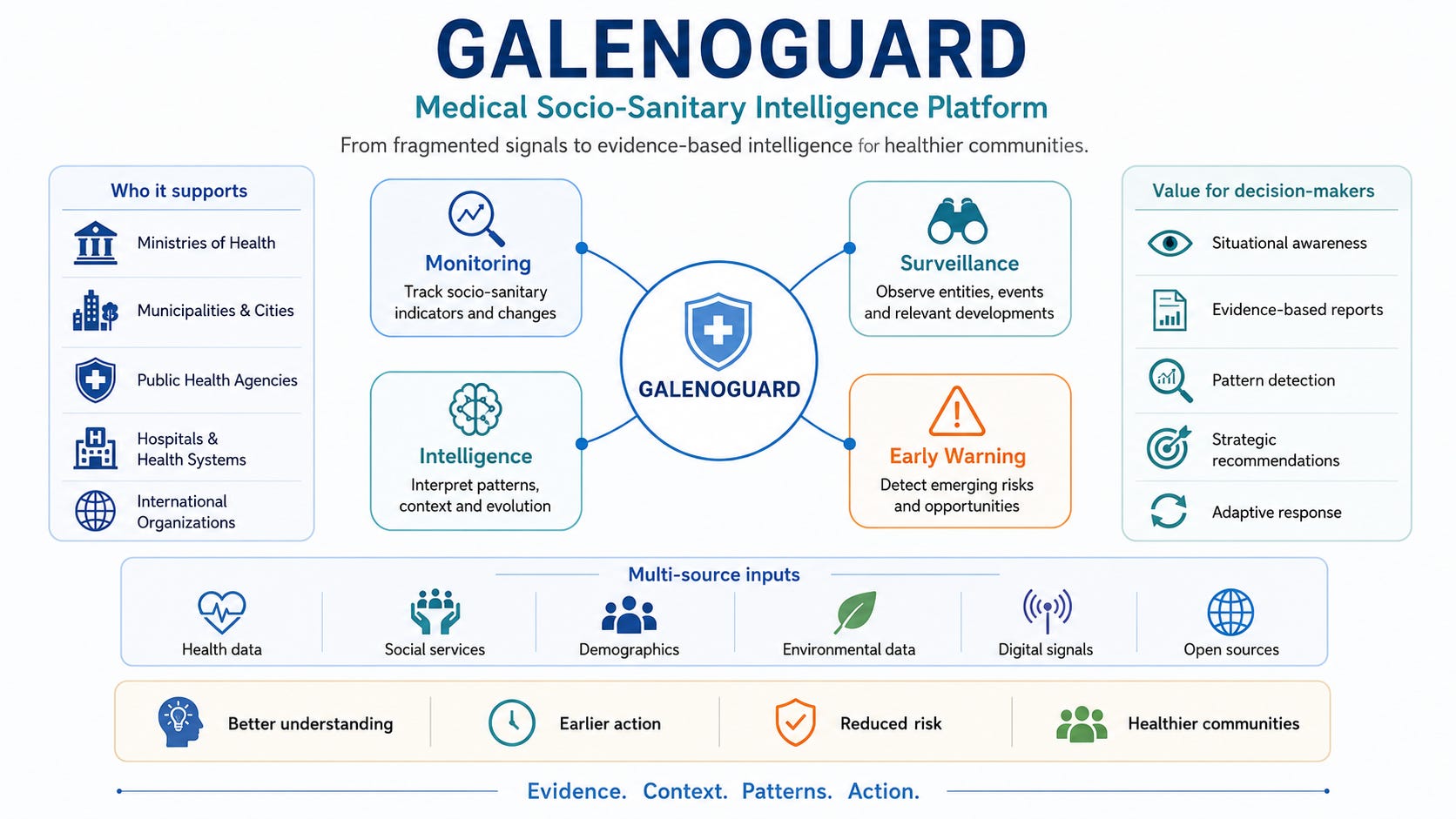
That is the gap GALENOGUARD is designed to address.
GALENOGUARD is not simply a dashboard.
It is not just a monitoring platform.
And it is not another passive reporting tool.
It is conceived as a medical socio-sanitary intelligence platform for:
situational awareness,
continuous monitoring,
surveillance,
early warning,
pattern detection,
risk evolution analysis,
and strategic recommendations.
Its purpose is to help public institutions move from scattered data to evidence-based socio-sanitary intelligence.
Not only to know what is happening. But to understand:
what it means,
how it is evolving,
what risks are emerging,
what opportunities are appearing,
and what should be done next.
That distinction matters.
Because in public health and socio-sanitary governance, delay is costly.
Delay in interpretation.
Delay in validation.
Delay in response.
Delay in adaptation.
A system that helps organizations think earlier and more clearly is no longer a luxury.
It is becoming an essential public capability.
1. Why a socio-sanitary intelligence platform is needed
Most institutions already have information systems.
What they often lack is an intelligence layer.
They can collect data.
They can store records.
They can produce reports.
They can document events.
They can compare metrics.
But that does not automatically produce strategic understanding.
A socio-sanitary intelligence system must do more than display information.
It must help institutions answer questions such as:
What is the real state of a municipality, territory, or population?
Which socio-sanitary patterns are becoming more relevant?
What risks are increasing but still under-recognized?
Which interventions are working?
Which measures are failing?
How is the situation evolving over time?
What should decision-makers prioritize now?
This is where GALENOGUARD becomes meaningful.
Its ambition is to support information superiority in public health decision-making.
That phrase may sound strong, but the idea is straightforward:
better evidence
better interpretation
better anticipation
better decisions.
In a local authority, this may mean anticipating a deterioration in a vulnerable district.
In a ministry, it may mean identifying an escalation pattern across multiple jurisdictions.
In an international organization, it may mean comparing territories, validating trends, and supporting response planning.
The scale changes, the need does not.
2. The core mission of GALENOGUARD
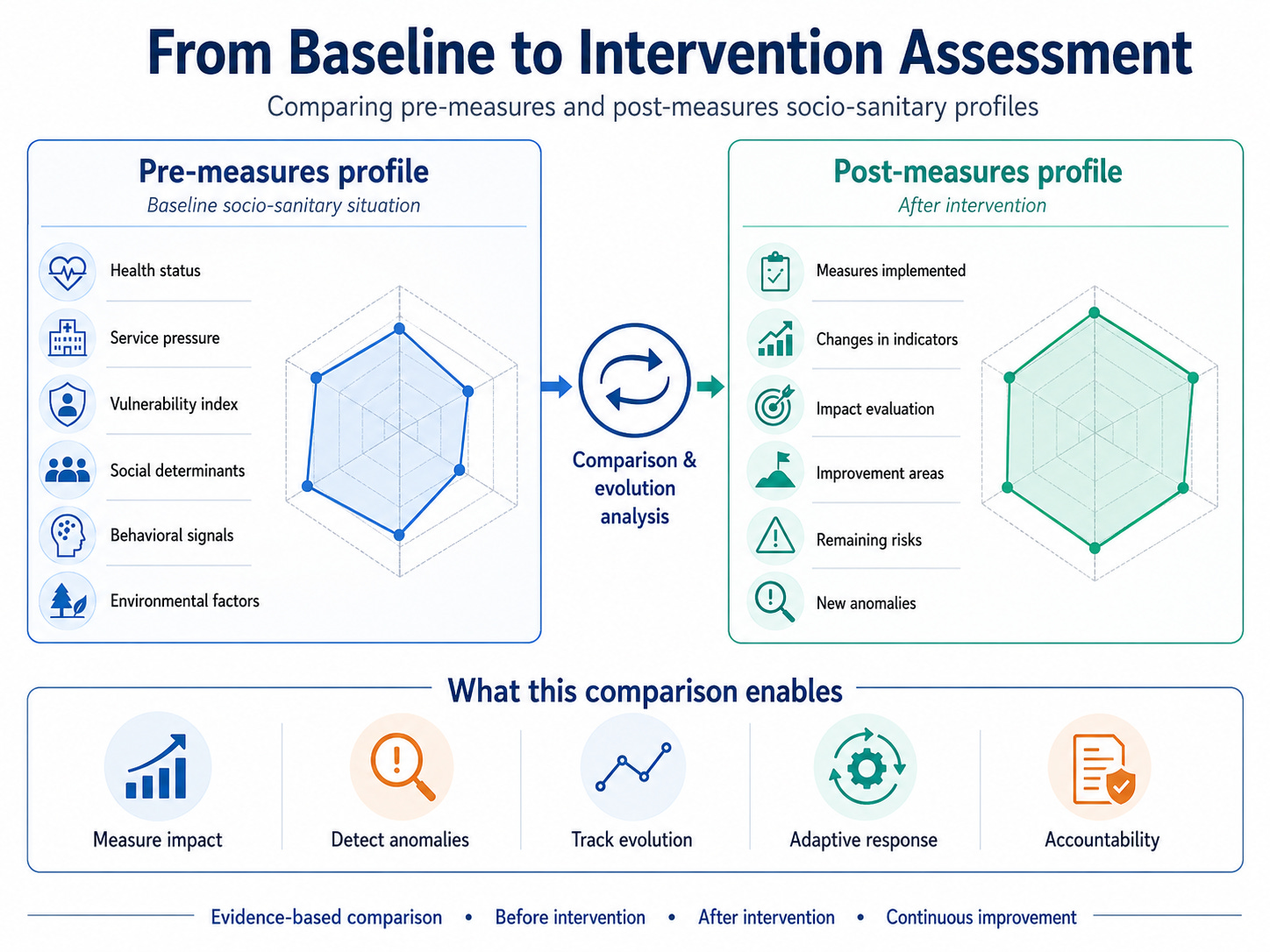
At its core, GALENOGUARD is designed to generate a validated socio-sanitary profile of a place and then track its evolution over time.
This includes five fundamental objectives:
Generate a sufficiently robust evidence base to validate the socio-sanitary situation of a municipality, region, or territory.
Build a socio-sanitary profile using patterns and key indicators before corrective measures are introduced.
Monitor the evolution of that profile once measures are implemented.
Detect anomalous developments and risk escalation trends as they emerge.
Provide operational or strategic recommendations in response to risk alerts and changing conditions.
This is one of the strongest ideas in the original conceptual design: a distinction between pre-measures and post-measures intelligence.
That is important.
Too many systems describe a situation only in the present tense.
GALENOGUARD is built to compare states:
before intervention,
during intervention,
and after intervention.
That means it is not only a diagnostic system.
It is also an evaluation and adaptation system.
It does not merely ask: What is the situation?
It also asks:
What changed?
Why did it change?
Which measures influenced that change?
What remains unresolved?
What needs to be adjusted next?
That makes it far more useful for real policy and operational decision-making.
3. From monitoring to early warning
One of the most valuable aspects of GALENOGUARD is that it does not treat monitoring as an end in itself.
Monitoring is only the beginning.
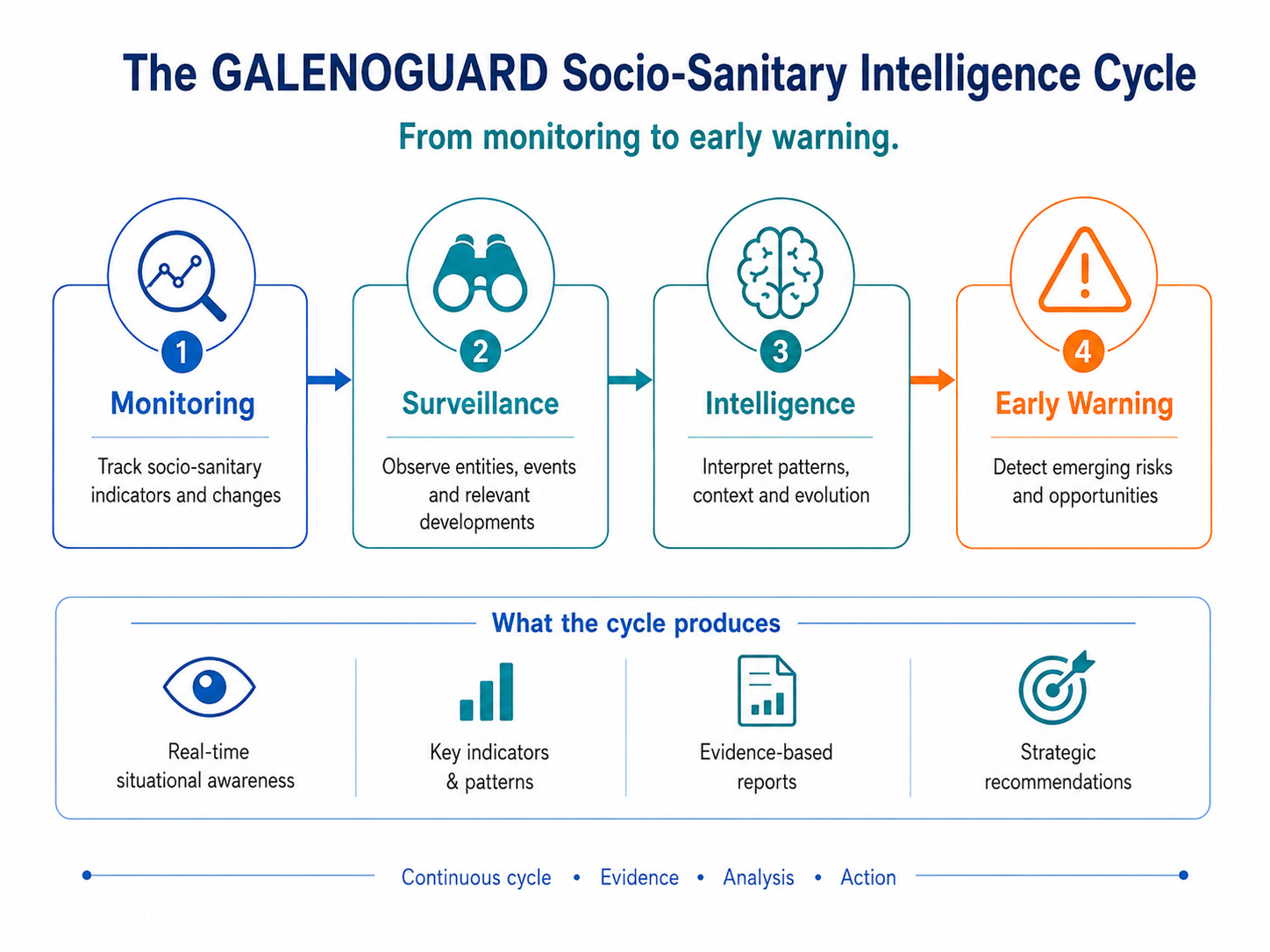
The platform is structured around four core functions:
Monitoring of the socio-sanitary environment,
Surveillance of relevant entities and events,
Intelligence production about that environment,
and Early warning on socio-sanitary risks.
This progression is critical.
Monitoring tells us what is visible.
Surveillance helps define what deserves attention.
Intelligence helps explain what matters.
Early warning helps anticipate what may happen next.
That is the difference between seeing and understanding.
A mature public-health intelligence system must move across these layers continuously.
It must not only collect signals.
It must transform them into meaningful patterns.
It must not only describe the environment.
It must identify trajectories, anomalies, and emerging threats.
It must not only issue alerts.
It must support action.
This is especially important in socio-sanitary environments, where weak signals often appear before major deterioration is widely recognized.
A small behavioral change.
A local rise in concern.
A shift in public sentiment.
A change in service pressure.
A concentration of vulnerability indicators.
An anomalous event in one neighborhood.
A deviation from expected recovery patterns.
None of these signals alone may be decisive.
Together, properly interpreted, they may become a warning.
That is why the platform’s value lies not only in visibility but in patterned interpretation.
4. The importance of pre-measures and post-measures profiles
One of GALENOGUARD’s most original and practical contributions is the distinction between:
the pre-measures socio-sanitary profile, and
the post-measures socio-sanitary profile.
This gives institutions a structured way to reason about intervention.
A pre-measures profile helps answer:
What is the baseline situation?
Which patterns define current socio-sanitary risk?
Where are the structural vulnerabilities?
Which indicators should be watched most closely?
A post-measures profile helps answer:
What changed after the measures were introduced?
Which indicators improved?
Which risks persisted?
Which anomalies emerged unexpectedly?
Are the corrective actions producing the intended effects?
This allows decision-makers to compare not only states, but trajectories.
That matters because many public interventions are judged too quickly, too vaguely, or without a coherent evidentiary structure.
GALENOGUARD creates the basis for a more disciplined approach:
establish the baseline,
validate the initial profile,
track the evolution,
compare pattern shifts,
and adjust operational measures accordingly.
In other words, it supports not just analysis, but adaptive governance.
5. An evidence-based hybrid cognitive AI approach
The conceptual architecture behind GALENOGUARD is not based on raw automation alone.
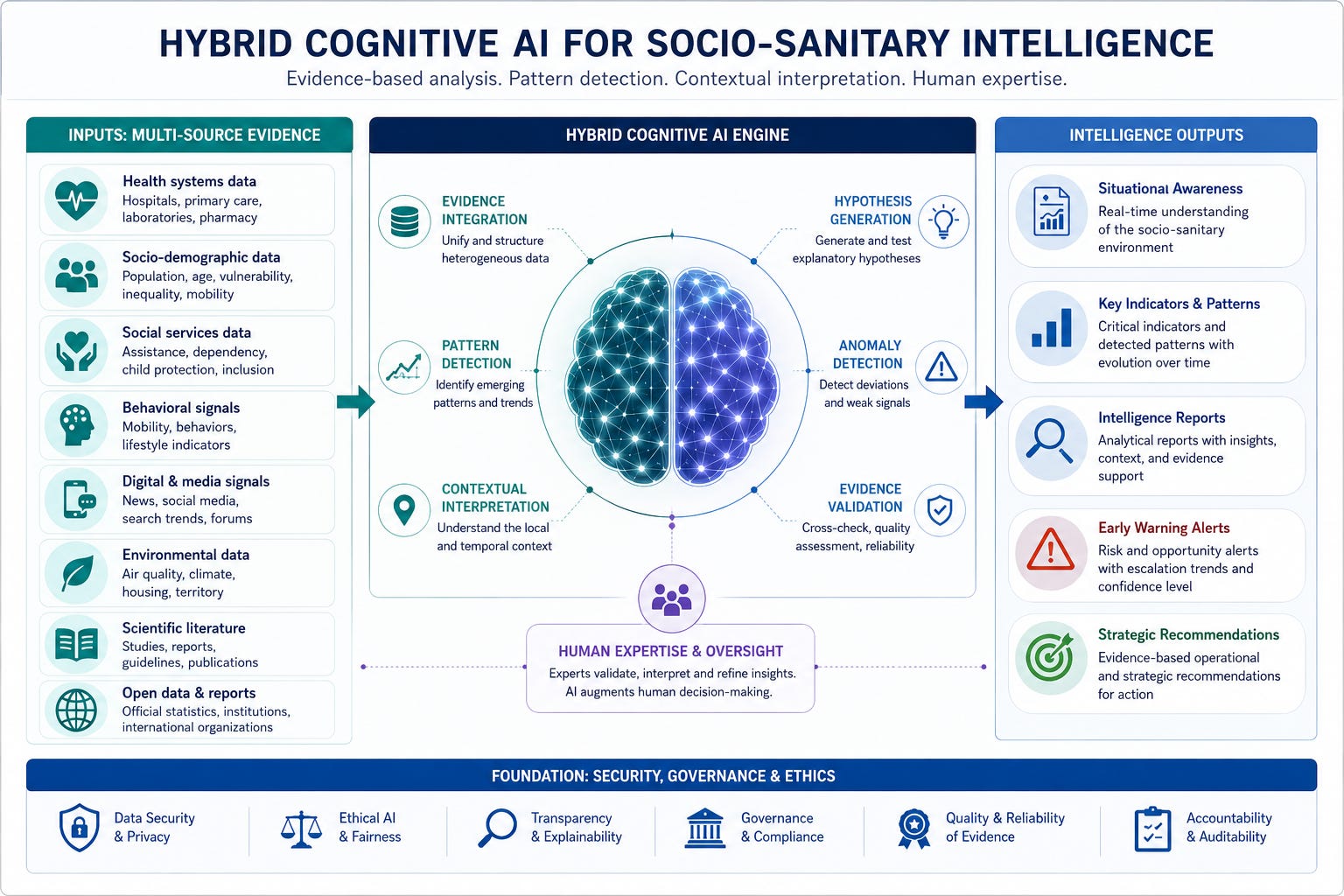
It is based on what the briefing defines as a hybrid cognitive AI model grounded in evidence.
That is a very important choice.
A purely statistical system can detect trends.
A purely administrative system can organize records.
A purely generative system can summarize language.
But a real socio-sanitary intelligence platform must do more.
It must be able to combine:
quantitative indicators,
contextual interpretation,
human expertise,
pattern recognition,
structured hypothesis generation,
and evidence validation.
This is where the “hybrid” element becomes meaningful.
GALENOGUARD should be understood as a system that integrates multiple layers of reasoning:
evidence collection,
pattern interpretation,
situational analysis,
intelligence production,
alert generation,
and recommendation support.
Its purpose is not to replace professionals.
It is to enhance the capacity of public-health and socio-sanitary actors to reason under uncertainty.
That means moving beyond a simple “data in / dashboard out” logic.
It means building a system capable of:
detecting meaningful socio-sanitary patterns,
connecting weak signals,
identifying anomalies,
supporting analytical interpretation,
and helping decision-makers choose a response posture.
This is especially relevant in complex environments where risk is not only epidemiological, but also social, behavioral, territorial, communicational, and institutional.
6. A multi-source platform for heterogeneous environments
Public-health reality is not uniform.
Different territories have different capacities, different datasets, different institutional structures, and different risk landscapes.
A useful intelligence platform must therefore be multi-source and adaptable.
GALENOGUARD is designed as a platform that can integrate multiple streams of information into one coherent analytical environment.
These may include:
institutional data,
municipal indicators,
territorial information,
event monitoring,
health-system inputs,
social-service observations,
behavioral signals,
digital discourse,
and other contextual evidence.
The point is not to collect everything indiscriminately. The point is to make diverse evidence analytically useful.
This is especially important for multi-municipality, regional, or national deployments.
A ministry may need to compare dozens or hundreds of territories.
A large city may need neighborhood-level insight.
A regional authority may need to correlate local signals with broader trends.
An international organization may need structured comparability across jurisdictions.
The platform must therefore support both:
local specificity, and
cross-territorial coherence.
That is one of the reasons GALENOGUARD is compelling as a strategic concept.
It is not locked into one scale.
It is designed as a flexible intelligence infrastructure.
7. Early warning is not just about risk
Another strong feature in the conceptual model is that GALENOGUARD is not framed only around risk.
It is also oriented toward opportunities.
That is a mature perspective.
Public-health systems often focus on deterioration, crisis, and failure.
But intelligence is more useful when it also identifies positive deviations:
areas of resilience,
emerging improvements,
effective interventions,
constructive behavioral trends,
stabilizing signals,
and opportunities for preventive action.
This matters because good governance is not only reactive.
It is also strategic.
An alert system should not merely say: something is going wrong.
It should also be able to say:
something is improving
something is working
something can be reinforced before the window closes.
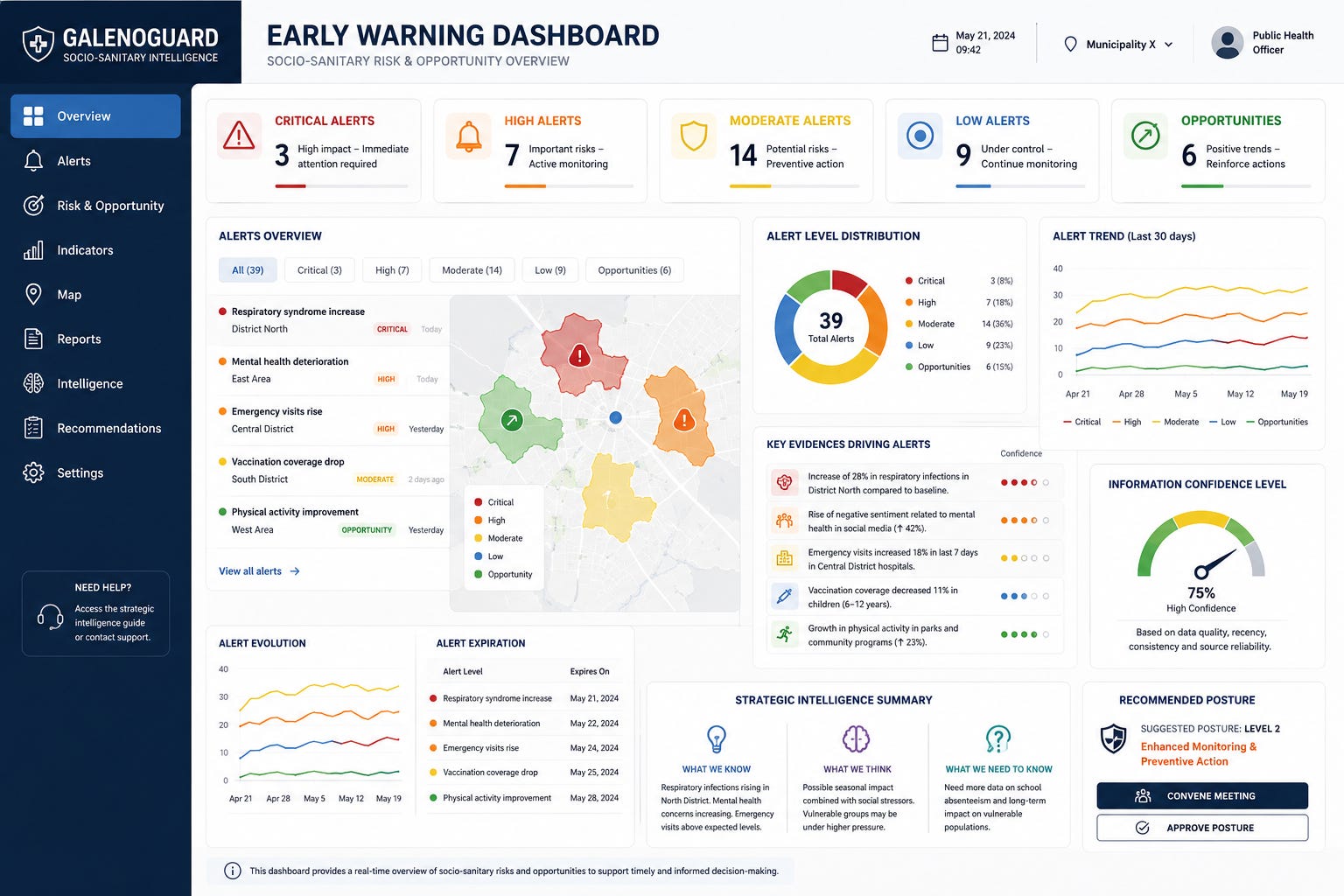
This is one reason why the early-warning dashboard concept is so valuable.
It translates intelligence into usable posture.
It helps decision-makers understand not only the level of alert, but the reasoning behind it.
And that makes action more timely.
8. The emotional and social dimension
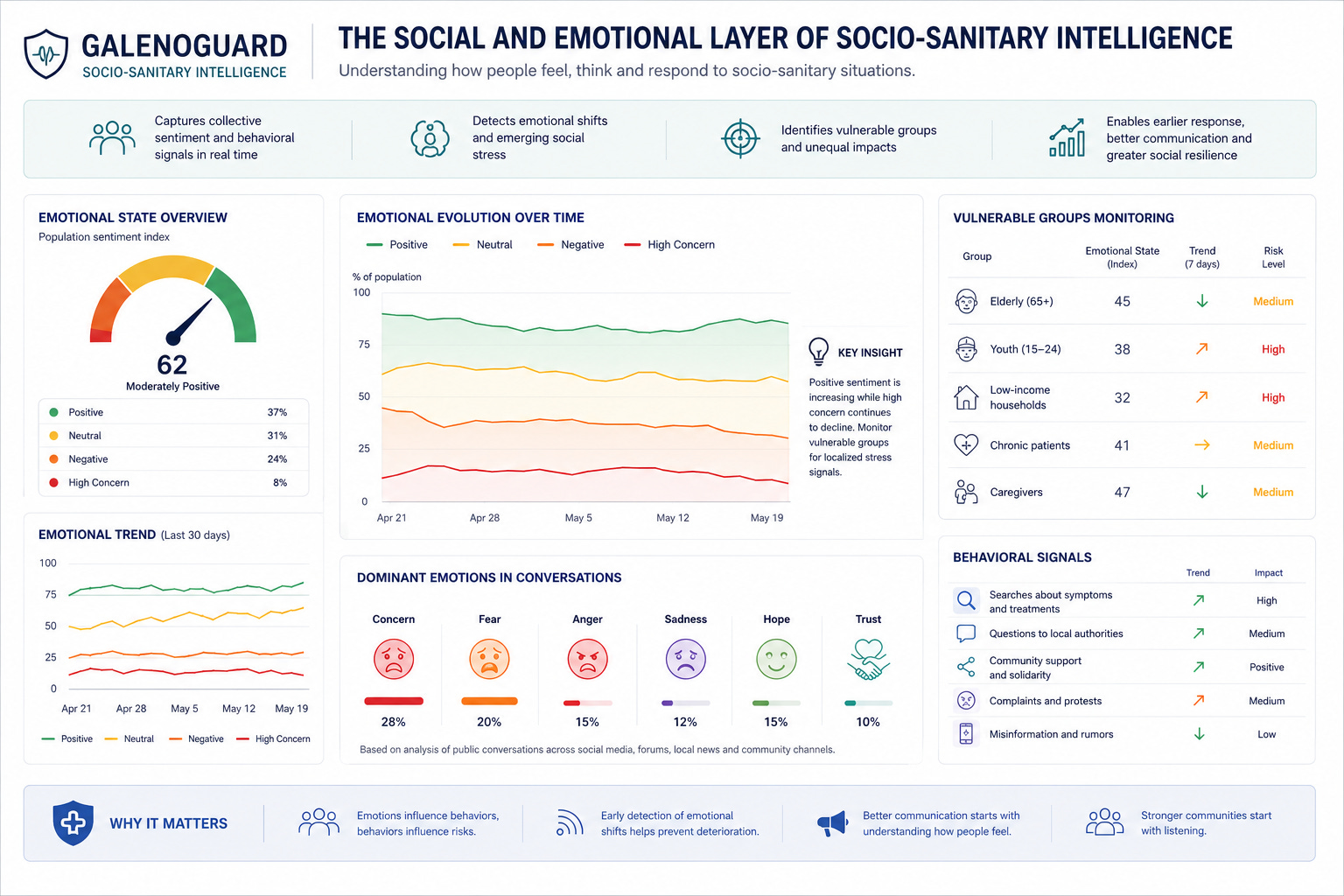
One of the most interesting components in the briefing is the inclusion of population emotional-state analysis.
This is an important idea.
Socio-sanitary reality is not purely clinical.
It is also emotional, social, behavioral, and communicational.
How people feel influences how they respond.
How they respond influences social stability.
How social stability changes influences public-health effectiveness.
A population under stress, uncertainty, fear, fatigue, or frustration behaves differently.
So does a vulnerable collective exposed to repeated socio-sanitary shocks.
The ability to analyze emotional evolution over time, detect positive and negative behavioral trends, and monitor specific groups under heightened risk can add significant value to intelligence production.
Used responsibly, this dimension can improve:
situational sensitivity,
communication strategy,
community support design,
intervention timing,
and early recognition of social tension or trust erosion.
This is not about surveillance for its own sake.
It is about understanding how socio-sanitary conditions are experienced and socially processed.
That can be vital during crises, transitions, and policy implementation.
9. From request to recommendation: the operational logic
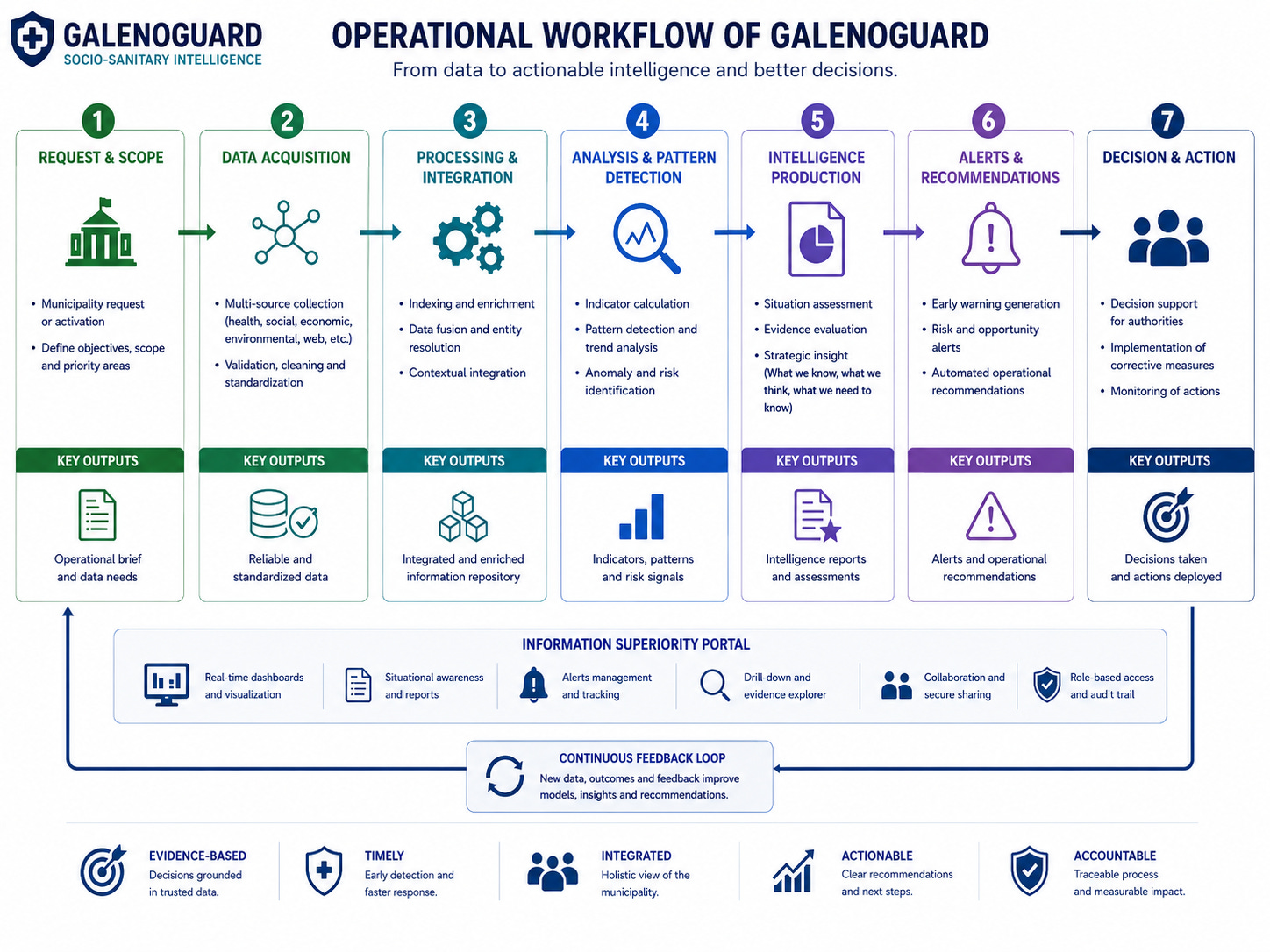
The operational logic of GALENOGUARD is also well designed.
It begins with a request or operational need.
Then it asks a sequence of practical questions:
Is relevant information already available?
Is that information sufficiently updated?
Is it enough to establish a socio-sanitary profile?
If not, what additional reliable information is needed?
How should the information be validated?
What intelligence products should be generated?
What recommendations follow from the resulting profile?
This is not a minor detail.
Many platforms assume that data is already clean, sufficient, and ready for use.
Real institutions know that this is rarely the case.
By including information sufficiency, update quality, and validation as explicit steps, GALENOGUARD acknowledges a basic truth: intelligence quality depends on evidence quality.
That makes the model operationally credible.
It also reinforces the idea that the platform is not just a passive aggregator.
It is part of a structured workflow that supports:
evidence validation,
profile generation,
situational reporting,
pattern detection,
intelligence production,
and operational recommendations.
This is exactly the kind of pipeline that ministries, health agencies, and cities need when they are trying to act before uncertainty becomes crisis.
10. Toward a new discipline of public-health intelligence
What GALENOGUARD ultimately points toward is something larger than one platform.
It points toward a new discipline: public-health intelligence as a strategic capability.
Not only epidemiology.
Not only data analytics.
Not only monitoring.
But integrated socio-sanitary intelligence.
That means building institutional capacity to:
understand complex local and territorial realities,
validate socio-sanitary conditions with evidence,
detect meaningful patterns,
track the impact of interventions,
anticipate deterioration or improvement,
and translate knowledge into action.
This matters at every level.
For cities.
For municipalities.
For regional governments.
For ministries.
For international health organizations.
In all of these settings, the core challenge is the same: how to convert fragmented public-health information into timely, actionable, and trustworthy intelligence.
GALENOGUARD is a strong answer to that question.
Not because it promises magical automation.
But because it proposes something more serious: a structured intelligence architecture for socio-sanitary understanding, anticipation, and decision support.
Closing
The future of public-health governance will not depend only on more data.
It will depend on better interpretation.
Better validation.
Better pattern recognition.
Better anticipation.
Better strategic response.
That is the real promise of GALENOGUARD.
To help institutions move:
from observation to understanding,
from reporting to intelligence,
from reaction to anticipation,
and from fragmented signals to coordinated socio-sanitary action.
In an age of complex health risks, that shift may become one of the most important capabilities a public institution can build.