

In contrast to opportunistic approaches that are doctrinally and intellectually weak, or implementations based on past doctrines, the aim of this publication is to make visible the scientific and doctrinal elements we are using for the conception, design, and development of our BioNeuroCognitive Complex Reasoning systems, which support the creation of “High Precision Strategy Reasoning Boxes” and “Critical Real-Time High-Precision Military Strategic Reasoning” architectures.
This work is applicable to other domains as well, such as high-precision political, security, corporate, technological, competitive, financial, legal, and healthcare strategy, and so on.
Introduction
Knowing, with precision, what is happening or what may happen in the environment of interest of each organization is vital in order to make correct decisions and actions. Deducing, with robust evidential support, the intentions, capabilities, vulnerabilities, and possible lines of action of potential agents of risk, problems, or opportunity can confer vital strategic superiority to our organization or interests. Being able to define high-precision strategies and operations that change the status quo of a situation in our favor, without generating conflicts or adverse reactions, is characteristic of the action of 21st-century security and defense organizations. The BinomialCD team has been working for years on research into the design of these kinds of systems.
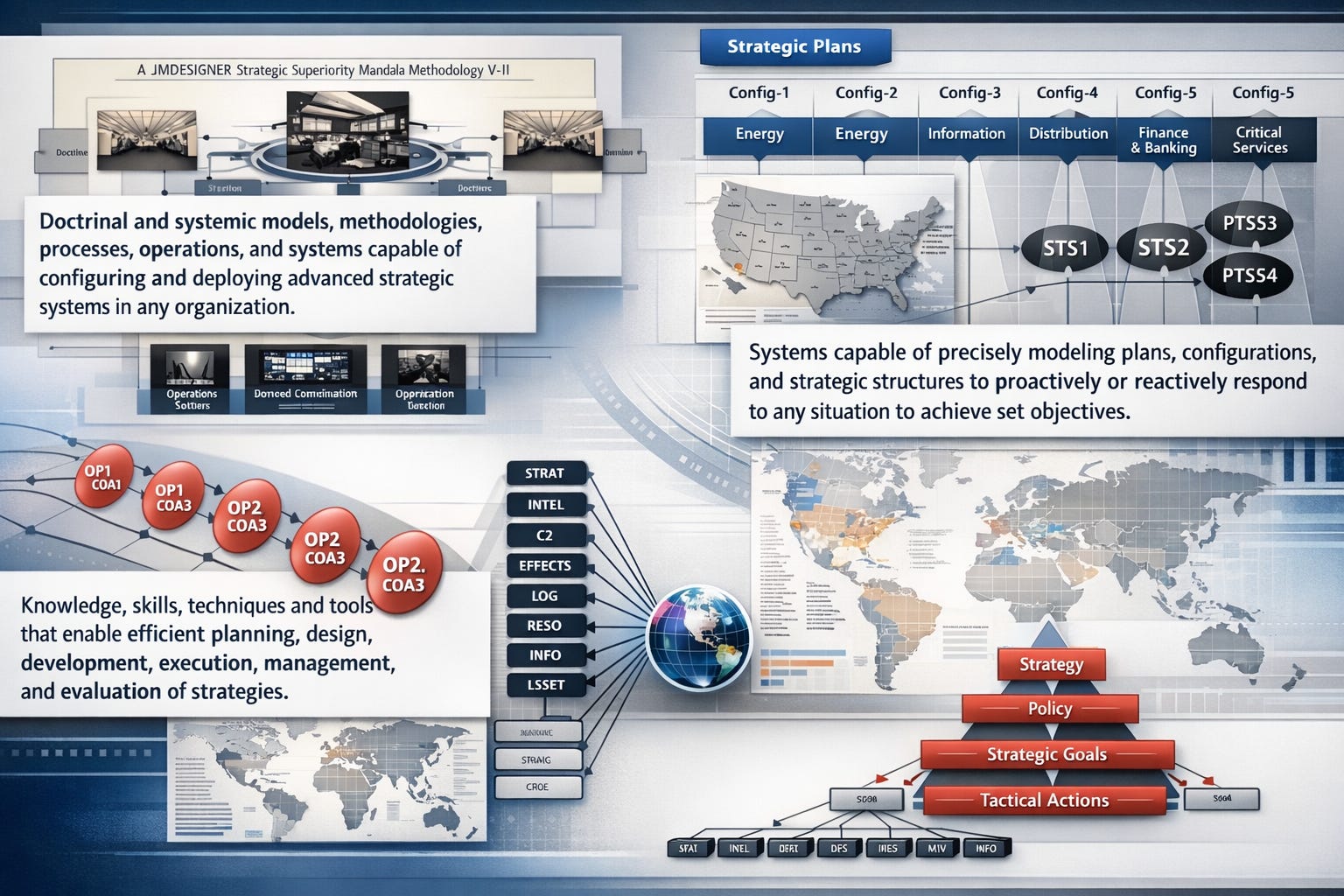
Figure: Fundamental elements of our R&D work on High-Precision Strategic Systems
Foundations of high-precision military strategic reasoning
In the early days, the term strategy was equated with the art of the generals who “made men into soldiers and, on the battlefield, developed their knowledge to offer victory to their people”.
The term also refers to the person or collective with the capacity to administer resources and the capacity for leadership—in short, the capacity to successfully carry out the missions entrusted to them; in this sense, the Greeks had the “Estrategon”, a council of ten members elected annually to manage civic challenges.
Other works distinguish between strategy and tactics depending on the importance of the problem to be faced. In this sense, the longer-lasting the effect of the solution to the problem, the more strategic it is; this characteristic is called “range”. From other disciplines and doctrinal conceptions, the term acquires different meanings or is broadened.
From the above, it is understood that strategic studies are eminently multidisciplinary. As Admiral Eliseo Álvarez Arenas said, “strategy is applied ingenuity”, and that ingenuity, in the most Ortega-style sense, is itself and its circumstance—that is, depending on its field of application: geography, politics, diplomacy, science, technology, the economy, etc.
The advent of the study of biological and artificial intelligent systems has given it a more objective and universal sense, understanding strategy as the intellective and volitive processes that enable successful interaction with the environment according to imposed or freely chosen objectives.
We define “High-Precision Strategy” as a coordinated set of methods, techniques, procedures, and resources considered relevant for planning an objective and achieving it successfully.
There are numerous strategic doctrines, generally dependent on the domain of application, especially in the military world, which is where the term was coined.
There are numerous and growing strategic models that are independent of the domain of application.
From a scientific point of view, we identify the capacity to plan and execute high-precision strategies with the capacity to create and develop, dynamically, centralized or distributed Complex Reasoning structures in a machine, an individual, a collective, or an organization, and the capacity to carry them out through interaction with the environment.
Doctrinal foundations in our research work on the design of high-precision strategic reasoning systems:
Military strategists such as Jomini, Clausewitz, Von Bullow, Ludendorff, Castex, Foch, Moltke, Fuller, Beaufre, Liddell, Hart, Gallois, Abrahamson, Álvarez Arenas, Baquer, Sokolovsky, Wardlaw, Sun Tzu, etc.
Civil strategists such as Sir Michael Howard, Buzan, O’Neill, Walt, Freedman, Kahn, Chu, Borden, Brodie, Kauffmann, Schlesinger, Blackett, the Hudson, Rand, Brookings, Elcano institutes, the Federation of American Scientists, etc.
Business strategists such as Mary Parker Follet, Drucker, Godet, Senge, Hamel, Kotler, Peters, Prahalad, Pascale, Alvin Toffler, Porter, Handy, Ohmae, etc.
Mathematicians: Von Neumann, Russel, Wiener, Gödel, Morgenstern, Bayes, Markov, Nash, Brans, Kilgour, Steinbruner, Langlois, Nye, Bobrow, etc.
Biologists: Von Bertalanffy, Laszlo, Koestler, Edward Wilson, Charles Riley, Mancuso, etc.
Cognitive scientists such as Minsky, Baron, Paper, Carbonell, Mayer, Schum, Hawkings, Hastie, Lewis, Parasuraman, Rodríguez Delgado, Calle Guglieri, Fisher, Crelisten, Kotts, Waltz, etc.
Doctrinal concepts studied and applied for our R&D lines in high-precision military strategic reasoning
A. Strategic concepts.
Strategy as a concept.
Strategy and philosophy.
Strategy and anthropology.
Strategy and mathematics.
Strategy and technology.
Strategy and human, biological, and artificial intelligence.
Uncertainty and security.
Strategy–space–time.
Strategic doctrines and models.
Strategic Reasoning.
B. Introduction to general strategy.
Mission of strategy.
Elements of strategy.
Moral factors.
Objectives, plans, and strategic resources.
Strategic virtues in individuals and organizations.
Strategic skills.
Strategic audacity.
Strategic perseverance.
Strategic superiority.
Strategic surprise.
Strategic cunning.
Strategic forces. Concentration, unification, reserve, and economy.
C. Introduction to the use of strategy in organizations.
Application of strategy in military organizations.
Application of strategy in business organizations.
Application of strategy in political organizations.
Mathematical approaches applied for our R&D lines in high-precision military strategic reasoning.
A. Game theory.
Game models of national security and business strategy.
Nash equilibria.
Pareto-optimal equilibria.
Bobrow compensation games.
Conflict strategy games.
Escalation and de-escalation strategy games.
Threat strategy games.
Risk strategy games.
Opportunity strategy games.
Deterrence strategy games.
Détente strategy games.
Stability and verification games.
B. Decision theory.
Decision: processes, elements, and stages.
Decisions under a certain context. Coverage and margin analysis, linear and dynamic programming, etc.
Decisions under a random context. Bayesian analysis, expected value, Monte Carlo simulation, queueing theory, Markov chains, neural networks, genetic algorithms, etc.
Decisions under an uncertain context. Loss matrix: equal probability or Laplace criterion, Wald criterion (minimax-maximin), Hurwicz or moderate criterion, Savage risk criterion, subjective probabilities, etc.
Decisions under risk. Decision trees, linear regression, evidence-based criterion (Dempster–Shafer), etc.
C. Logic.
Structured argumentation and deductive logic.
Propositional logic. Language. Formal semantics, logical consequence, and deductive calculus.
First-order logic.
Metalogic.
Intuitive set theory. Notions, relations, functions, Venn diagrams, and argument analysis.
Modal logic.
D. Search and detection theory.
Search and detection factors.
Double-contact theory.
Detection of randomly distributed targets.
Random search.
Effective sweep width.
Parallel sweep search.
Diffuse search.
Evidence-based search.
E. Polemology and counterfactuals.
Polemology of conflict scenarios.
Factorial analytical method.
Counterfactuals.
Comparisons, reformulations, and analogies.
F. Lanchester’s Laws of War equations.
Force levels and production rates.
Loss rates.
Generalized Lanchester equations.
Software tools studied and applied for our R&D lines in high-precision military strategic reasoning.
Mathematical tools of operations research.
Tools for planning and decision analysis.
Situational awareness tools.
Intelligence analysis tools.
Scenario analysis tools.
Pattern management tools.
Simulation tools.
Logical inference management tools.
Information, data, and evidence management tools.
Structured argumentation tools.
Multimodal explanation tools.
“What-If” modeling and counterfactual tools.
Ontology creation and management tools.
Project planning and management tools.
Projection, forecasting, exploratory and normative prospective tools.
Hypothesis management tools.
Visualization and representation tools for complex information.
Cockpit management tools.
Key elements of a high-precision military strategic reasoning system
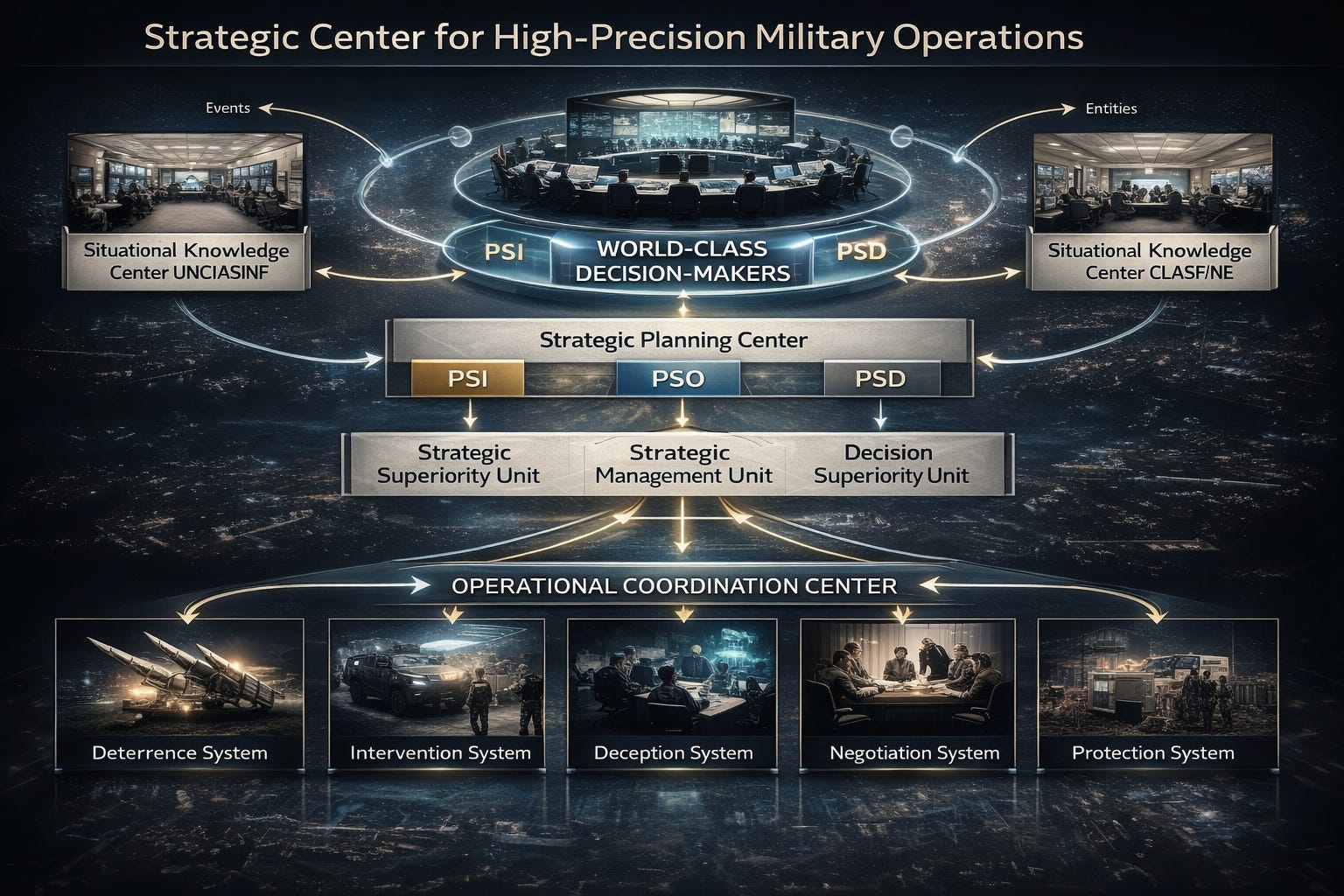
STRATEGIC SURVEILLANCE (SITUATIONAL AWARENESS): IT DEALS WITH WHAT IS HAPPENING. Situational surveillance is concerned with obtaining evidence that makes it possible to clearly establish what is happening and who is participating in the events and situations described.
STRATEGIC INTELLIGENCE: IT DEALS WITH WHY IT IS HAPPENING AND WHAT MAY HAPPEN. Intelligence is generally concerned with understanding why something is happening and what may happen in the short term in a portion of the real world. It is closely related to intentions (what they think and how they think) of a set of actors, their capabilities to carry them out, and the analysis of the consequences this would have based on knowledge of the target’s vulnerabilities. Unlike research, which is oriented toward providing certainties, the intelligence process, by working in continuous symbiosis with the state of the real world, can only offer significant reductions of the uncertainties posed.
STRATEGIC PLANNING: IT DEALS WITH SETTING OBJECTIVES AND DESIGNING PLANS AND OPERATIONS TO FULFILL THEM. Strategy’s function is to establish realistic objectives consistent with the organization’s missions and to design simple or combined plans and operations of intervention, deterrence, negotiation, deception, and protection that decisively influence the achievement of the objectives.
STRATEGIC OPERATIONS: THEY DEAL WITH INFLUENCING AND CHANGING THE STATUS QUO OF A SITUATION TO ONE MORE FAVORABLE TO THE STRATEGIC APPROACHES OF AN ORGANIZATION OR PERSON. Operations are sequences of combined actions, coordinated over time and under continuous monitoring and evaluation, of intervention, negotiation, deterrence, deception, and protection in the three dimensions of the real world: the physical, psychological, and cyber dimensions.
STRATEGIC DECISIONS: THEY ESTABLISH THE MOMENT S(X,T) AT WHICH STRATEGIC OPERATIONS ARE APPLIED BASED ON OBJECTIVES, THE SITUATIONAL CONTEXT, OPPORTUNITY, AND STRATEGIC SURPRISE. Strategic decisions are triggered in an inherently complex environment, and therefore it is necessary to pose, imperatively or optionally, enabling or inhibiting elements and elements of justification and prior explanation of such decisions.
IMPACT ASSESSMENT AND STRATEGIC LEARNING: EACH STRATEGIC SEQUENCE REQUIRES AN ASSESSMENT THAT DETERMINES WHETHER THE RESULTING SCENARIOS ARE CLOSER TO OUR DESIRABLE OR TREND SCENARIOS, and, from those evaluations, to analyze the positive and negative elements to improve in the form of lessons learned.
The key processes in a high-precision military strategic reasoning system.
A. Determination and continuous analysis of the strategic environment.
Determination and analysis of objectives.
Determination and analysis of actors.
Determination and analysis of factors.
Determination and analysis of forces.
Determination and analysis of conflicts.
Determination and analysis of threats.
Determination and analysis of risks and opportunities.
B. Planning, design, and management of structured strategies.
Design and management of strategic plans.
Design and management of strategic scenarios.
Design and management of strategic structures.
Design and management of strategic sequences.
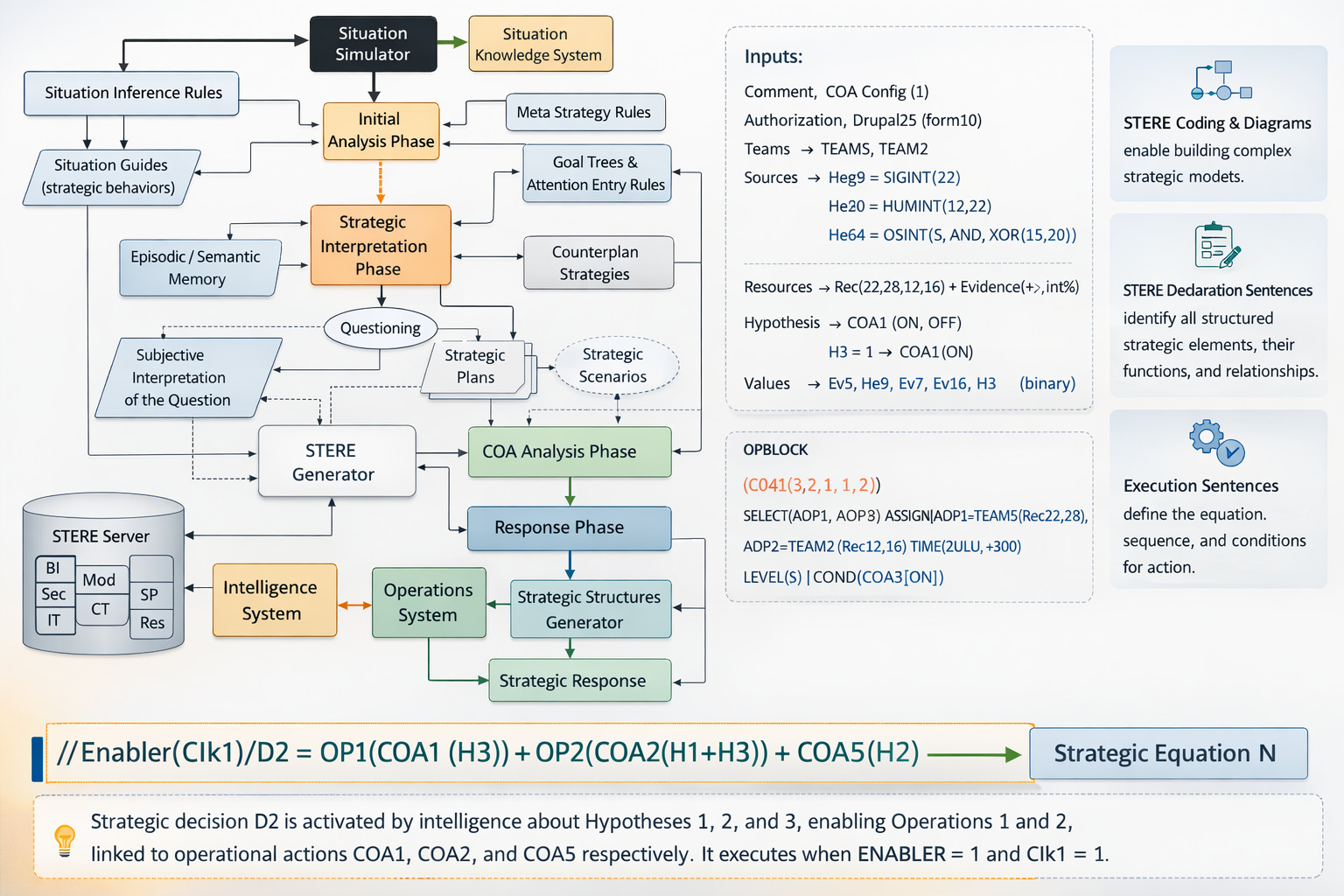
Design and management of strategic equations.
Acquisition and management of strategic resources.
Planning and production of situational awareness.
Planning and production of intelligence information.
Planning and production of operational courses of action.
Planning and production of decision-making processes.
C. Planning, design, and execution of strategic operations
Detection and analysis of strategic centers of gravity.
Design, development, and management of combined strategic operations.
Strategic operations (physical, psychological, and virtual) of deterrence.
Strategic operations (physical, psychological, and virtual) of deception.
Strategic operations (physical, psychological, and virtual) of negotiation.
Strategic operations (physical, psychological, and virtual) of intervention.
Strategic operations (physical, psychological, and virtual) of protection.
D. Impact assessment, situation analysis, and learning
Assessment of impact and operational efficiency.
Assessment of objectives.
Assessment of plans.
Assessment of scenarios.
Assessment of actors and factors.
General assessment of forces.
General assessment of conflicts.
Assessment of threats.
Assessment of risks and opportunities.
Learning from strategic cases.
Key concepts around high-precision military strategic reasoning
Strategic height: Capacity to understand the real world of interest to the organization and to influence it in line with the organization’s objectives.
Strategic efficiency: Capacity to manage, coordinate, and use available resources in order to deploy combined operations of intervention, negotiation, deterrence, deception, and protection.
Strategic flexibility: Capacity to adapt or change the organization’s objectives and means as a function of knowledge of the environment and the evolution of the organization’s mission.
The strategic height, efficiency, and flexibility of a person or organization increase proportionally with the increase in cognitive-rational capacities and their operational coordination. That is, the strategic capacity of a person or organization is directly proportional to the intelligence residing in it and to its structured functioning.
Concept of strategic sequence and strategic decision, key in high-precision military strategic reasoning systems
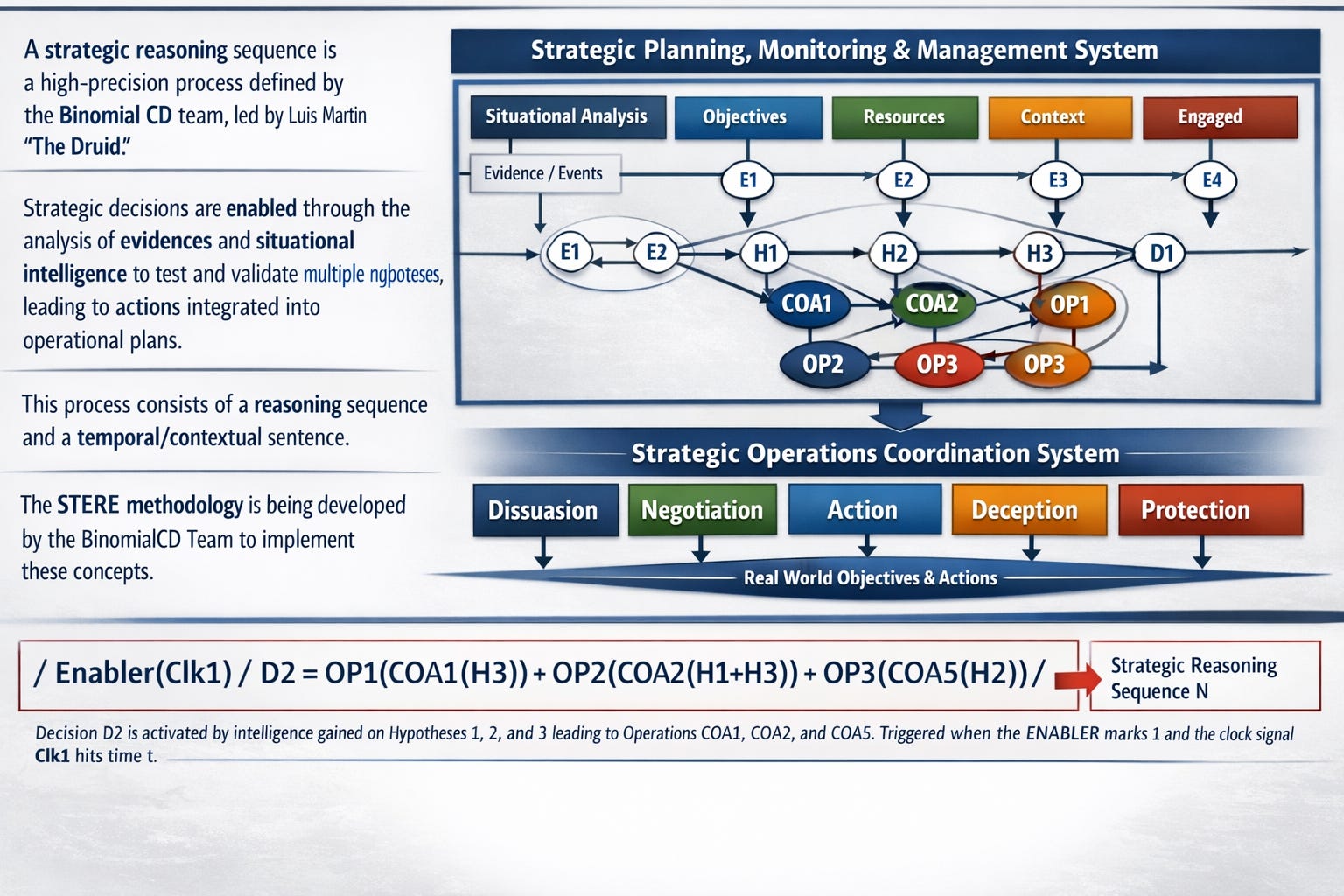
Through high-precision military strategic reasoning systems (HPSS) we can plan and develop precision strategies that trigger operations at time T and in context X, allowing us to influence, accurately and in line with our main objectives, in:
The objectives of an opponent.
The emotional state of an opponent.
The preferences of an opponent.
The plans of an opponent.
Anticipation of an opponent’s actions.
An opponent’s manipulations and traps.
The strategic center of gravity of an organization.
The social and psychological profile of a person or group.
Hidden relationships between people or organizations.
The relationships of a person or organization.
A person’s or organization’s past, present, and intended future social network.
The profiles and perceptions of people and organizations.
Alternative ways of framing problems and solutions.
Decision alternatives as a function of the situation and the objectives.
The possibility of future events as a function of events that have occurred up to the present.
The credibility of information, people, and organizations.
The cost–benefit of certain objectives and actions.
The processes that can lead to an event or situation.
Expert opinions on a topic.
The trade-offs required to carry out an action.
Escalation trends in a situation or conflict.
The forces of the actors in a possible operational scenario.
The strategy of the actors in a possible operational scenario.
The disposition of a target’s forces as a function of its geographic, political, etc. situation.
The meaning of trends and numerical patterns in people, objects, and organizations.
The probability of development of situations.
The degree of risk of an actor, factor, or situation.
The degree of opportunity of an actor, factor, or situation.
The capacity for influence of a person or an organization.
The vulnerabilities of a person or an organization.
Alternative futures as a function of present evidence.
The systemic problems of an organization.
The different conflict scenarios derived from a present or future position.
Key influences, in the form of people and organizations, with regard to an objective.
Undesired events and their consequences.
Desired events and their consequences.
The dissolution of structural problems.
Temporary or total inhibition over situations in the environment.
Critical incidents for an organization or person.
Detection of critical incidents for an organization or person.
The situations that would be established if we adopt approaches contrary to our objectives.
Possible and realizable scenarios as a function of the morphology of the proposed actions.
New scenarios based on the actors’ strategies.
The possibility of occurrence of unthinkable situations.
The processes that could lead to unthinkable situations.
The generation of intuitions.
The generation of topics.
The generation of reveries.
Validation or refutation of hypnotic imagery.
The contradictions and paradoxes of the organization.
Implicit communication flows in organizations and people.
Situations resulting from erroneous actions.
The influence of external organizations and people.
Limit situations.
The factors that allow establishing early warnings of threat, risk, and opportunity.
Example of an infrastructure of a high-precision military strategic reasoning system supporting national security (BinomialCD SSC-1 Victoria)
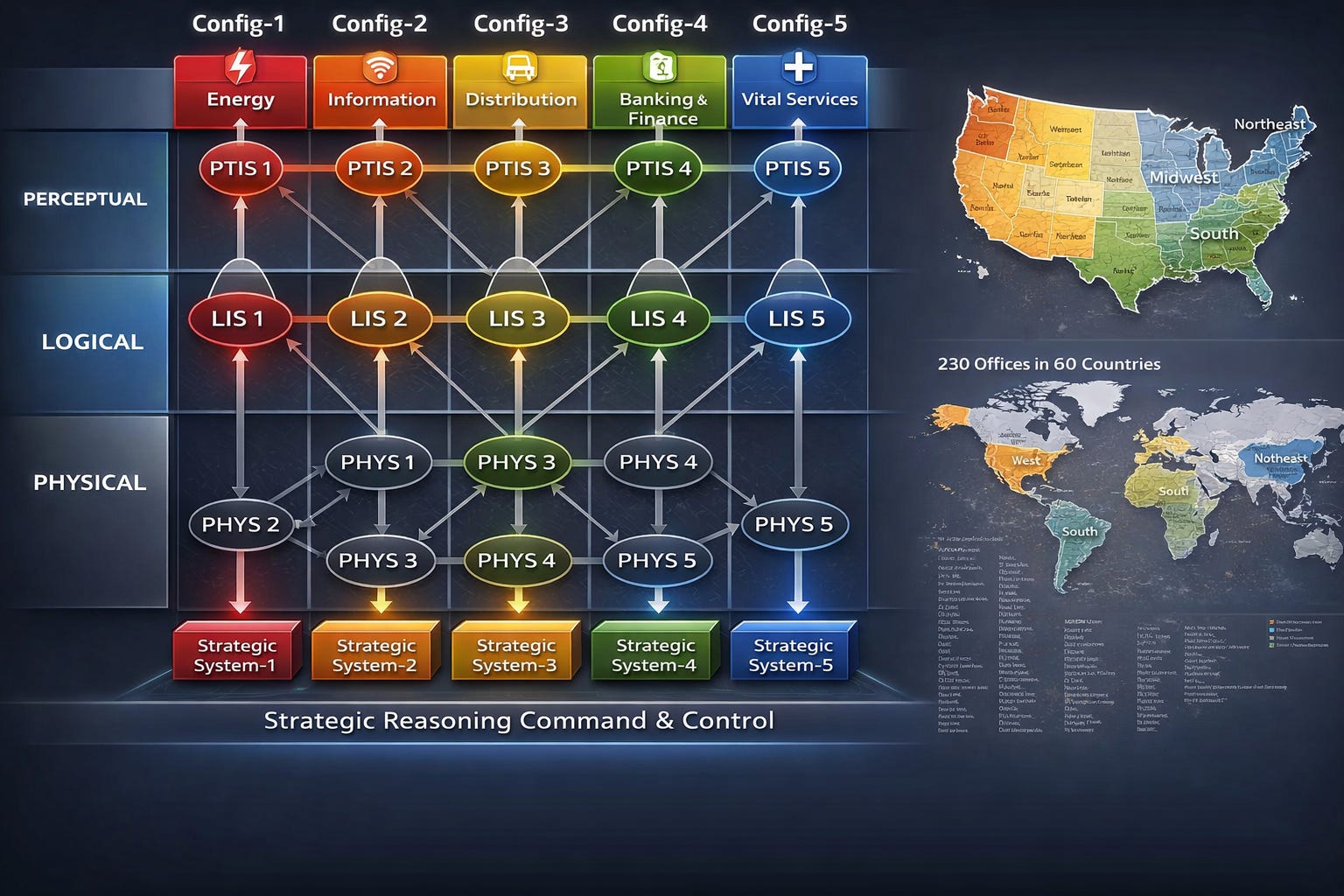
Complex cognitive reasoning language and software for planning, simulation, and management of high-precision military strategic plans and operations (BinomialCD STERE SDL/SERVERONE).
With all humility, but with full firmness, our work in this field will mark a before and after in achieving Military Strategic Superiority in hybrid and multi-domain warfare situations.