

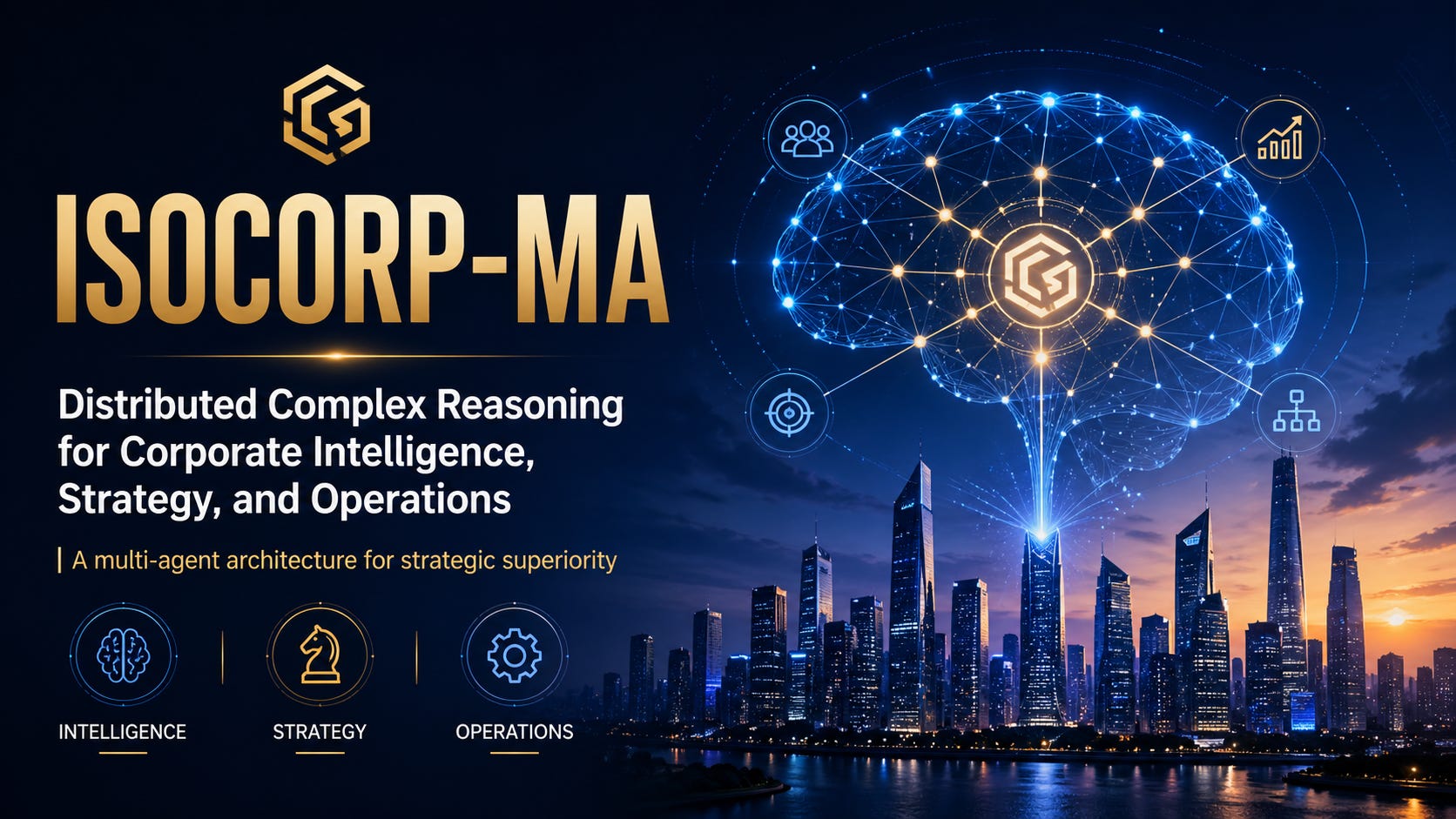
We are working on a new generation of multi-agent architectures designed to support corporate intelligence, strategy, and operations. We call this architecture BinomialCD ISOCORP-MA.
Its conceptual origin comes from our work on Military Distributed Complex Reasoning Architectures or Mil-DCRAs, developed for intelligence, strategy, and multi-domain operational superiority. ISOCORP-MA translates that logic into the corporate world.
The core idea is simple. Modern companies operate in competitive environments that increasingly resemble complex theatres of operation. Markets change, competitors move, regulation shifts, customers evolve, technologies disrupt, supply chains become fragile, reputations can change overnight, and capital, talent, alliances, channels, narratives, and timing all interact dynamically.
In this context, a corporate strategy cannot be treated as a static document. It must become a living operational system.
That is the purpose of ISOCORP-MA.
From corporate planning to corporate reasoning
Most organizations still separate strategy from operations. The strategic plan is created at the top, execution is delegated downward, information returns slowly, and correction often arrives late.
The result is familiar. Good strategies lose contact with reality, operational teams act without enough strategic context, executives receive fragmented signals, risks are detected after they have already matured, and opportunities are missed because the organization cannot orient itself quickly enough.
ISOCORP-MA proposes a different model. The company should not only plan. It should reason continuously, across the entire strategic-operational system.
This requires a multi-agent architecture capable of monitoring the environment, structuring information, identifying key actors and factors, generating strategic options, supporting executive decisions, coordinating operations, and learning from results.
In other words, the organization needs a corporate reasoning engine.
The AI-Based Small Staff Team
The first phase of ISOCORP-MA follows what we call an AI-Based Small Staff Team approach.
In the coming years, many executive teams will be reduced, augmented, or transformed by AI systems able to perform part of the analytical, strategic, and operational work currently distributed across large managerial structures. This does not mean replacing leadership. It means changing the cognitive architecture around leadership.
CEOs and senior management teams will increasingly need small, high-capability AI staff systems that can help them:
Understand the competitive environment
Detect opportunities and risks
Monitor strategic projects
Analyze actors and stakeholders
Design business development operations
Anticipate market movements
Support high-level decision-making
Coordinate execution
Learn from outcomes
Reduce organizational inefficiencies
This is not simply AI for productivity. It is AI for corporate command, strategic reasoning, and operational superiority.
The corporate environment as an operational theatre
The word “operations” is often misunderstood in business. In many organizations, operations means process execution. But in strategic environments, operations means something deeper.
It means the organized sequence of actions through which a company changes its position in the market, influences relevant actors, reaches customers, neutralizes obstacles, exploits opportunities, and converts strategic intent into measurable effects.
A company does not merely sell. It manoeuvres. It does not merely communicate. It shapes perception. It does not merely compete. It contests positions, channels, relationships, accounts, attention, trust, resources, and timing.
This is why military-derived reasoning models can be useful when properly adapted to the corporate domain. Not because companies are armies, but because both military and corporate environments require intelligence, strategy, planning, execution, feedback, adaptation, and decision-making under uncertainty.
ISOCORP-MA applies this logic to corporate development, especially business development, market expansion, account strategy, competitive displacement, and channel creation.
A multi-agent architecture for corporate superiority
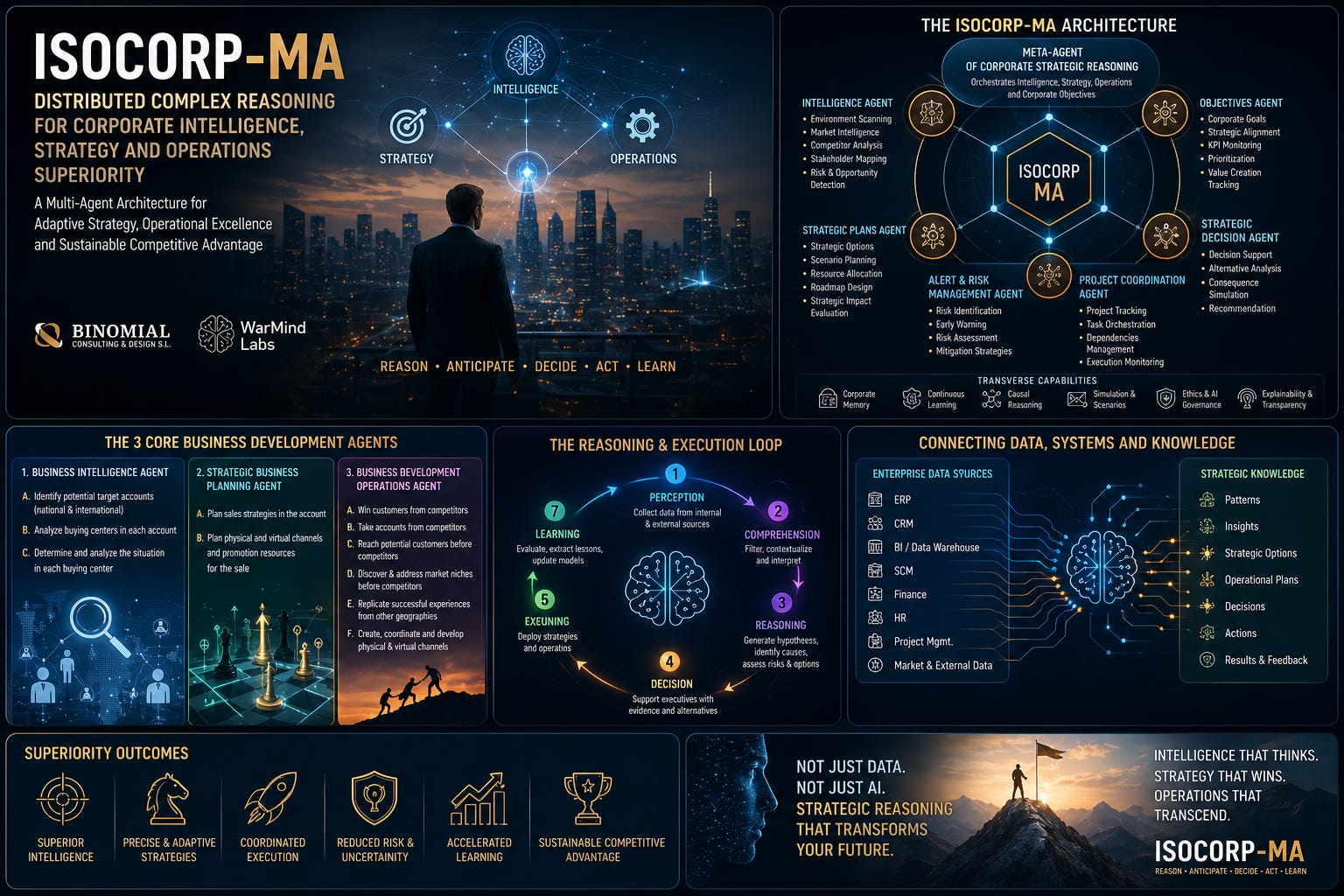
ISOCORP-MA is structured around distributed agents that interact through multiple analytical, strategic, and operational reasoning sequences. These agents are not isolated tools. They form a reasoning system.
At the upper level, the architecture includes agents focused on strategic analysis, strategic options, operations design, impact evaluation, and lessons learned. At the core, a Meta-Agent of Corporate Strategic Reasoning orchestrates the system, aligning intelligence, strategy, operations, supervision, and corporate objectives.
Below that level, specialized agents perform specific reasoning functions:
Strategic Information Agent, responsible for environmental scanning, market intelligence, competitor analysis, stakeholder mapping, and risk or opportunity detection
Objectives Agent, responsible for corporate goals, strategic alignment, KPI monitoring, prioritization, and value creation tracking
Strategic Plans Agent, responsible for strategic options, scenario planning, resource allocation, roadmap design, and strategic impact evaluation
Strategic Decision Agent, responsible for decision support, alternative analysis, consequence simulation, and recommendation
Project Coordination Agent, responsible for project tracking, task orchestration, dependency management, and execution monitoring
Alert and Risk Management Agent, responsible for risk identification, early warning, risk assessment, and mitigation strategies
Around them, transverse capabilities support the whole architecture:
Corporate memory
Continuous learning
Causal reasoning
Simulation and scenario modelling
Ethics and AI governance
Explainability and transparency
This is the real difference between a multi-agent architecture and a collection of disconnected AI assistants. A disconnected assistant answers. A reasoning architecture coordinates.
Business intelligence agent
The first key agent is the Business Intelligence Agent. Its task is to provide continuous and strategically aligned information to the organization.
In business development, this agent supports three critical functions:
Identifying potential target accounts at national and international levels
Analyzing existing buying centers within each account
Determining the situation inside each buying center, including decision-makers, influencers, blockers, technical evaluators, economic buyers, procurement structures, internal politics, timing, pain points, and strategic relevance
This is essential because the real customer is rarely a single person. The customer is usually a decision system. A company that does not understand the customer’s internal decision system is not selling strategically. It is merely presenting an offer.
The Business Intelligence Agent helps transform account information into account understanding.
Strategic business planning agent
The second key agent is the Strategic Business Planning Agent. Its role is to convert intelligence into strategy.
This agent supports the planning of sales strategies for specific customers, markets, segments, and strategic opportunities. It helps define:
Which accounts should be prioritized
Which buying centers matter most
Which actors must be influenced
Which value propositions should be emphasized
Which channels should be activated
Which promotional resources should be used
Which timing is optimal
Which competitive moves should be anticipated
Which risks could block the opportunity
It can also plan the physical and virtual channels required for commercialization, including direct sales, partner channels, sectoral alliances, digital campaigns, executive influence, content strategy, events, technical demonstrations, proof-of-concept sequences, institutional relationships, and ecosystem positioning.
The objective is not simply to create a sales plan. The objective is to design a coherent operation for market movement.
Business development operations agent
The third key agent is the Business Development Operations Agent. This is the agent that translates strategic intent into coordinated action.
Its mission is operational. It helps the company move before competitors, reach customers earlier, exploit underdeveloped niches, and coordinate channels of commercialization.
Its capabilities may include:
Winning customers from competitors
Recovering or taking strategic accounts
Reaching potential customers before competitors do
Discovering and addressing market niches before they become visible to others
Replicating successful customer experiences from other geographic markets
Creating and coordinating physical and virtual commercialization channels
Supporting the deployment of business development operations
Tracking obstacles that prevent the strategic project from advancing
Identifying actors or factors that must be influenced, bypassed, or neutralized through legitimate corporate action
This last point is important. Corporate operations must remain ethical, legal, and governance-compliant. The objective is not manipulation. The objective is disciplined strategic action.
In a competitive market, organizations must understand obstacles, anticipate resistance, and design legitimate ways to move forward. ISOCORP-MA provides reasoning support for that process.
Monitoring the strategic project of the organization
One of the central ideas of ISOCORP-MA is the organizational project.
Every company has a project, whether explicit or implicit. It may be growth, internationalization, market leadership, technological differentiation, a new product category, industrial transformation, a financing process, a merger or acquisition, strategic repositioning, survival, or turnaround.
ISOCORP-MA is designed to help CEOs and senior management teams monitor the environment around that project. This includes:
Key actors and stakeholders
Competitors, customers, partners, suppliers, and investors
Regulators and institutional actors
Talent markets and technology shifts
Public narratives and reputational dynamics
Operational bottlenecks
Emerging risks
Strategic opportunities
The architecture is not limited to internal performance. It connects the internal corporate system with the external environment. That is where strategic advantage appears.
From enterprise data to strategic reasoning
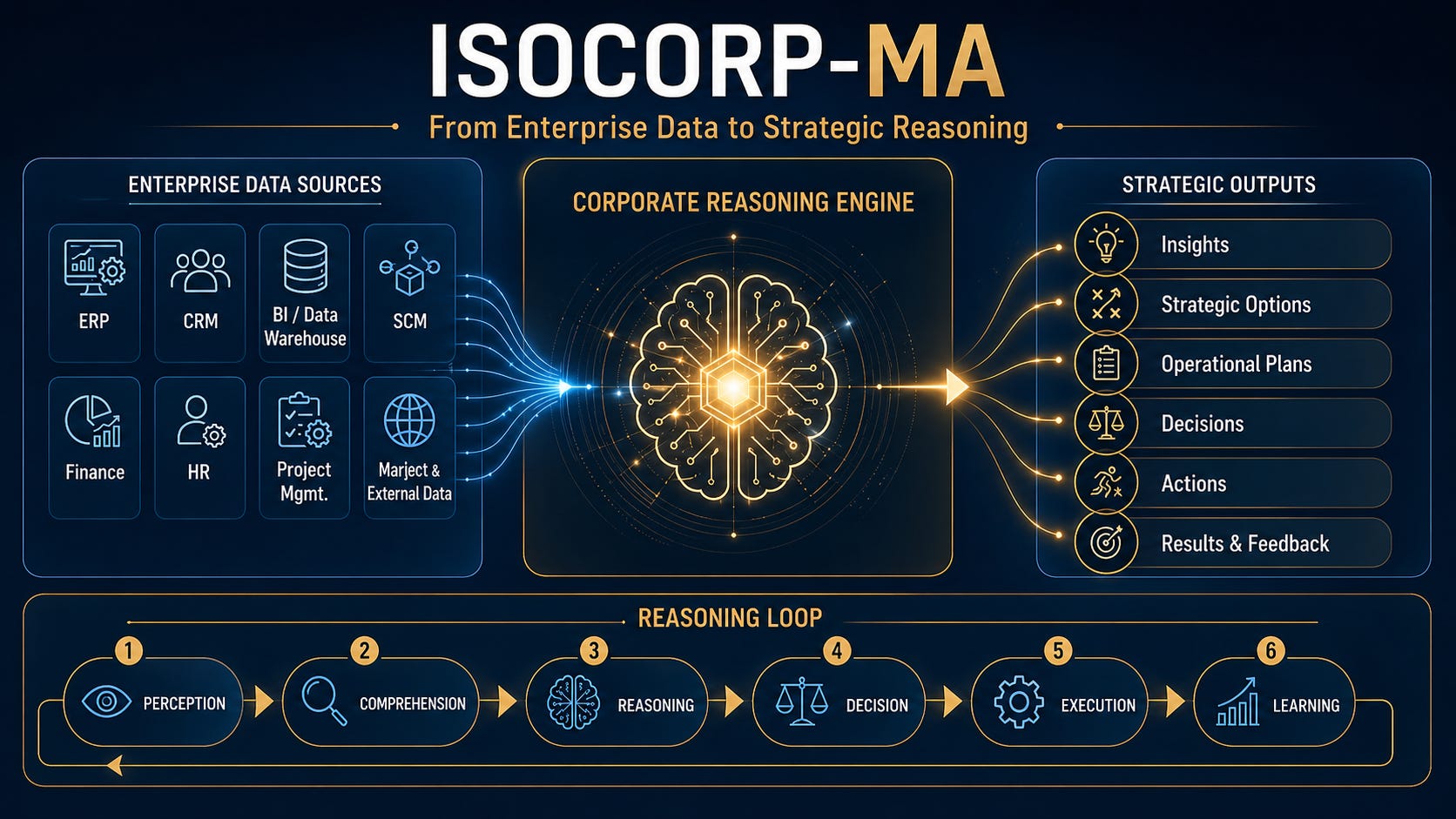
Modern companies already have many systems: ERP, CRM, business intelligence platforms, data warehouses, product lifecycle management, supply chain management, finance systems, HR systems, project management tools, market data sources, and customer success platforms.
These systems contain valuable information, but they often remain fragmented. They produce data, dashboards, alerts, reports, and indicators, but not necessarily strategic reasoning.
ISOCORP-MA is designed to connect with these systems as sources of truth and operational context. The point is not to replace them. The point is to reason over them.
ERP can reveal operational constraints. CRM can reveal customer movement. BI and data warehouses can reveal patterns. Finance can reveal resource capacity. HR can reveal organizational readiness. Supply chain systems can reveal fragility. External data can reveal competitive and market movement.
But none of this becomes corporate intelligence automatically.
The missing layer is reasoning.
The reasoning and execution flow
ISOCORP-MA follows a continuous reasoning and execution cycle.
The flow can be understood in seven stages:
Perception
The system collects structured, unstructured, internal, and external data.Comprehension
It filters, contextualizes, and interprets the relevant information.Reasoning
It generates hypotheses, identifies causal relations, detects risks, and evaluates strategic options.Decision
It supports executive choice with evidence, alternatives, confidence levels, and projected consequences.Planning
It designs coordinated action plans aligned with corporate objectives.Execution
It supports the deployment of strategic and operational actions.Learning
It evaluates results, extracts lessons, updates models, and improves future decisions.
This feedback loop is critical. A company that does not learn from its operations repeats errors. A company that learns slowly loses tempo. A company that learns in real time gains strategic advantage.
Strategic benefits
The expected benefits of ISOCORP-MA are not merely operational. They are strategic.
The architecture aims to provide:
Superiority in intelligence and decision-making
High-precision, adaptable strategies
Coordinated and synchronized operational execution
Reduced uncertainty and risk
Accelerated organizational learning
Sustainable competitive advantage
These benefits should be measured through concrete superiority metrics:
Decision precision
Strategic impact
Response speed
Operational efficiency
Risk reduction
Return on intelligence
The last metric is especially important. Organizations often measure return on investment. They rarely measure return on intelligence. But in complex environments, intelligence quality directly affects capital allocation, market timing, risk exposure, competitive position, and execution success.
Why this is not ordinary agentic AI
It is useful to be precise here.
Distributed Complex Reasoning Agents, or DCRAs, should not be confused with the current popular notion of “agentic AI.”
Most agentic AI systems are task-oriented. They use tools, follow workflows, execute instructions, automate actions, and may operate multimodally. This is valuable, but it is not the same thing.
DCRAs are structurally different. They are designed for complex reasoning under uncertainty, strategic coordination, operational adaptation, decision-support, causal interpretation, simulation, governance, and multi-agent orchestration.
The difference is not cosmetic. It is a difference in structure, complexity, criticality, and purpose.
A multimodal AI agent may help produce a report.
A DCRA architecture can help an organization understand an evolving competitive environment, generate strategic options, coordinate operations, evaluate impact, and learn from execution.
One is a tool.
The other is a reasoning system.
Corporate intelligence beyond dashboards
Many companies already have dashboards. Dashboards show indicators, but indicators are not intelligence.
A dashboard may tell a CEO that sales are falling. It may not explain why, identify which competitors are moving, show which buying centers are blocked, detect which account should be attacked or defended, suggest which channel strategy should change, infer which actor is preventing progress, simulate alternative courses of action, or learn from previous strategic operations.
ISOCORP-MA moves beyond dashboards by connecting information to reasoning, and reasoning to operations.
The executive does not need more screens.
The executive needs a system that helps convert complexity into decision.
The future of corporate staff work
The traditional corporate staff model is under pressure. Large executive structures are expensive, slow, politically complex, and often fragmented by functional silos. At the same time, the complexity of the environment is increasing.
This creates a paradox. Companies need more intelligence, but cannot solve the problem simply by adding more management layers.
AI-Based Small Staff Teams offer a different path. A smaller human leadership team can be augmented by distributed reasoning agents that provide continuous intelligence, planning, coordination, simulation, and learning.
This does not eliminate the need for human executives. It raises the level at which they operate.
Executives should spend less time searching for information, reconciling reports, and managing fragmented interpretations. They should spend more time making strategic decisions, shaping the future of the organization, and exercising judgement.
ISOCORP-MA is designed for that shift.
Binomial Consulting & Design as a deeptech company in complex reasoning
Binomial Consulting & Design S.L. operates as a deeptech company specialized in BioNeuroCognitive Complex Reasoning.
Our work focuses on consulting, design, and modelling of multi-agent architectures for superiority in intelligence, strategy, and operations across multiple domains:
Military
Corporate
Criminal intelligence
Counterterrorism
Space
Science and technology
Health
Environment
Critical infrastructure
Institutional strategy
The common denominator is not the domain itself. The common denominator is the need for complex reasoning.
Where there is uncertainty, competition, risk, adaptation, actors, constraints, and strategic consequence, there is a need for architectures that can reason.
Toward corporate strategic superiority
ISOCORP-MA is not a productivity layer, a chatbot, or a conventional automation platform. It is a multi-agent architecture for corporate intelligence, strategy, and operations.
Its objective is to help companies understand their environment, anticipate change, design better strategies, deploy coordinated operations, and learn continuously from results.
The companies that win in the next decade will not simply be those that use AI to reduce costs. They will be those that use AI to improve strategic cognition.
They will see earlier, understand deeper, decide faster, act with greater precision, learn continuously, and adapt before their competitors understand what has changed.
That is the purpose of ISOCORP-MA.
Intelligence that thinks.
Strategy that wins.
Operations that transcend.