

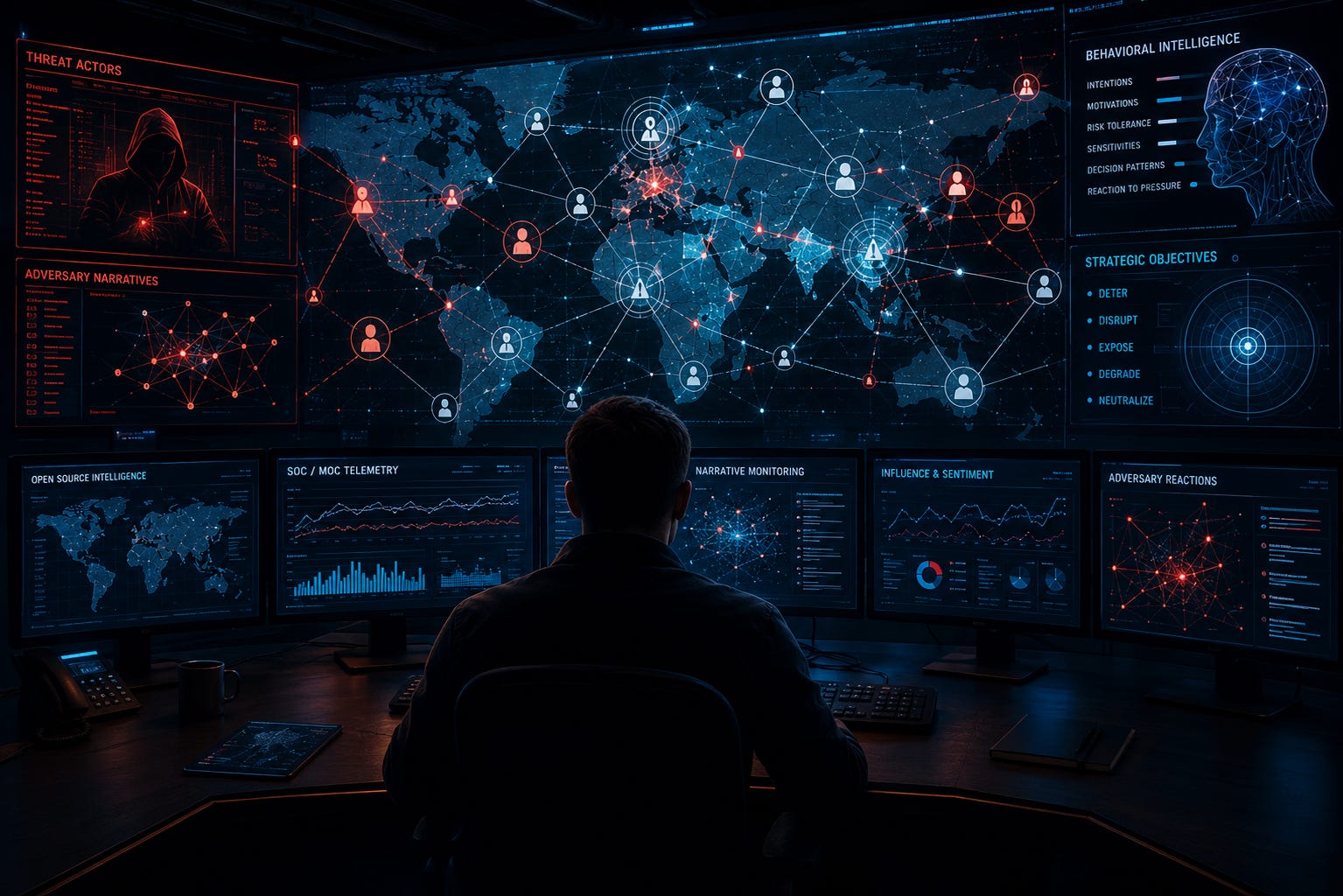
The future of cyber defense will not be decided only by firewalls, sensors, signatures, or automated response. It will also be decided by the ability to understand intentions.
Cybersecurity has traditionally been built around artifacts: malware samples, IP addresses, indicators of compromise, command-and-control infrastructure, exploit chains, lateral movement, privilege escalation, and exfiltration patterns.
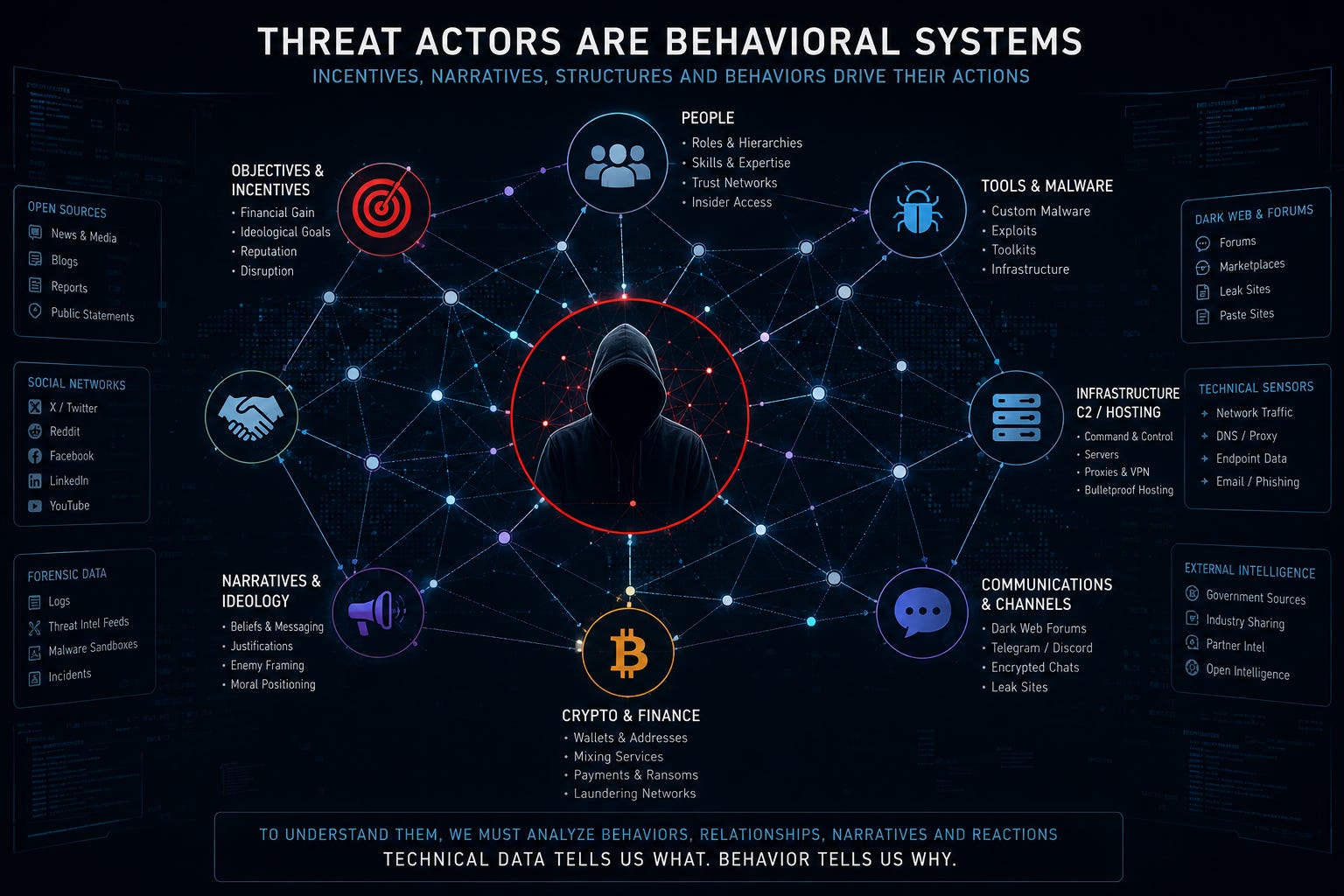
But threat actors are not artifacts. They are organizations.
They have incentives, narratives, internal hierarchies, risk thresholds, operational rituals, fears, ambitions, and cognitive vulnerabilities. A ransomware group is not merely a technical adversary. A state-aligned cyber unit is not merely a set of TTPs. A cybercriminal ecosystem is not simply a collection of wallets, domains, and aliases.
They are human systems operating through digital means.
This is where psychological action becomes relevant to cybersecurity.
Not as propaganda. Not as manipulation for its own sake. Not as uncontrolled influence. But as a disciplined, defensive, intelligence-led capability for understanding, exposing, deterring, and disrupting hostile cyber organizations.
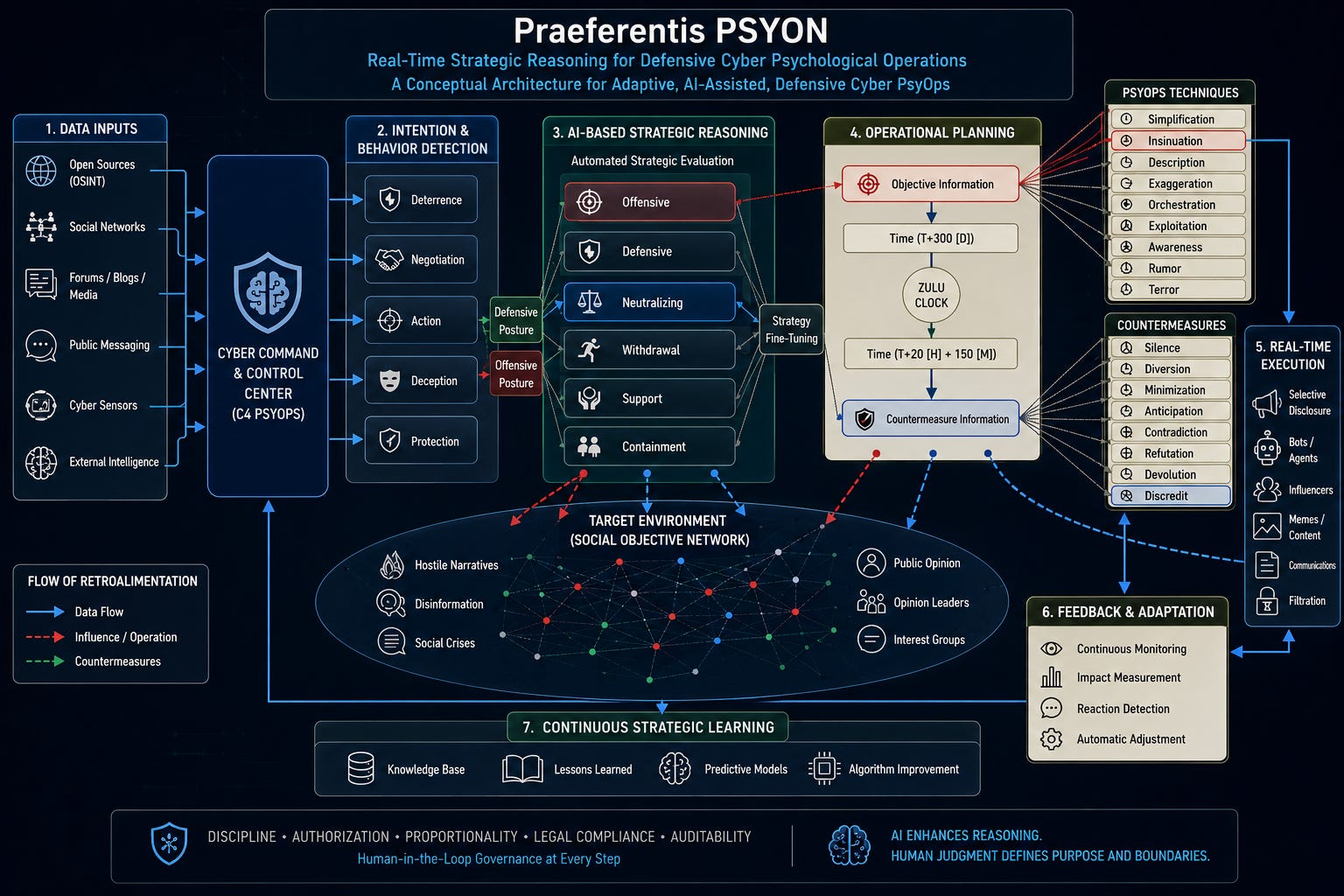
Praeferentis PSYON is my conceptual framework for this problem: the planning and execution of cyber psychological operations in real time, based on automatic strategic reasoning.
From cybersecurity to cyber-behavioral intelligence
Psychological action, in classical doctrine, is a systematic process of communication designed to shape ideas, attitudes, perceptions, motivations, and conditioned responses. Its objective is not merely to transmit information, but to induce behavioral effects in individuals, groups, or organizations.
In the cyber domain, this logic must be treated with extreme care.
The objective is not to deceive populations, manipulate citizens, or automate propaganda. The relevant defensive use case is much narrower and more disciplined: to detect, identify, characterize, deter, and disrupt hostile cyber groups.
A cyber threat actor can be studied not only through technical telemetry, but through behavioral signals:
their reaction to exposure;
their sensitivity to attribution;
their dependence on reputation;
their internal coordination patterns;
their choice of victims;
their narrative discipline;
their public messaging;
their operational tempo;
their tolerance for risk;
their response to uncertainty.
This is cyber-behavioral intelligence.
It complements traditional cyber threat intelligence by asking a different question.
Not only: what are they doing?
But also: what do they believe is happening, what do they want others to believe, and how do they change behavior when the environment changes?
The psychological layer of cyber conflict
Cyber conflict already contains a psychological layer.
Ransomware operators use fear, deadlines, humiliation, reputational damage, and controlled leaks. Hacktivist groups use symbolic targeting, public claims, moral narratives, and media amplification. State-linked actors use ambiguity, deniability, signaling, intimidation, and selective disclosure.
The psychological layer is already present.
The problem is that defenders often treat it as noise.
Praeferentis PSYON treats it as signal.
A hostile group’s communications, claims, silence, exaggerations, denials, rebranding attempts, leaks, and reactions to pressure can all reveal aspects of its internal structure and strategic posture.
For example, a group that rapidly denies an attribution may reveal sensitivity to sponsor exposure. A group that overclaims capability may reveal a need for recruitment or market credibility. A group that suddenly changes its messaging after public reporting may reveal operational dependency on reputation. A group that attacks symbolic targets may be optimizing for perception rather than technical effect.
These are not merely public relations details.
They are intelligence artifacts.
Concurrent MD² PsyOps
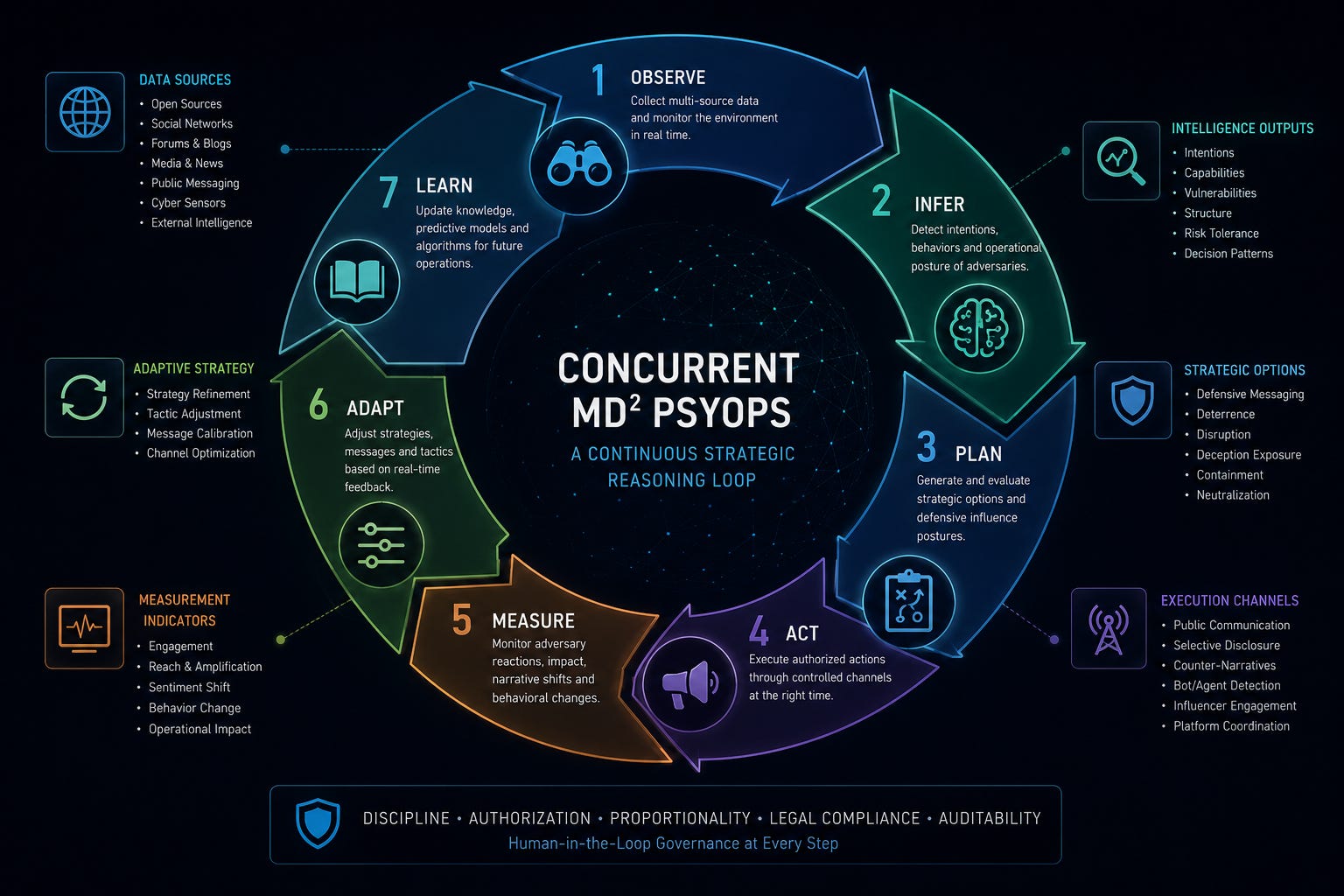
The model I call Concurrent MD² PsyOps is based on a simple premise: psychological action in cyberspace should not be linear, slow, or detached from operational intelligence.
It must be concurrent.
It must be adaptive.
It must be measured.
It must be connected to the defensive architecture of SOCs, MOCs, cyberintelligence platforms, and operational response systems.
The purpose is not to “win an argument” in the information space. The purpose is to generate observable reactions from hostile actors, allowing defenders to infer intentions, capabilities, vulnerabilities, organizational structure, and decision-making patterns.
This means that psychological action becomes part of the detection and response loop.
A defender observes the environment, identifies behavioral indicators, selects a defensive influence posture, measures adversarial reactions, updates the model, and adjusts the strategy.
The cyber operation becomes cognitive.
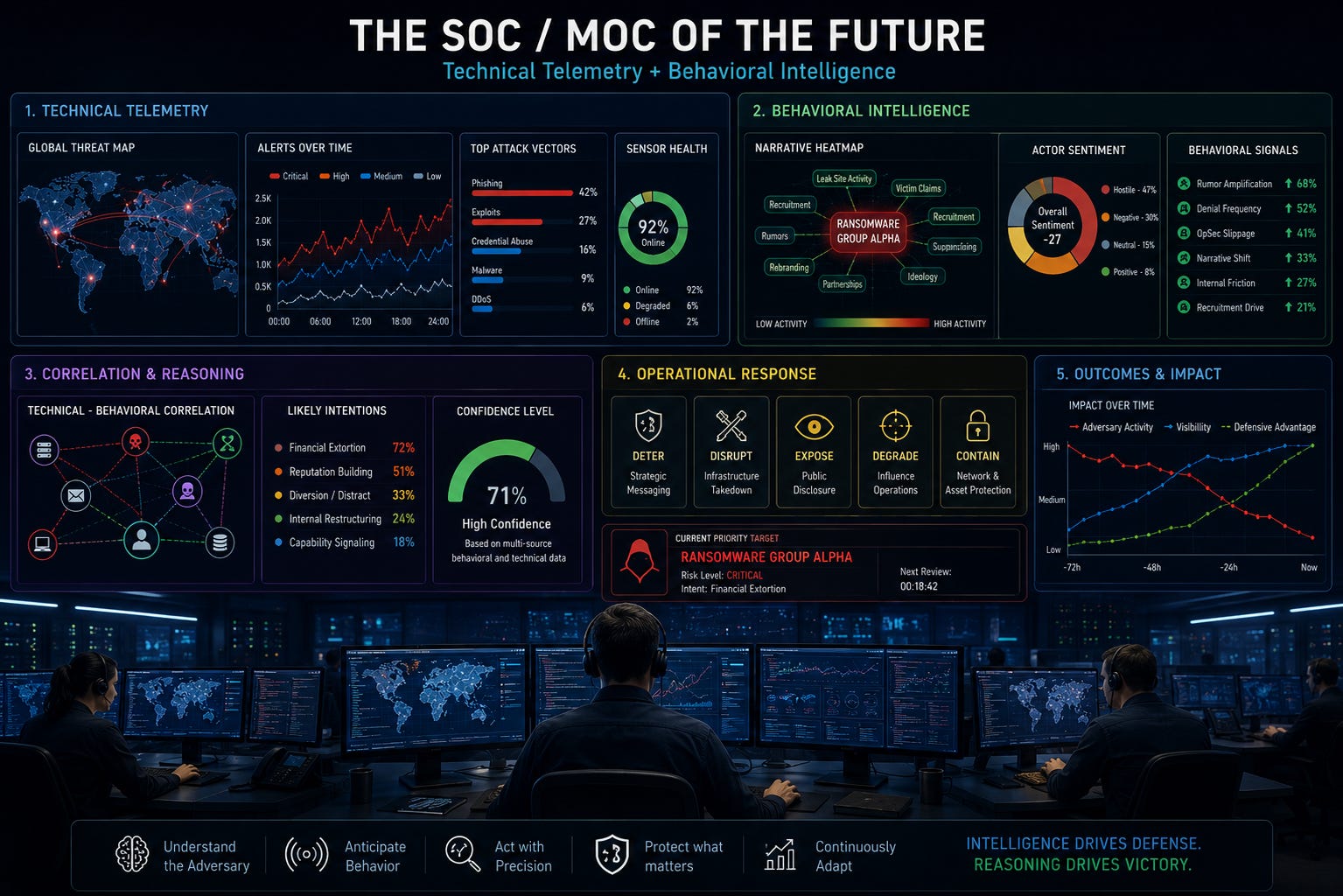
The SOC becomes not only a detection center, but also a behavioral observatory.
The MOC becomes not only an operational hub, but also a strategic reasoning node.
Techniques as strategic instruments
Classical psychological action includes a wide set of techniques: simplification, overexposure, description, exaggeration, orchestration, awareness, exploitation, rumor, silence, diversion, minimization, anticipation, contradiction, refutation, decentralization, and discredit.
In an uncontrolled environment, these techniques can become dangerous.
In a defensive cyber context, they should be treated as controlled strategic instruments, subject to doctrine, authorization, legal boundaries, proportionality, auditability, and human oversight.
The relevant question is not: how can we influence people?
The relevant question is: which defensive communication posture produces the clearest, safest, and most measurable intelligence effect against a hostile cyber organization?
This distinction is essential.
A defensive system should not autonomously generate propaganda. It should not target civilians. It should not manipulate populations. It should not fabricate evidence. It should not escalate conflict without authorization.
Instead, it should help expert operators reason about adversarial psychology.
It should model likely reactions.
It should recommend safe courses of action.
It should estimate operational risk.
It should detect when a hostile group is reacting to pressure.
It should identify when a narrative shift indicates fragmentation, panic, deception, or strategic repositioning.
This is the legitimate role of AI in cyber psychological operations: not autonomous manipulation, but automatic strategic reasoning under human command.
Why real time matters
Cyberattacks unfold at machine speed.
Narratives now move at platform speed.
A ransomware leak site can publish claims instantly. A Telegram channel can mobilize thousands of followers in minutes. A false attribution can circulate before a SOC has completed initial triage. A hostile actor can observe public reporting and change infrastructure, tooling, or messaging within hours.
Traditional psychological operations were designed for slower cycles.
Cyber psychological operations require real-time adaptation.
That is why AI becomes structurally important.
The AI system is not valuable because it “generates content.” That is the least interesting capability.
The real value is strategic reasoning.
It must detect weak signals across open sources, social networks, forums, blogs, media, public messaging, cyber sensors, and external intelligence feeds. It must classify intentions and behaviors. It must distinguish negotiation, deception, action, deterrence, and protection dynamics. It must evaluate offensive, defensive, neutralization, retreat, support, and containment postures. It must recommend proportional and authorized actions. It must monitor reactions and continuously refine the strategy.
This is not a chatbot problem.
It is a command-and-control reasoning problem.
Praeferentis PSYON as an architecture
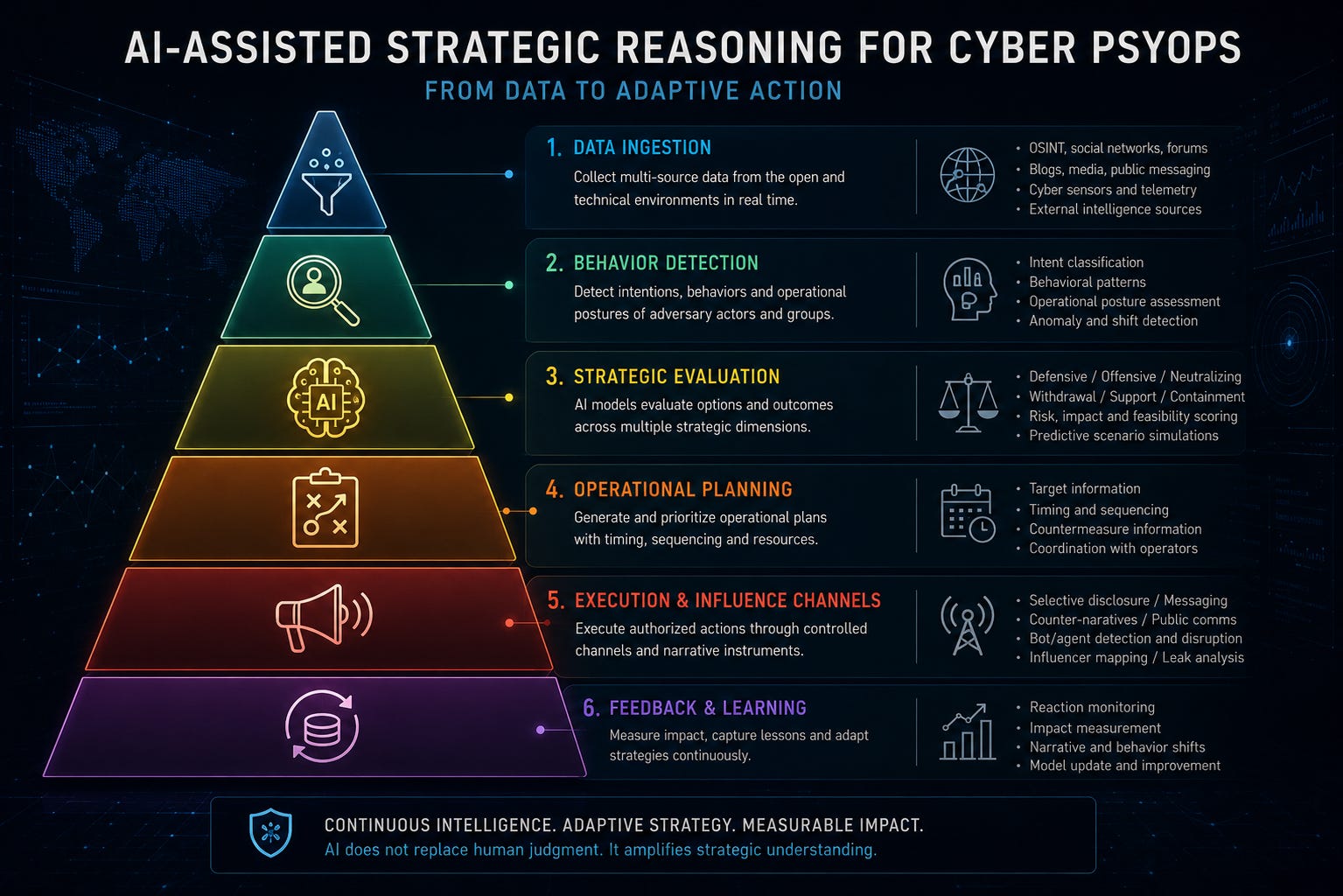
The Praeferentis PSYON architecture contains seven conceptual layers.
The system ingests data from open sources, social networks, forums, blogs, media, public messaging, cyber sensors, and external intelligence sources.
It detects intentions and behaviors. The goal is not only to identify hostile content, but to infer operational posture: deterrence, negotiation, action, deception, protection, or preparation.
An AI-based strategic reasoning layer evaluates possible responses. This is where the system compares defensive, offensive, neutralizing, withdrawal, support, and containment strategies.
The system generates an operational plan. This includes target information, timing, countermeasure information, sequencing, and coordination with authorized operators.
Execution happens through controlled channels. These may include selective disclosure, public communication, counter-narrative positioning, bot and agent detection, influencer mapping, content monitoring, official statements, or leak analysis.
Feedback is measured continuously. The system monitors reactions, impact, narrative shifts, behavioral deviations, and adversarial adaptation.
The system learns. It updates its knowledge base, lessons learned, predictive models, and algorithmic performance.
This is the key point: the architecture is not a one-shot influence mechanism.
It is a continuous strategic learning system.
The defensive value for SOCs and MOCs
For SOCs and MOCs, this approach offers several strategic advantages:
It can improve early warning by detecting behavioral preparation before technical execution.
It can support deterrence by identifying which adversarial groups are sensitive to exposure, disruption, reputation loss, or operational uncertainty.
It can improve attribution by correlating technical indicators with behavioral reactions.
It can reveal organizational structure by observing who reacts, who amplifies, who denies, who remains silent, and who changes operational rhythm.
It can support incident response by anticipating adversarial communication strategies after containment, disclosure, or law enforcement action.
It can also help defenders distinguish between genuine capability and psychological theater.
This last point is critical.
Many cyber actors operate in the space between technical damage and perceived damage. They exploit uncertainty. They create fear. They use ambiguity as a weapon.
A defensive cyber organization must therefore learn to measure not only compromise, but perception.
Not only intrusion, but influence.
Not only malware, but behavior.
The governance problem
Any system capable of psychological reasoning must be governed with exceptional discipline.
Without governance, cyber psychological operations can become indistinguishable from manipulation, propaganda, or escalation.
Therefore, a defensive Praeferentis PSYON system must include hard constraints:
human authorization;
legal review;
mission scope control;
targeting restrictions;
audit logs;
proportionality checks;
escalation thresholds;
content provenance;
red-team evaluation;
model behavior monitoring;
and explicit separation between defensive cyber operations and population influence.
AI should not be allowed to decide psychological effects autonomously.
It should support expert reasoning.
It should generate options, not uncontrolled actions.
It should expose assumptions, uncertainty, and risk.
It should help operators understand the adversary without turning the defensive organization into the same type of actor it is trying to counter.
This is the strategic paradox of cyber psychological operations: to understand influence without becoming captured by it.
Toward BioNeuroCognitive cyber defense
The deeper implication is that cybersecurity is moving from a purely technical discipline toward a BioNeuroCognitive discipline.
The “bio” layer concerns human systems, incentives, stress, trust, identity, and collective behavior.
The “neuro” layer concerns perception, attention, salience, fear, memory, and decision-making.
The “cognitive” layer concerns reasoning, belief formation, deception, planning, and adaptation.
Cyber conflict operates across all three.
A purely technical defense will remain necessary, but insufficient. We will still need EDR, XDR, SIEM, SOAR, CTI, attack surface management, identity security, deception environments, and incident response. But these systems must be connected to a higher-order reasoning layer capable of interpreting adversaries as adaptive cognitive systems.
That is the purpose of Praeferentis PSYON.
Not to automate propaganda.
Not to replace human judgment.
Not to create uncontrolled influence engines.
But to give cyber defenders a disciplined framework for strategic reasoning in the psychological dimension of cyber conflict.
Because the next battlefield is not only the network.
It is the adversary’s model of the network.
It is not only the attack path.
It is the decision path.
It is not only the compromise.
It is the mind behind the compromise.
Final thought
Cybersecurity has spent decades learning how to detect machines.
The next stage is learning how to reason about adversaries.
Praeferentis PSYON is a step in that direction: an architecture for real-time defensive cyber psychological operations, where AI is used not as an autonomous manipulator, but as a strategic reasoning system under human command.
The future SOC will not only ask: What happened?
It will ask:
What did the adversary intend?
What reaction are they seeking?
What behavior will reveal them?
What defensive signal will change their calculus?
That is where cyber defense becomes strategic.
And that is where psychological intelligence becomes part of the architecture.