

Hybrid threats are not linear threats. They are adaptive systems.
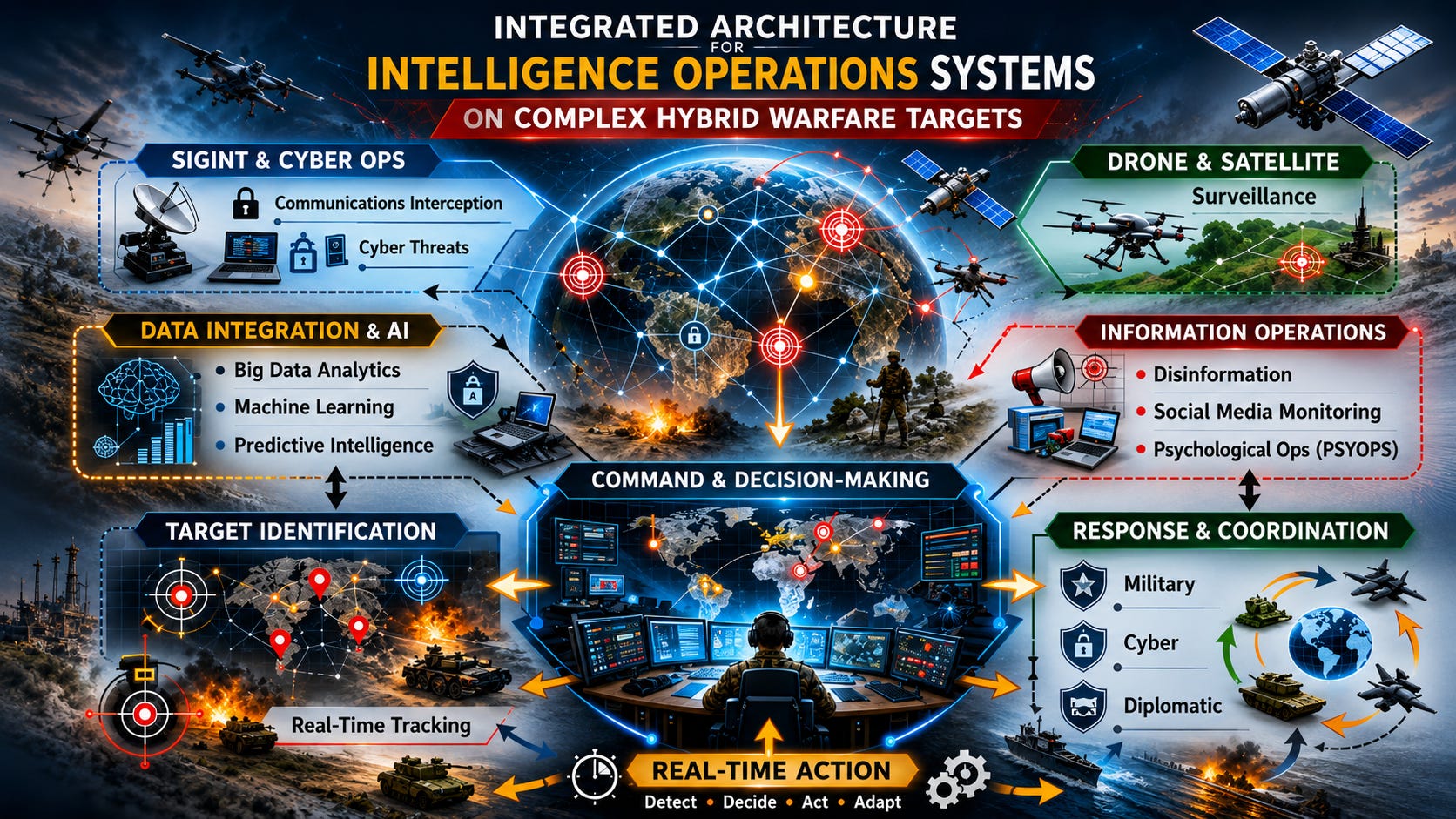
They combine military pressure, cyber operations, organized crime, terrorism, disinformation, financial disruption, drone activity, electromagnetic effects, and social destabilization. They do not operate through a single channel. They spread across institutions, networks, infrastructures, markets, media ecosystems, and human perception.
That is why conventional intelligence models are increasingly insufficient.
The central problem is no longer only to collect more information. The problem is to reason operationally across complex, unstable, asymmetric target systems in real time.
This article introduces an unclassified summary of my R&D work applying BioNeuroCognitive Complex Reasoning Systems Architectures to the generation and deployment of critical real-time, permanent and transient, adaptive, evolving, and autonomous intelligence operations networks for hybrid warfare threats.
The model is an AI-based systemic interpretation of Robert M. Clark’s target-centric intelligence approach.
I call this architecture: TCOPS-V2 Global Solution.
Its objective is to provide superiority in intelligence operations across military, criminal, terrorist, and corporate threat environments by expanding the capabilities of current systems and adopting AI-based security, defense, and warfare doctrines.
The new character of hybrid threats
The most important feature of current threats is their asymmetric character.
Hybrid warfare, organized crime, terrorism, hostile corporate intelligence, cyber-enabled coercion, and mass-effect attacks are not isolated phenomena. They are transversal, combinatorial, and contagious.
They are transversal because they cut across domains.
They are combinatorial because they can merge different attack vectors into one operational effect.
They are contagious because disruption in one system can propagate into others.
A cyberattack can trigger a financial crisis. A drone incident can generate political panic. A disinformation campaign can amplify the effects of a physical attack. A terrorist cell can use criminal logistics, cyber tools, financial channels, and social media narratives simultaneously.
This means that intelligence operations must evolve from static collection cycles to adaptive systemic reasoning.
The intelligence system must not simply answer: What happened?
It must answer:
What is forming?
What system is emerging?
Which target network is being activated?
Which relationships matter?
Which weak signal indicates catastrophic potential?
Which response architecture can be assembled before the attack matures?
This is the domain of TCOPS-V2.
From intelligence cycle to target-centric intelligence operations
Traditional intelligence cycles were designed for a slower world.
They separate collection, processing, analysis, dissemination, and decision-making into sequential stages. This remains useful, but it is insufficient against adaptive threats that move across physical, cyber, cognitive, social, and financial environments.
Clark’s target-centric intelligence model offers a stronger alternative.
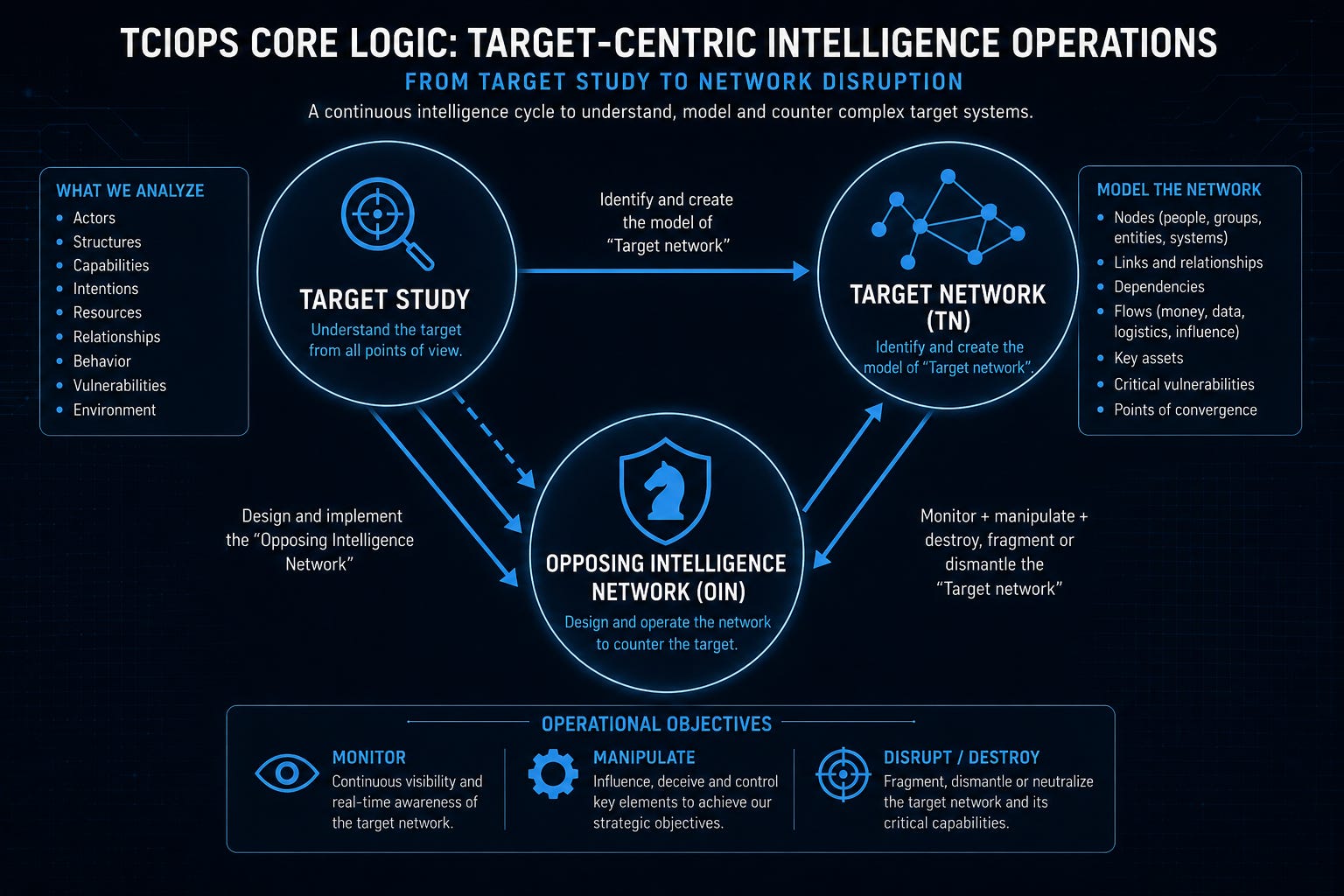
It places the target at the center of the intelligence process. The goal is not simply to process information, but to construct and continuously refine a living model of the target.
In TCOPS-V2, this target-centric logic is transformed into an operational architecture.
The system studies the target from multiple perspectives:
It models the target’s structure, composition, behavior, dependencies, intentions, resources, and vulnerabilities.
It defines the Target Network.
It designs an Opposing Intelligence Network: an intelligence structure configured to observe, understand, contain, and counter the target network.
It operates that opposing network under legal, strategic, and human command constraints.
And when the operation ends, it dismantles the temporary structures and preserves the generated intelligence safely.
Targets are systems
The fundamental principle is simple: All targets are systems.
A target is not merely a person, organization, facility, server, cell, platform, or event. It is a system of relationships:
Every target has structure.
Every structure has functions.
Every function produces signals.
Every signal can be connected to evidence.
Every evidence chain can support hypotheses.
Every hypothesis can be verified, refuted, or replaced.
This is why TCOPS-V2 treats intelligence as a continuous modeling process.
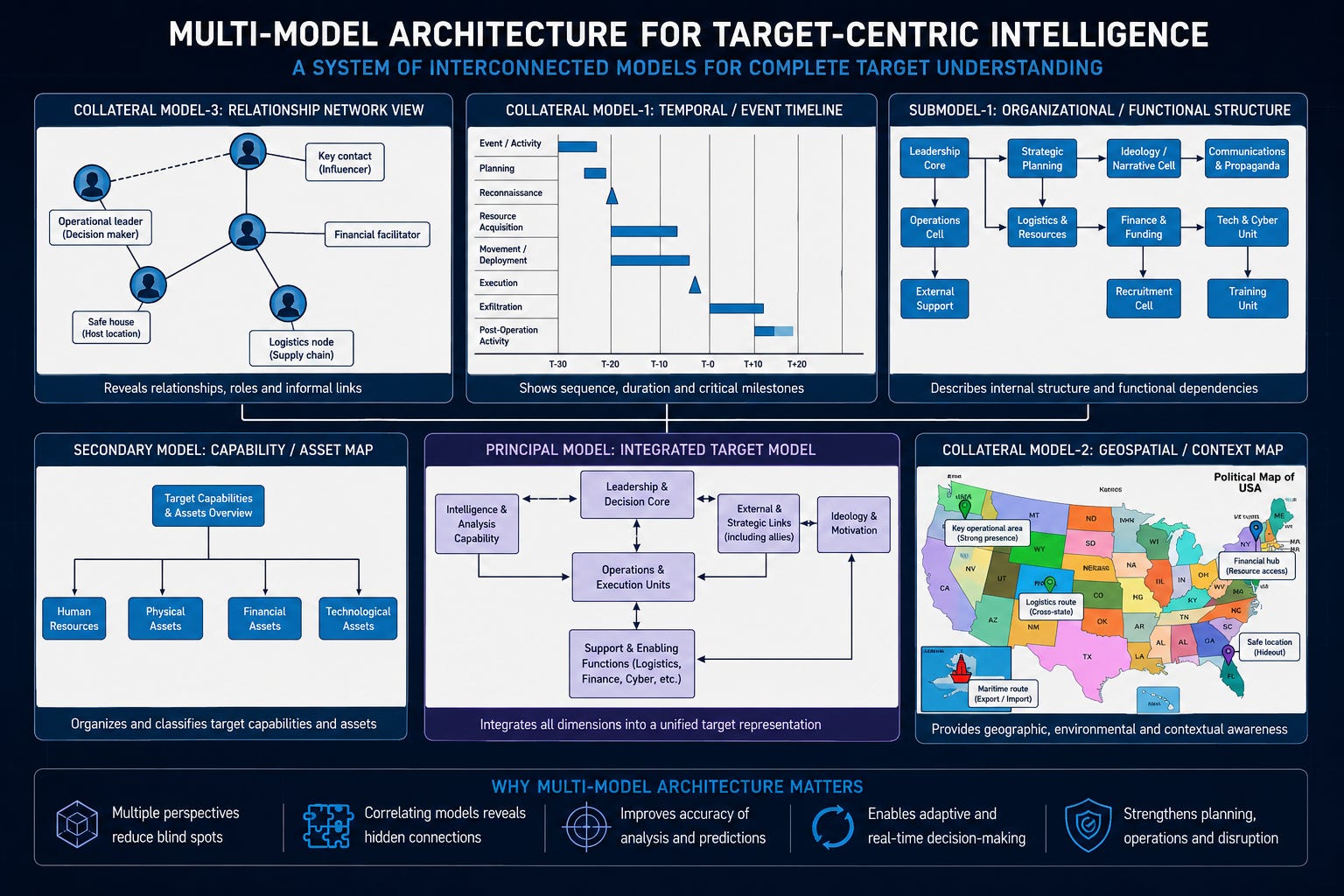
A target must be represented through multiple models:
the relevant model, which captures the main system;
submodels, which capture subsystems;
and collateral models, which provide alternative but informative views of the same target.
Collateral models may be hierarchical, temporal, spatial, process-based, network-based, kinematic, analogical, mathematical, financial, social, or behavioral.
No single model is enough.
The objective is not to create a beautiful diagram. The objective is to create an operationally useful representation of reality.
Intelligence as BioNeuroCognitive Reasoning
Intelligence is not just data processing.
From a process perspective, intelligence is a mental activity oriented toward understanding the meaning of what is happening.
This is why BioNeuroCognitive Complex Reasoning Systems Architectures are central to TCOPS-V2.
The “bio” dimension refers to human systems: motivation, stress, trust, group dynamics, incentives, fear, loyalty, identity, and survival logic.
The “neuro” dimension refers to perception: attention, salience, memory, reaction, pattern recognition, emotional triggers, and decision pressure.
The “cognitive” dimension refers to reasoning: hypotheses, evidence, inference, contradiction, refutation, planning, deception detection, and scenario construction.
Hybrid warfare targets operate across all three dimensions:
They are biological because they involve people and organizations.
They are neurological because they act through perception and reaction.
They are cognitive because they plan, adapt, deceive, learn, and exploit ambiguity.
Therefore, the intelligence system must also reason across these dimensions:
It must not only store information. It must construct meaning.
It must not only detect indicators. It must understand relationships.
It must not only describe events. It must infer intentions.
The iterative TCOPS-V2 intelligence process
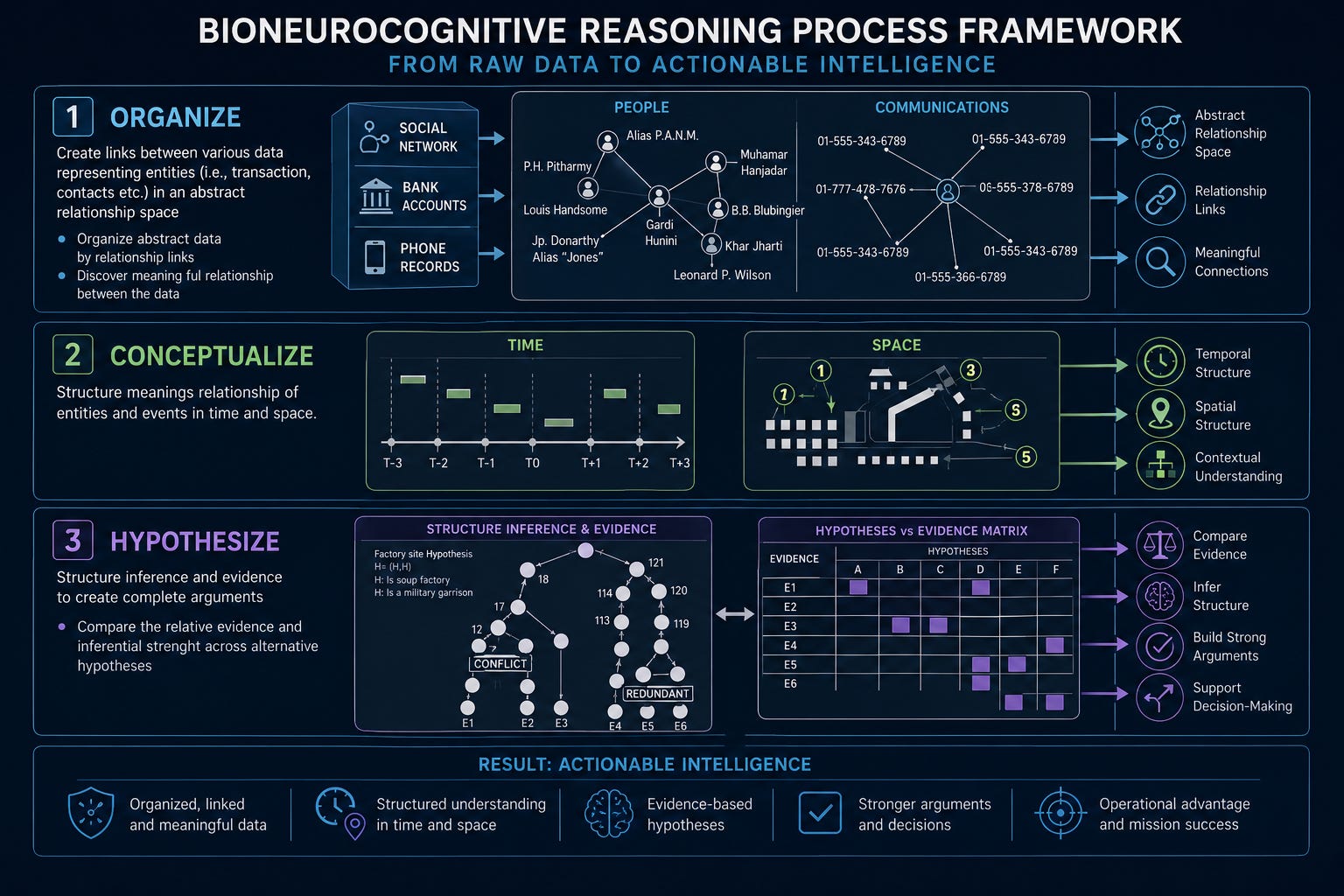
The production of intelligence is continuous, iterative, and incremental.
It is not a one-time report. It is a reasoning loop.
Information is captured and organized according to the problem context and the intelligence product required.
Information elements are decomposed and structured into temporal, spatial, hierarchical, relational, and functional models.
Hypotheses are generated from evidence.
Those hypotheses are verified, refuted, expanded, or replaced.
The intelligence product is updated.
The operational plan is adapted.
The system continues learning.
This is where AI becomes essential.
The AI does not replace the analyst.
The AI expands the analyst’s capacity to model, compare, correlate, simulate, reason, and detect weak signals across complex evidence spaces.
A properly designed TCOPS-V2 system can help operators move from raw intelligence to target hypotheses, from target hypotheses to collection requirements, from collection requirements to virtual intelligence units, and from virtual intelligence units to operational response.
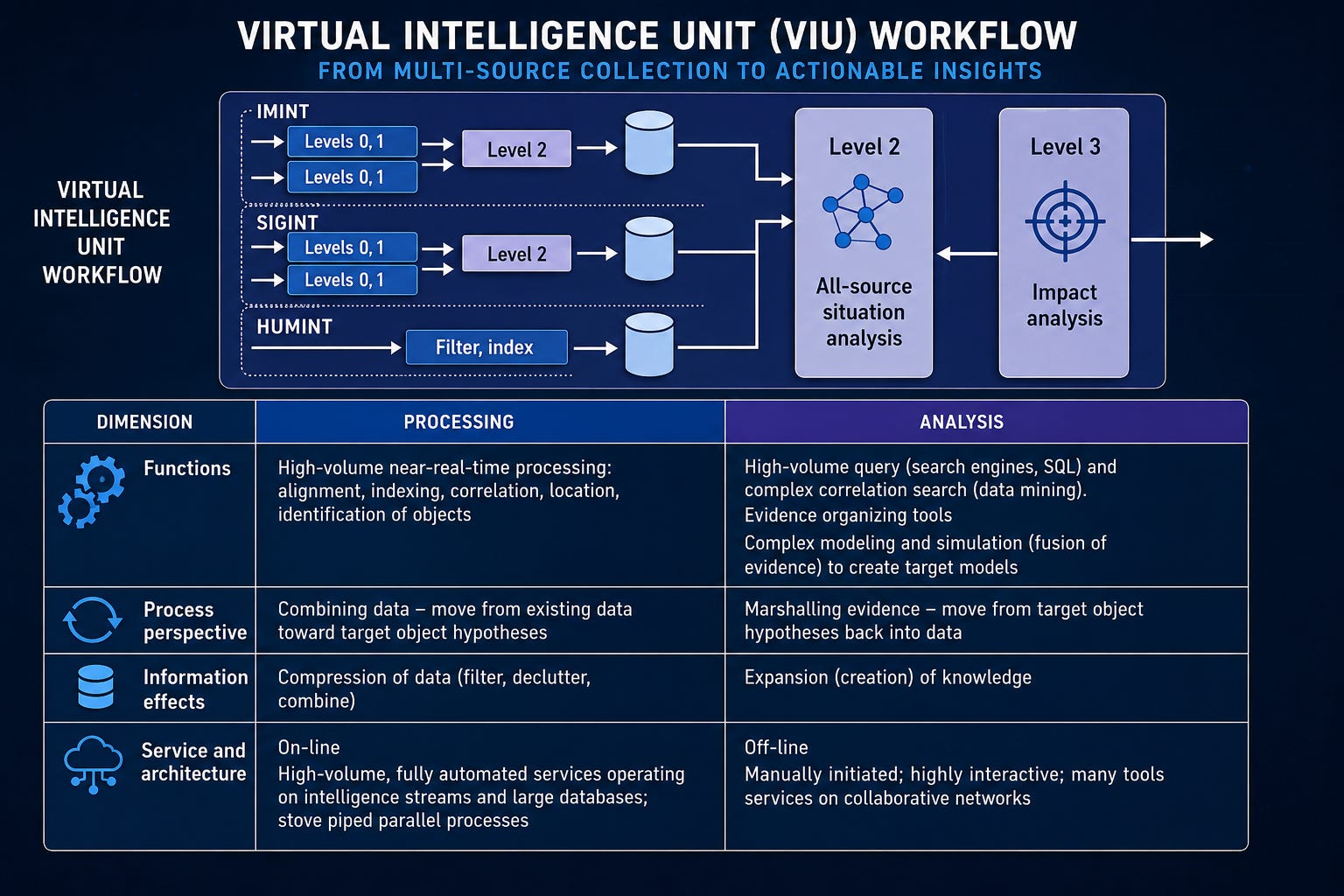
Permanent and transient intelligence units
One of the key contributions of TCOPS-V2 is the distinction between permanent and transient intelligence structures.
Permanent intelligence units are physical, organizationally stable, and responsible for continuity, governance, doctrine, repositories, platforms, training, and long-term institutional memory.
Transient intelligence units are virtual, mission-specific, adaptive, and created in response to a particular target, threat, scenario, or operational need.
This distinction is crucial.
Hybrid threats are not always permanent. Many are temporary coalitions, opportunistic networks, or rapidly assembled attack configurations. A permanent intelligence structure may be too slow or too rigid to counter them alone.
TCOPS-V2 addresses this by creating Virtual Intelligence Units: temporary reasoning structures that can be configured around specific targets, indicators, intelligence requirements, and operational hypotheses.
A Virtual Intelligence Unit may be assigned to a terrorist logistics chain, a cybercriminal infrastructure, a drone-enabled threat scenario, a financial attack pattern, a disinformation network, or a combined WMD/mass-effect risk scenario.
The unit exists because the target exists.
When the target changes, the unit adapts.
When the target disappears, the unit can be dismantled, while its validated knowledge is preserved.
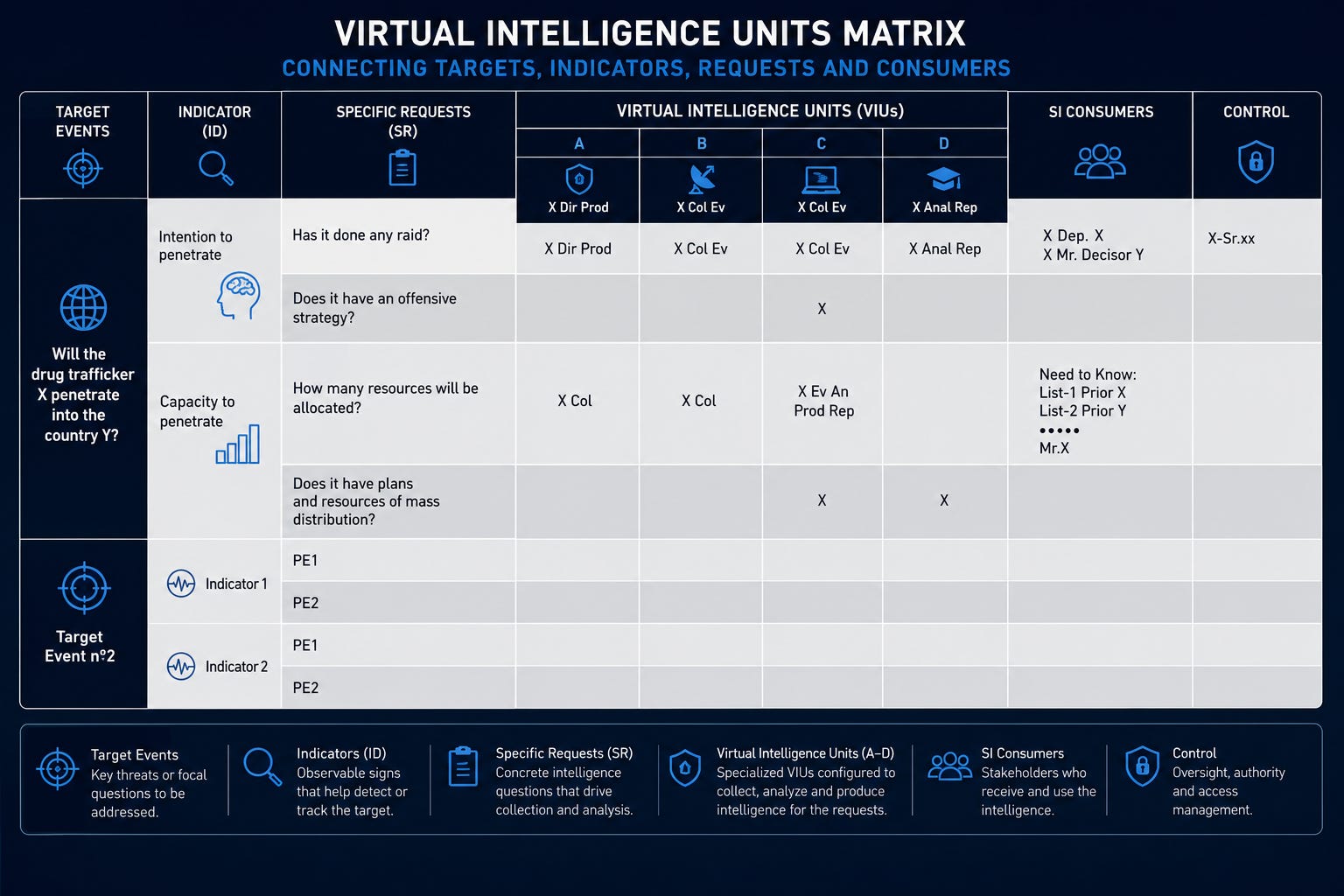
From asymmetric threats to symmetric response
Asymmetric threats are dangerous because they exploit imbalance.
They attack where institutions are slow.
They combine domains that defenders separate.
They use ambiguity where defenders require certainty.
They move through informal networks while defenders rely on formal structures.
The purpose of TCOPS-V2 is to transform asymmetric threats into symmetric problems.
This does not mean mirroring the adversary. It means building an opposing intelligence architecture capable of matching the target’s complexity.
If the threat is networked, the response must be networked.
If the threat is adaptive, the response must be adaptive.
If the threat is multi-domain, the response must be multi-domain.
If the threat is cognitive, the response must reason cognitively.
This is the deeper function of the Opposing Intelligence Network.
It is not simply a monitoring team.
It is a structured, AI-assisted, human-governed intelligence operations system designed to understand the target network as a system and generate appropriate strategic, operational, and tactical responses.
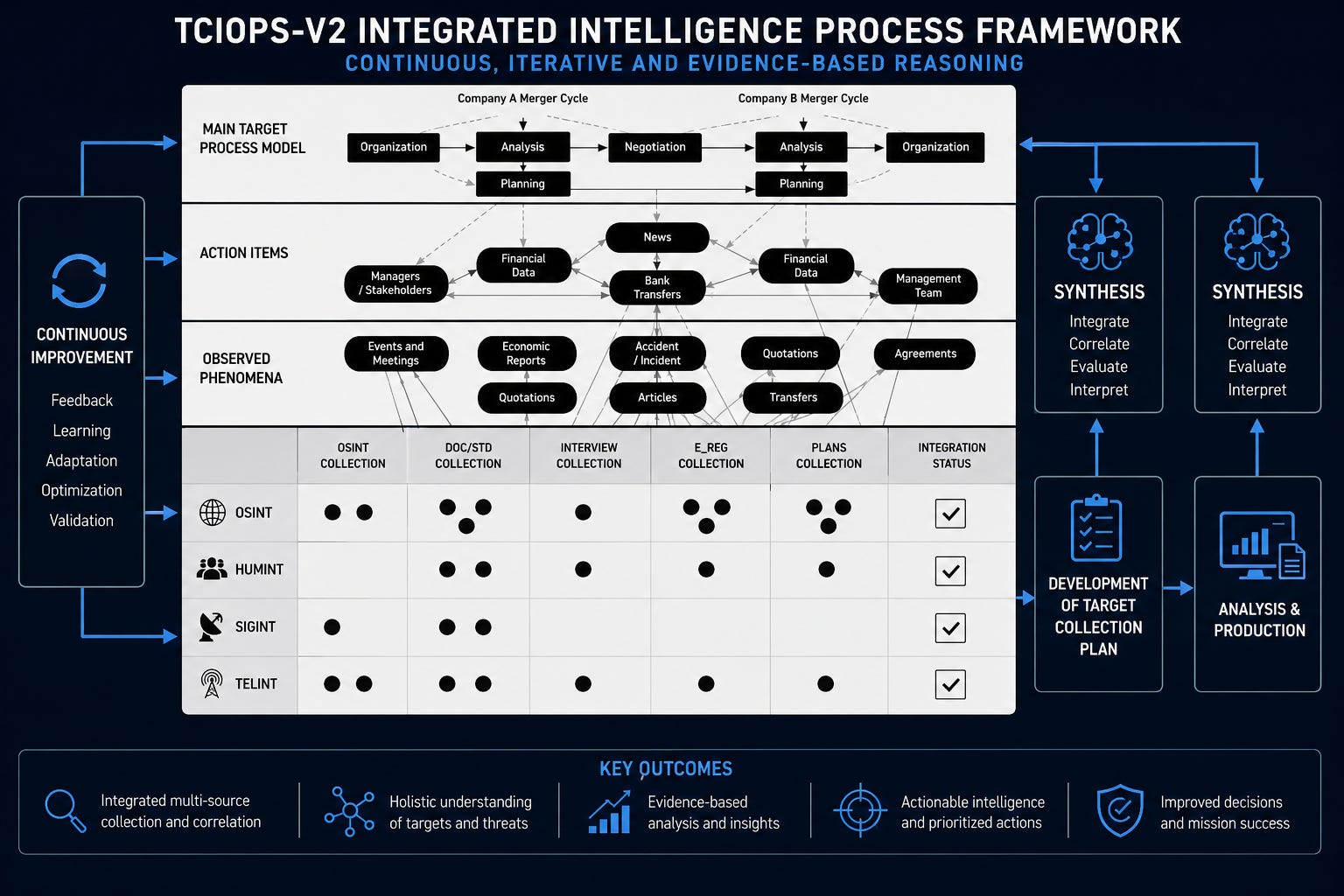
The master intelligence plan
A TCOPS-V2 architecture requires more than tools.
It requires a Master Intelligence Plan.
This plan defines the traceability between strategic objectives, operational intelligence requirements, tactical indicators, virtual units, intelligence consumers, and control mechanisms.
It also defines how evidence is collected, validated, correlated, modeled, and converted into intelligence products.
This is where cognitive engineering becomes critical.
The system must support how analysts actually reason.
It must allow them to organize evidence, compare hypotheses, refute assumptions, detect contradictions, identify missing information, build target models, and generate operationally relevant products.
In this sense, TCOPS-V2 is not only a technological architecture. It is a methodological, organizational, educational, and doctrinal architecture:
It requires platforms.
It requires repositories.
It requires reasoning tools.
It requires training.
It requires governance.
It requires human command.
And it requires a disciplined separation between autonomous analytical assistance and authorized operational decision-making.
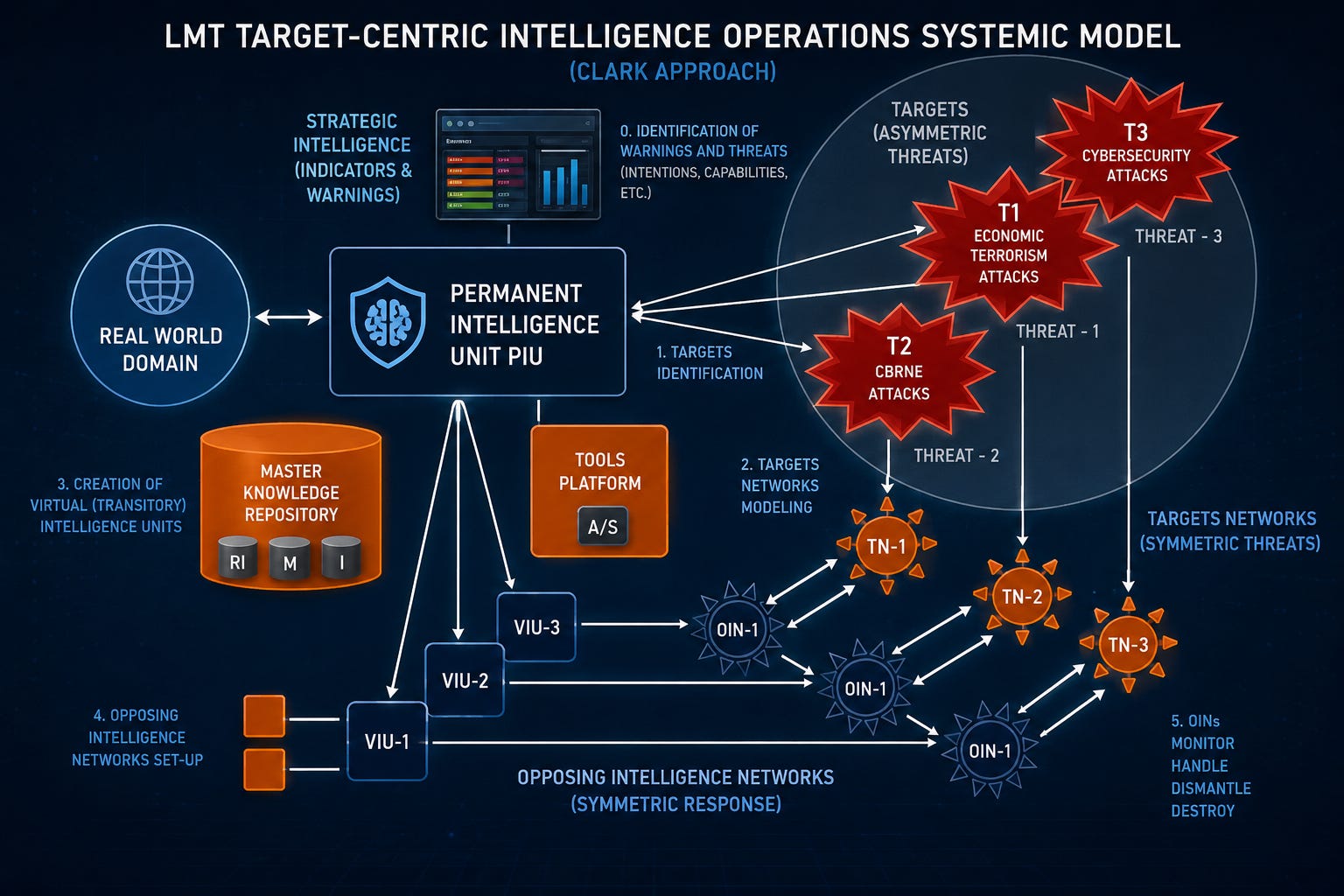
AI-based security, defense, and warfare doctrines
The next generation of intelligence operations will be AI-assisted, but it must not be AI-uncontrolled.
AI-based security, defense, and warfare doctrines must recognize three simultaneous truths.
AI can dramatically expand intelligence capabilities. It can process high-volume data, detect patterns, generate hypotheses, simulate scenarios, correlate evidence, and support real-time operational reasoning.
AI can also amplify error. A bad model can produce false confidence. A biased inference can distort operational judgment. A poorly governed system can escalate risk.
Human command remains non-negotiable. AI should support intelligence reasoning, not replace strategic responsibility.
In TCOPS-V2, AI is used to increase reasoning capacity, not to eliminate accountability.
The system may help construct target models.
It may recommend collection priorities.
It may compare hypotheses.
It may detect anomalies.
It may propose possible courses of action.
It may evaluate risk, cost, benefit, feasibility, timing, and uncertainty.
But the final operational meaning remains a human responsibility.
This is essential because the targets considered in this framework can involve catastrophic scenarios: nuclear, biological, chemical, cyber, drone-enabled, financial, electromagnetic, and other mass-effect threats.
The higher the consequence, the stricter the governance must be.
Toward real-time intelligence superiority
TCOPS-V2 is designed around a specific operational thesis: Intelligence superiority is no longer achieved by having more data. It is achieved by reasoning faster and better across complex target systems.
This requires permanent and transient intelligence networks.
It requires AI-assisted modeling.
It requires target-centric doctrine.
It requires BioNeuroCognitive reasoning.
It requires virtual intelligence units.
It requires repositories of validated knowledge.
It requires continuous feedback.
It requires adaptive operational planning.
And above all, it requires the ability to move from strategic warning to tactical action without losing traceability.
This is what I call real-time operational reasoning.
Not merely real-time data.
Not merely real-time dashboards.
Not merely real-time alerts.
Real-time reasoning.
A system that understands that every target is a system.
Every system has models.
Every model contains hypotheses.
Every hypothesis requires evidence.
Every evidence chain informs action.
Every action modifies the environment.
And every modified environment must be observed again.
Final thought
Hybrid warfare does not attack isolated targets. It attacks systems.
Therefore, intelligence must become systemic.
It must be able to understand actors, relationships, intentions, resources, vulnerabilities, narratives, infrastructures, time, space, and cascading effects as part of one complex operational environment.
TCOPS-V2 Global Solution is my contribution to this problem: an AI-based systemic interpretation of target-centric intelligence, expanded through BioNeuroCognitive Complex Reasoning Systems Architectures and designed for adaptive, evolving, and autonomous intelligence operations networks under human command.
The future of intelligence operations will not be defined by collection alone. It will be defined by the ability to build the right model of the target before the target becomes a disaster.
That is the core of TCOPS-V2. That is the logic of real-time operational reasoning. And that is the next frontier of intelligence superiority.