


Almost two decades ago, we published a short essay on the warp of existence: a reflection on Habermas, Ratzinger, Teilhard de Chardin, structured reasoning, strategic information systems, and the role of intelligent design in helping people and organizations think and live better.
For readers who wish to consult the original source material behind this reflection, We have included a reconstructed English version of the earlier essay and white paper as an attachment at the end of this post.
At the time, the text belonged to a different technological world.
There was no generative AI as we understand it today. There were no large language models in the hands of millions of people. There was no global public debate on AGI, alignment, artificial agency, synthetic cognition, machine-mediated reasoning, or the theological implications of non-human intelligence.
And yet, the core problem was already there.
How should intelligence serve human becoming?
Today we recover and update that old reflection for two reasons.
The first is the publication of Magnifica Humanitas, Pope Leo XIV’s first encyclical, focused on safeguarding the human person in the time of artificial intelligence. The Vatican presents the document explicitly as a response to the “new things” of our time and frames AI through the dignity of the person, the common good, solidarity, subsidiarity, and justice.
The second is Ben Goertzel’s recent and stimulating article, “Pope Leo + Anthropic vs. Teilhard + Transhumanism”, where he introduces a tension that deserves serious attention: on one side, a defensive view of AI as something to contain, regulate, and place under ethical guardrails; on the other, a Teilhardian or cosmist view of AI as part of a broader phase transition in mind, consciousness, and planetary intelligence.
That tension is real.
But it is not enough to choose one side.
The deeper question is this:
Can we design intelligent systems that protect human dignity while also expanding the horizon of human becoming?
This post argues that we can.
But only if we stop treating AI merely as a tool, a threat, a product, or an industrial technology.
AI must be understood as part of the evolving architecture of intelligence itself.
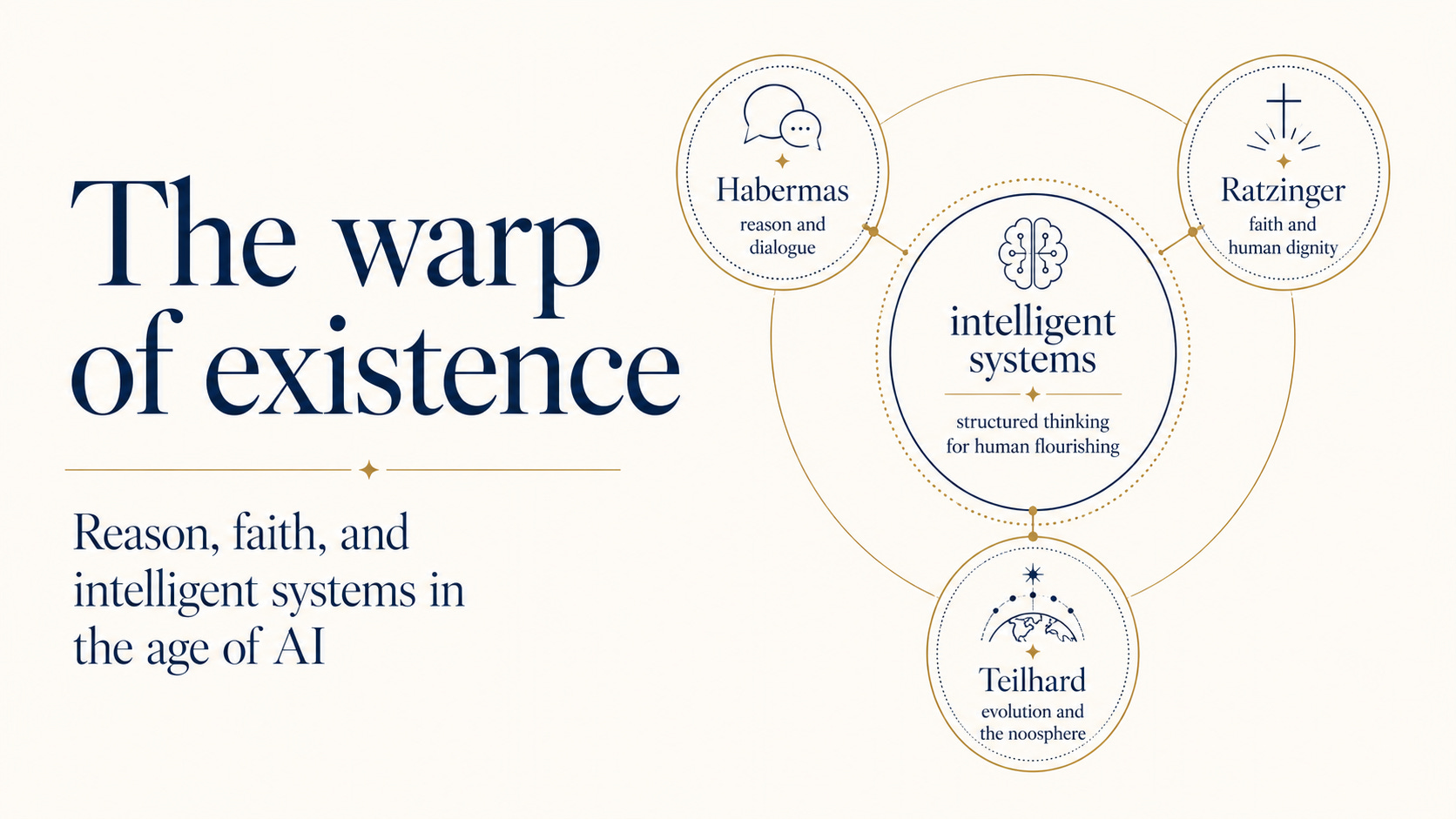
The Warp of Existence.
Reason, faith, and intelligent systems converge around a central question: how should intelligence serve human becoming?
TL;DR
This text revisits a reflection written almost two decades ago on Habermas, Ratzinger, Teilhard de Chardin, structured reasoning, strategic information systems, and intelligent design.
Its central thesis remains current:
Intelligence is not only a cognitive capacity. It is an evolutionary vector.
In the age of AI, this means that intelligent systems should not be designed only to automate tasks, optimize workflows, or increase productivity.
They should help human beings, organizations, and societies:
reason better
perceive more deeply
deliberate more honestly
reduce cognitive error
structure evidence
expand consciousness
preserve dignity
act with responsibility
participate in the evolution of the noosphere
The contemporary AI debate is often trapped between two incomplete positions.
One says: protect humanity from AI.
The other says: use AI to transcend humanity.
The right question is more demanding:
How can AI help humanity become more fully human while opening new forms of intelligence, responsibility, and consciousness?
1. The old question returns
Every human being carries a set of unavoidable questions.
Why am I here?
Where am I going?
What is the meaning of suffering, pleasure, beauty, love, death, sacrifice, failure, and hope?
These are not decorative questions. They form the deep structure of human existence.
Modernity often avoids them. Sometimes it reduces them to private emotion. Sometimes it replaces them with productivity, consumption, ideology, identity, technological acceleration, or procedural ethics.
But the questions remain.
They return whenever a civilization faces a change in the nature of intelligence.
That is exactly what is happening now.
Artificial intelligence is not merely another technological wave. It is not simply a new industrial revolution. It is a transformation in how human beings externalize cognition, produce meaning, distribute agency, generate knowledge, and act upon the world.
This is why the debate about AI cannot be limited to safety, regulation, productivity, or market concentration.
Those issues matter.
But they are not enough.
The deeper issue is anthropological, philosophical, theological, and civilizational.
What is intelligence for?
2. Three voices, one horizon
The old essay selected three European thinkers as reference points: Jürgen Habermas, Joseph Ratzinger, and Pierre Teilhard de Chardin.
They do not belong to the same intellectual family.
Habermas represents the tradition of communicative reason, public dialogue, rational legitimacy, and the fragile possibility of reaching understanding through discourse.
Ratzinger represents the encounter between faith and reason, the defense of human dignity, and the need to prevent both religious irrationalism and secular reductionism.
Teilhard represents the evolutionary imagination: the idea that matter, life, mind, and spirit participate in a process of increasing complexity and consciousness.
Three voices.
One horizon.
The horizon is the possibility that intelligence is not merely an instrument for survival, calculation, or domination.
It may also be the medium through which existence becomes more conscious of itself.
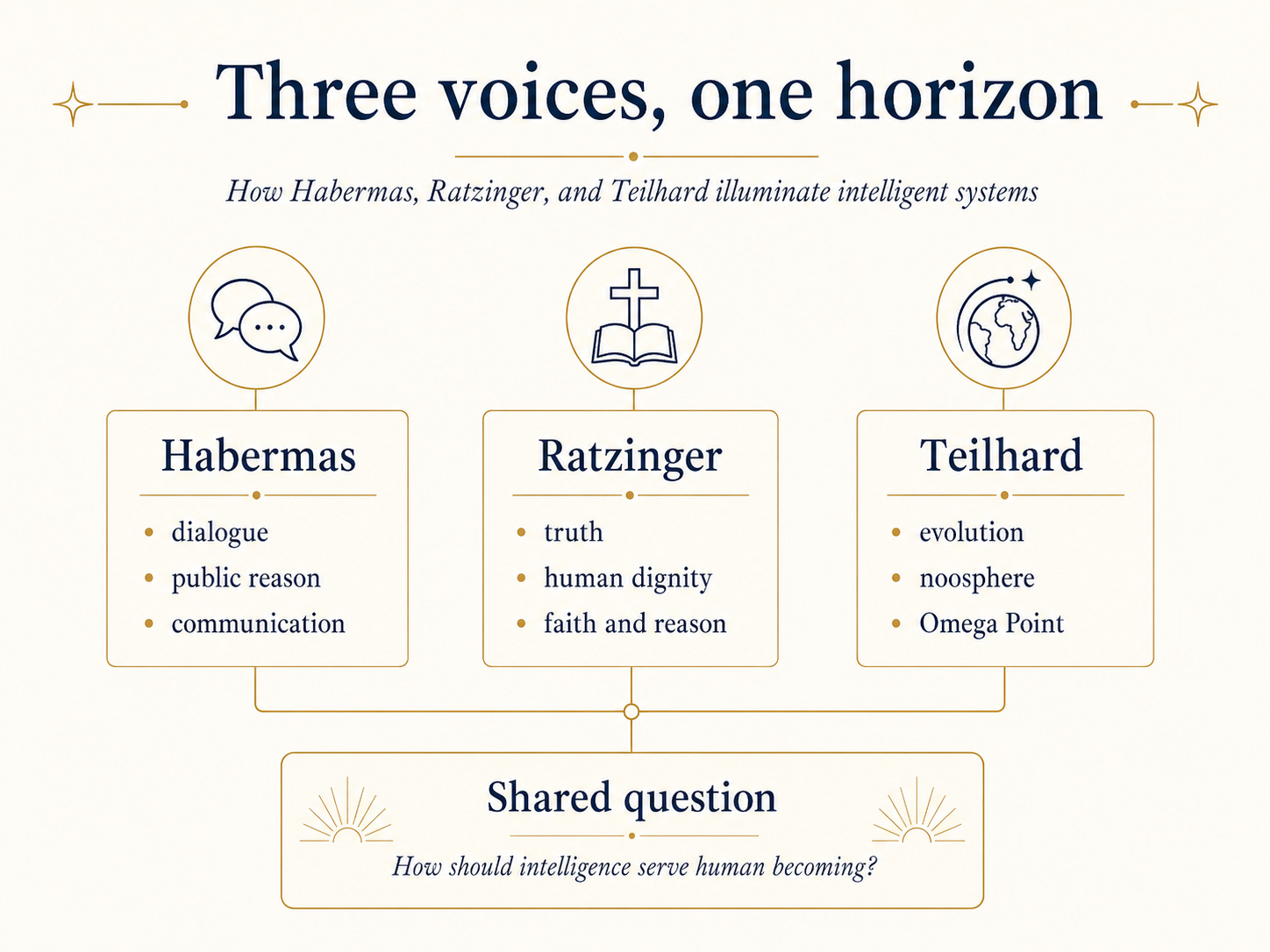
Figure 1 — Three voices, One horizon.
Habermas, Ratzinger, and Teilhard illuminate three complementary dimensions of intelligent systems: public reason, human dignity, and the evolutionary horizon of consciousness.
3. Habermas: intelligence as communication
Habermas helps us understand that intelligence is not only individual cognition.
It is also communication.
A society does not become intelligent merely because its members possess information. It becomes intelligent when it can structure dialogue, expose assumptions, deliberate publicly, correct error, and produce legitimacy through reasoned exchange.
This matters enormously for AI.
A society saturated with AI-generated content may become more informed and less rational at the same time.
It may produce more text and less understanding.
It may accelerate communication while degrading dialogue.
It may simulate consensus while destroying the conditions for legitimate agreement.
From a Habermasian perspective, the central risk of AI is not only misinformation.
It is the corruption of communicative reason.
The question, then, is not only whether AI systems are accurate.
The question is whether they improve or degrade the conditions for rational communication among human beings.
Do they help us deliberate?
Do they make disagreement more intelligible?
Do they clarify assumptions?
Do they expose manipulation?
Do they increase the quality of public reason?
Or do they merely produce persuasive noise?
An intelligent system that does not improve the quality of human communication is not yet a civilizational technology.
It is only a cognitive amplifier without ethical direction.
4. Ratzinger: intelligence under the sign of dignity
Ratzinger helps us understand another danger.
Reason can become instrumental.
When reason detaches itself from truth, dignity, conscience, and transcendence, it becomes a technique of control. It can calculate without wisdom. It can optimize without moral orientation. It can dominate without understanding what it destroys.
This is one of the strongest concerns behind Magnifica Humanitas.
The encyclical’s public framing is clear: AI must be placed at the service of the human person and the common good, not converted into an instrument of domination, exclusion, or death. The Vatican’s presentation also uses the language of “disarming” AI, meaning freeing it from logics that turn technical power against human dignity.
This is not a secondary concern.
AI can concentrate power.
AI can intensify surveillance.
AI can automate exclusion.
AI can degrade work.
AI can mediate social recognition.
AI can manipulate attention, belief, emotion, and desire.
AI can make lethal, economic, educational, administrative, and reputational decisions at scale.
A purely technical view of AI cannot answer these concerns.
A purely market-driven view cannot either.
Ratzinger’s contribution is the insistence that intelligence must remain open to truth and subordinated to the dignity of the person.
But there is a limitation if this position becomes merely defensive.
If we only ask how to protect the human being from AI, we may fail to ask how AI can help the human being become more capable of truth, responsibility, creativity, and transcendence.
Protection is necessary.
But protection is not enough.
5. Teilhard: intelligence as evolution
Teilhard de Chardin brings the missing dimension.
For Teilhard, evolution does not stop with biological life. It continues through consciousness, culture, communication, and spiritual convergence.
Matter becomes life.
Life becomes thought.
Thought becomes collective intelligence.
Collective intelligence opens toward what Teilhard called the Omega Point, interpreted within his Christian framework as convergence in Christ, but also readable more broadly as a horizon of increasing unity, consciousness, and meaning.
This is where the AI debate becomes more interesting.
Ben Goertzel argues that Teilhard offers a much more adventurous frame than a purely defensive ethics of AI. In his reading, Teilhard’s relevance lies in seeing technological and cognitive evolution not as the abolition of humanity, but as the opening of humanity into richer forms of mind and consciousness.
I think this point is important.
But it also needs discipline.
A Teilhardian reading of AI should not become naïve techno-mysticism.
Not every increase in intelligence is an increase in wisdom.
Not every acceleration is evolution.
Not every network is a noosphere.
Not every superintelligence is a spiritual advance.
The noosphere is not the internet.
It is not social media.
It is not the sum of all machine-generated content.
It is not merely planetary computation.
The noosphere, if the concept is to retain its dignity, must mean an increase in structured, responsible, meaningful, and morally oriented consciousness.
AI may contribute to that.
It may also destroy the conditions for it.
That is why design matters.
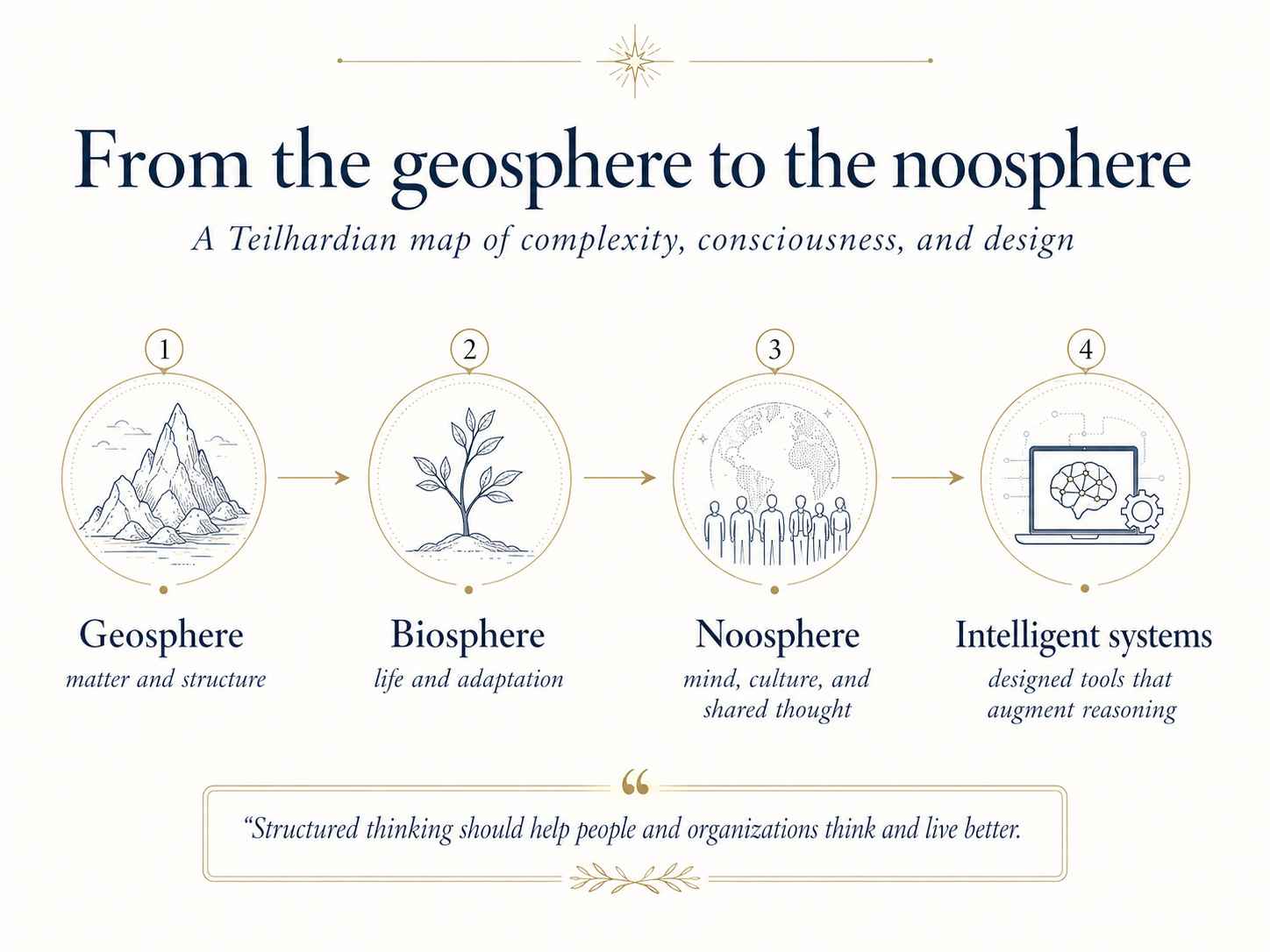
Figure 2 — From the Geosphere to the Noosphere.
A Teilhardian map of complexity, consciousness, and design: matter, life, mind, and intelligent systems as successive layers of organized becoming.
6. The central correction: AI is not automatically transcendence
There is one conceptual error that must be avoided.
It appears both in some techno-optimist visions and in some superficial spiritual readings of AI.
The error is to assume that intelligence automatically produces transcendence.
It does not.
Intelligence can serve truth. It can also serve manipulation.
It can serve life. It can also serve domination.
It can expand consciousness. It can also automate stupidity at planetary scale.
It can help us become more human. It can also make us less capable of attention, judgment, memory, responsibility, and love.
So the real question is not whether AI is “good” or “bad.”
The real question is whether AI is designed, governed, and integrated into human life in a way that increases the quality of consciousness.
This requires more than regulation.
It requires more than innovation.
It requires a doctrine of intelligent design understood not as a theological argument about biological origins, but as a discipline for creating artificial systems that amplify the best capacities of human beings.
7. Intelligent design as pragmatic humanism
In the old white paper, design was presented as a form of pragmatic intellectual work.
The designer is not merely a maker of objects.
The designer observes the world as a system, detects deficiencies, proposes better models, formulates problems for scientific inquiry, provides reference architectures, and creates products, services, processes, and organizations that help people live and act better. The white paper explicitly defines the designer’s main objective as creating systems that help the people who use them “think and live better.”
That formulation is more relevant now than when it was written.
AI design is not interface design.
It is not model selection.
It is not prompt engineering.
It is not automation consulting.
AI design is the prefiguration of artificial cognitive environments in which human beings will increasingly think, decide, learn, work, communicate, create, and remember.
This gives the designer a moral and civilizational responsibility.
The designer of intelligent systems must ask:
What kind of human attention does this system produce?
What kind of reasoning does it encourage?
What forms of dependency does it create?
What types of error does it hide?
What capacities does it amplify?
What capacities does it atrophy?
What communities does it strengthen?
What forms of power does it concentrate?
What forms of freedom does it protect?
What idea of the human person is embedded in the system?
Every intelligent system carries an anthropology.
Even when it pretends not to.
8. Structured reasoning as cognitive dignity
One of the most important ideas in the original documents is the role of structured reasoning.
The argument was simple: human beings and organizations suffer from defective reasoning patterns, cognitive distortions, inherited assumptions, ideological conditioning, poor education, badly processed experience, and various psychological or neurological limitations.
Structured reasoning based on evidence was proposed as a way to identify and repair those processes.
Not by replacing the person.
By helping the person think better.
The original text defines evidence-based structured reasoning as a knowledge-system design product intended to help subjects identify and repair cognitive processes that produce logical fallacies, erroneous behavioral patterns, and distorted visions of the world. It also emphasizes that evidence, not inherited cognitive patterns, should guide our way of seeing and influencing reality.
This is exactly where AI can become valuable.
AI should not be used only to answer questions.
It should help us improve the structure of questioning.
It should not merely generate conclusions.
It should expose reasoning paths.
It should not only summarize information.
It should help us distinguish evidence, inference, assumption, hypothesis, bias, probability, value, and decision.
A system that produces answers without improving reasoning may be useful.
But a system that improves reasoning becomes transformative.
This is the bridge between cognitive AI and human dignity.
To respect the human person is not only to protect the person from harm.
It is to help the person think, judge, decide, create, and act with greater freedom and responsibility.
9. Strategic information systems and the growth of consciousness
The old text also introduced strategic information systems as complementary to structured reasoning.
Structured reasoning improves the use of cognitive capacity.
Strategic information systems feed that capacity with higher-quality information.
Together, they create what the document called Evolutive Intelligence: entities, units, or organizations capable of producing higher-order knowledge and increasingly evolved forms of consciousness.
This idea can now be updated.
In the age of AI, every organization will need three cognitive layers:
Evidence systems
Systems that collect, validate, organize, and contextualize information.Reasoning systems
Systems that structure analysis, test hypotheses, expose assumptions, and reduce cognitive error.Meaning systems
Systems that connect decisions with purpose, dignity, responsibility, and long-term human flourishing.
Most AI implementations today focus on the first two layers.
Very few address the third.
That is why many AI strategies are operationally impressive but philosophically empty.
They optimize.
They automate.
They accelerate.
But they do not know what kind of human future they are serving.
10. Magnifica Humanitas and the Teilhardian challenge
The new Catholic concern with AI is necessary.
Magnifica Humanitas rightly insists that AI must be ordered toward the person, the common good, responsibility, and moral vigilance. It is significant that the document is explicitly framed in continuity with the Church’s social doctrine and with the tradition of responding to the “new things” of each historical period.
But Goertzel’s challenge is also necessary.
If AI is treated only as a danger to be contained, then the theological imagination remains too small.
AI is not only a risk to human dignity.
It is also a mirror held up to our understanding of intelligence, agency, creativity, consciousness, and destiny.
The real challenge is to synthesize both concerns.
We need the safeguards of Magnifica Humanitas.
But we also need the horizon of Teilhard.
We need an ethics of protection.
But also a metaphysics of becoming.
We need to defend the human person.
But also understand that the human person is not a static artifact.
Humanity is historical, developmental, relational, technical, symbolic, spiritual, and unfinished.
The point is not to replace the human.
The point is to cultivate the conditions for a more conscious humanity.
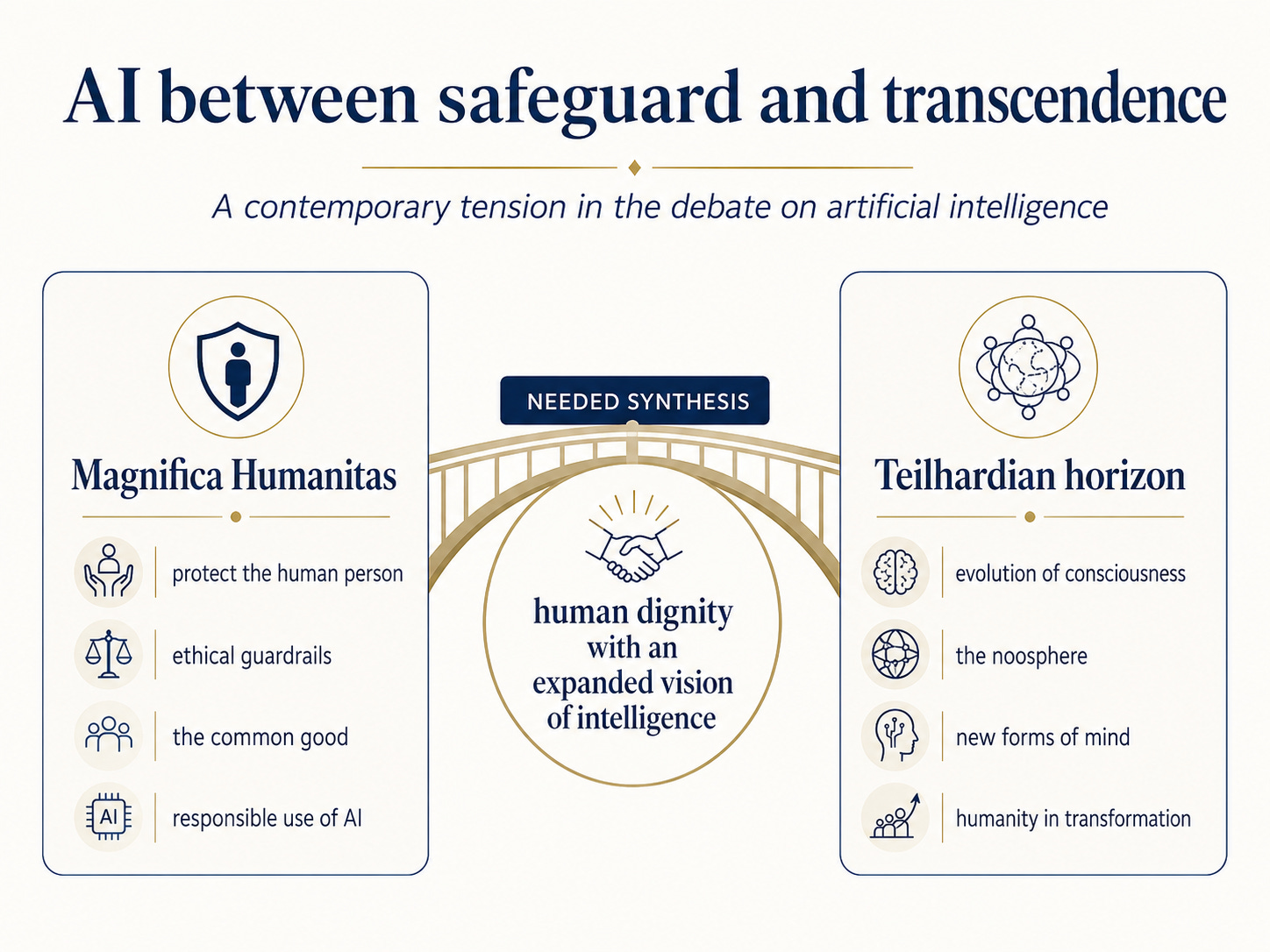
Figure 3 — AI between safeguard and transcendence.
The contemporary AI debate requires a synthesis between human dignity, ethical guardrails, and the Teilhardian horizon of evolving consciousness.
11. The noosphere is a design problem
Teilhard’s noosphere is often described as a sphere of thought surrounding the Earth.
That image is powerful.
But in the age of AI, it is insufficient.
The noosphere will not emerge automatically from connectivity.
Connectivity can produce collective intelligence.
It can also produce collective hallucination.
It can produce wisdom.
It can also produce memetic contagion.
It can produce dialogue.
It can also produce tribal synchronization.
It can produce planetary consciousness.
It can also produce planetary distraction.
The noosphere must therefore be designed.
Not centrally controlled.
Not bureaucratically imposed.
Not reduced to an ideological program.
But designed in the deeper sense: cultivated through systems, institutions, tools, norms, architectures, and practices that increase the quality of collective intelligence.
This requires AI systems that are:
evidence-sensitive
bias-aware
dialogically useful
structurally transparent
human-augmenting
ethically constrained
epistemically humble
oriented toward the common good
capable of supporting complex reasoning
compatible with human dignity and freedom
The noosphere is not a network.
It is a moral and cognitive achievement.
12. What intelligent systems should become
The original documents defined a practical ambition: to create technologies that allow people and organizations to think and live better.
That phrase remains the best design brief.
AI should help people and organizations think and live better.
Not merely faster.
Not merely cheaper.
Not merely with less labor.
Better.
This means that intelligent systems should become:
tools for structured reasoning
instruments of cognitive repair
environments for better judgment
systems for evidence-based deliberation
amplifiers of responsible creativity
safeguards against manipulation
architectures for strategic understanding
companions in learning
supports for human flourishing
contributors to the evolution of collective intelligence
This is a different AI agenda from the one dominating the market.
It is not centered on automation.
It is centered on human becoming.
13. The strategic implication
The next stage of AI will not be decided only by model performance.
It will be decided by the anthropology embedded in the systems we build.
If the human being is treated as a consumer, AI will become an engine of consumption.
If the human being is treated as a worker, AI will become an engine of productivity.
If the human being is treated as a data source, AI will become an engine of extraction.
If the human being is treated as a risk, AI will become an engine of control.
But if the human being is treated as a conscious, relational, unfinished, responsible, and transcendent being, AI can become something else.
A reasoning scaffold.
A strategic intelligence layer.
A cognitive prosthesis.
A tool for the formation of judgment.
A contribution to the noosphere.
A designed environment for the growth of complexity-consciousness.
14. The warp of existence
The warp of existence is made of suffering and beauty, error and truth, fear and courage, finitude and transcendence.
Intelligence does not abolish that warp.
It helps us navigate it.
Structured reasoning helps us see more clearly.
Strategic information helps us understand more deeply.
Design helps us transform intention into reality.
Faith reminds us that intelligence without dignity becomes domination.
Reason reminds us that dignity without truth becomes sentiment.
Teilhard reminds us that humanity is not finished.
Habermas reminds us that intelligence must remain communicative.
Ratzinger reminds us that intelligence must remain open to truth and dignity.
Magnifica Humanitas reminds us that AI must serve the person and the common good.
Goertzel reminds us that AI may also belong to a larger evolutionary drama of mind.
The task now is not to choose between safeguard and transcendence.
The task is to design their synthesis.
Because the future of AI is not only a technical problem.
It is a problem of civilization.
And perhaps, if Teilhard was right, it is also a problem of cosmic responsibility.
