

“Will AI kill us?” is a powerful headline.
It is also an incomplete engineering question.
Which AI? Connected to what? Pursuing whose objectives? Acting with what degree of autonomy? Under whose supervision?
An English-language editorial adaptation of Luis Martín “The Druid”’s return to Voces de OdiseIA, episode 73, published on September 20, 2026. The conversation explores complex reasoning, human responsibility, and the design of intelligent ecosystems.
We are deeply grateful to Frank Escandell for his perceptive questions and remarkable gift for inspiring deep reflection, and, as always, to OdiseIA for its invaluable work.
In his return to Voces de OdiseIA, Luis Martín redirects the discussion from an imagined machine with a will of its own to the systems that people actually design, deploy, and connect to the world. His position is not that AI cannot be dangerous. It is that danger has to be explained, rather than merely announced.
That shift matters for anyone working on complex reasoning, autonomous agents, or human–machine collaboration. It changes the problem from predicting a technological apocalypse to examining objectives, capabilities, interactions, and control.
The question is not only what a machine can do.
It is what kind of system we are creating around it.
1. Recursive self-improvement is a question, not a conclusion
The interview opens with a familiar scenario: an AI system begins researching, designing, and improving its successors, eventually moving faster than humans can supervise. This is the concern described as recursive self-improvement.
Martín challenges the leap from that possibility to a confident prediction of catastrophe. His criticism is directed at the way speculative scenarios acquire the authority of established technical conclusions through repetition.
But skepticism should remain disciplined in both directions. The conversation does not establish that recursive self-improvement is impossible. Nor does it provide a technical demonstration of an imminent, uncontrollable intelligence explosion.
What it offers is a different starting point: look at the mechanisms, the evidence, and the conditions under which a system operates.
A claim about improving a model is not yet a complete account of how that improvement would produce autonomous goals, effective action in the world, or the loss of human control. Those connections have to be explained.
The useful response is neither automatic belief nor automatic dismissal. It is to ask what, precisely, has been observed—and what is still being inferred.
2. Impressive output is not the whole problem of reasoning
Martín’s technical criticism centers on a distinction between producing useful outputs and exercising the kind of complex reasoning he wants to engineer.
He acknowledges the extraordinary utility of generative AI. At the same time, he questions whether its results demonstrate sufficiently robust capacities for weighing evidence, justifying decisions, and dealing with complex, changing situations. His concern is especially strong where mathematical or narrowly specified tasks give way to problems grounded in experience and the open world.
This is Martín’s conceptual critique, not a comparative evaluation establishing that every present-day AI system lacks reasoning.
The underlying engineering question is nevertheless worth preserving: what would count as adequate reasoning for the task we are delegating?
For Martín, the answer involves inference and learning from results, but also the ability to explain and justify a course of action. A system should not merely return something that looks convincing. Its behavior should be understandable in relation to its objectives and the situation in which it acts.
Later, he uses the image of the dancing bear: the audience is so surprised that the bear dances that it may forget to ask how well it dances. Applied to AI, the warning is not to confuse the surprise of a demonstration with an assessment of its underlying capacities.
The point is not to deny useful performance. It is to ask more of systems entrusted with consequential decisions.
3. AI is not only machine intelligence
One of the most constructive parts of the conversation is Martín’s three-part framing of intelligence. It moves the discussion beyond a competition in which machines become stronger while humans simply wait to be replaced.
Machine Intelligence
This is the most familiar domain: artificial systems that process information, learn, infer, and automate tasks. It is important, but in Martín’s account it is only one part of the larger field.
High-Performing Human Intelligence
The second domain concerns improving human cognitive capabilities. Martín emphasizes training and cognitive restructuring. The strategic intention is to strengthen the human capacity to interpret and reason, rather than treating it as a component scheduled for removal.
Dual Intelligent Ecosystems
The third domain brings the first two together: humans and machines working synergistically toward a common good.
This is the most important shift in perspective. We are no longer evaluating only a machine. We are considering the quality of an entire relationship: how people and artificial systems contribute to a shared purpose.
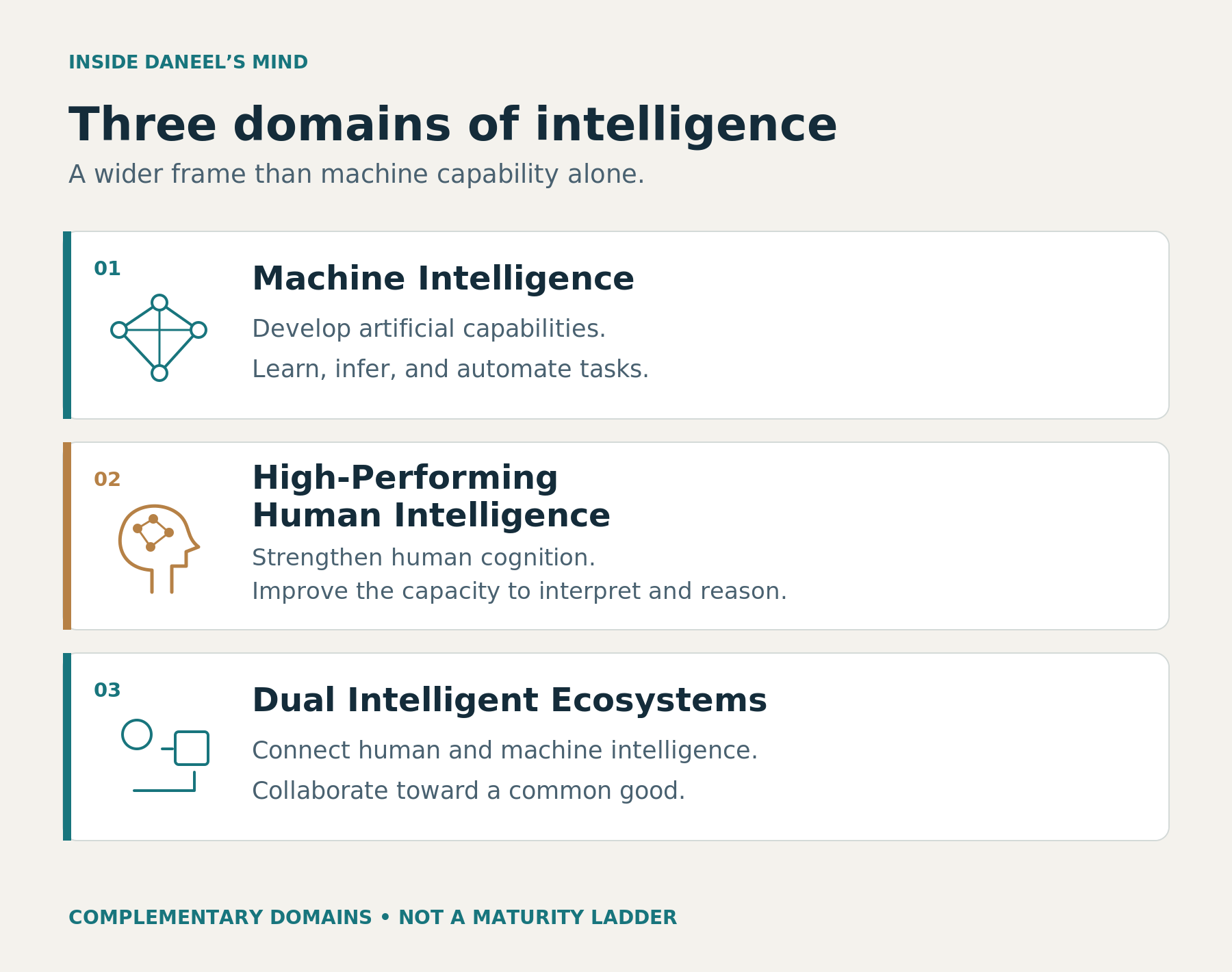
The practical implication is that a better AI future cannot be defined exclusively by stronger machines. It must also include more capable people and better ways of working together.
Replacing human effort and strengthening human intelligence are not the same ambition.
4. Creativity means changing the representation of the world
Asked what observable sign would indicate a more genuinely adaptive intelligence, Martín points to creativity. His definition is specific: the automatic generation of new representations of the world.
In this framing, creativity is not merely the production of an unfamiliar sentence or an attractive image. It involves developing alternative ways of representing a situation and relating those representations to possible action.
He connects three capabilities: learning under external influence, solving problems through experience and adaptation, and generating new knowledge structures. The ambition is a system that can maintain an understanding of a domain while also revising how it understands that domain.
The distinction is between operating within a representation and being able to develop a different one.
That is the research ambition described in the interview. It should not be confused with evidence that a particular architecture has already achieved it, or with an agreed test for superintelligence.
For the discussion of risk, however, it gives the original question more precision. Instead of asking whether a machine seems intelligent, we can ask how it represents its environment, what it can change, and how those changes affect its behavior.
5. Capability is not conscience. Responsibility cannot disappear
Martín then adds an explicitly ethical dimension to his conception of intelligence: what he calls GTA behavior—gentle and altruistic behavior. Creativity matters, but so does the orientation of intelligent action toward others.
This is a normative proposal about the intelligence we should aspire to build. It is not a claim that an agreeable conversational style demonstrates conscience, or that altruism has been established by a benchmark.
His broader argument is that useful or powerful behavior should not automatically be mistaken for moral understanding. In the interview, he links responsibility to the capacity to explain and justify conduct, and insists that people remain central to responsibility for artificial systems.
There is a crucial consequence: a system does not need to be conscious in order to cause harm. The conversation itself recognizes that actions can transform the world without awareness of their consequences.
So the absence of conscience is not a safety guarantee. It is a reason to examine more carefully the purposes, permissions, and supervision supplied by people.
Nor should calling something “autonomous” become a way of making responsibility disappear. As an ethical and design principle—not a statement of the law in any particular jurisdiction—the human and institutional chain of responsibility must remain visible.
Human responsibility is not an alternative to AI safety.
It is one of its foundations.
6. The serious risk may be in the interaction
The interview becomes most concrete when it turns from an isolated intelligence to interacting systems: agents, markets, infrastructures, institutions, and security environments.
The host asks whether a system could appear aligned in a local test and behave dangerously when connected to a larger environment. Martín responds by distinguishing complicated systems from complex ones and emphasizing emergent behavior: outcomes that cannot simply be read off from the intentions of individual components.
That distinction changes what we should examine. The relevant question is not only whether an individual agent performs its assigned task, but what happens when its actions alter the conditions under which other agents and people operate.
Martín discusses this in the context of malicious AI and evolving cyber threats. He also acknowledges the danger of integrating increasingly capable systems with weapons and other means of consequential action.
His central warning is therefore not dependent on the arrival of a single, all-powerful machine. It concerns the creation of complex AI-based ecosystems whose behavior becomes difficult to anticipate and supervise.
We should be equally careful not to turn emergence into mysticism. “Unexpected” does not by itself mean conscious, malicious, or superintelligent. It means that an outcome needs investigation and that the level of analysis may have to move from the component to the system.
The danger, in this account, is not that complexity absolves us of responsibility. It is that complexity makes responsibility more demanding.
7. Supervision must be an operational capability
If interaction is part of the problem, a reassuring statement about the model is not the whole response.
Martín calls for supervised systems, limits on behavior, real-time oversight, and auditing. He also discusses the possibility of intelligent agents or meta-agents that audit the behavior of other systems. These are directions for design, not guarantees that an additional AI layer will make an ecosystem safe.
The final question of the interview sharpens the issue: should we try to anticipate every dangerous behavior, or build systems able to detect problems, absorb disruption, and recover from what we did not anticipate?
A useful editorial synthesis of that exchange is a continuous cycle: observe, supervise, intervene, and learn. The diagram below is our way of organizing those concerns, not a named or validated architecture presented by Martín.
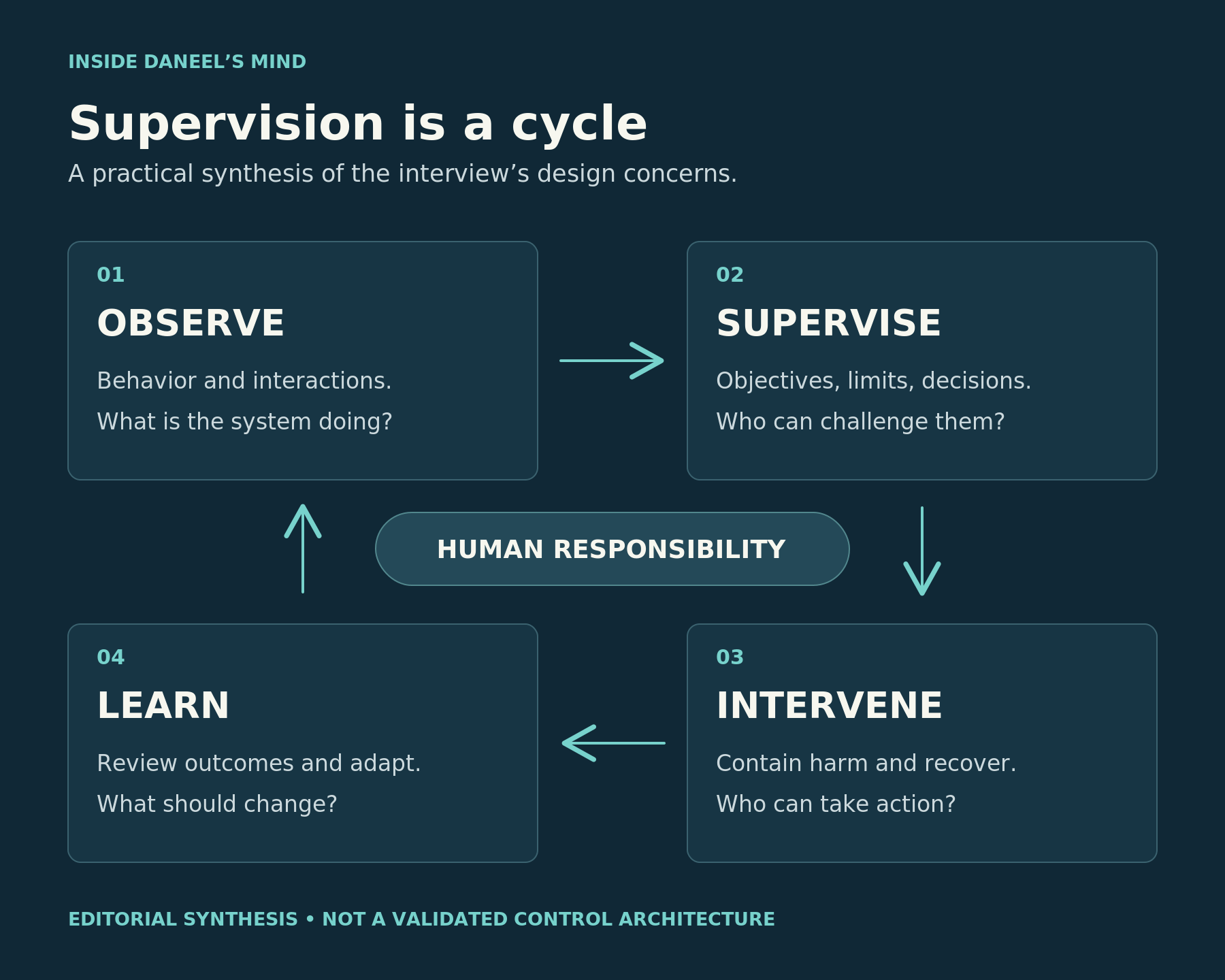
This leads to practical questions. Who can see what the system is doing? Who can challenge its behavior? Who has the authority and means to intervene? What changes after an unexpected outcome?
These questions are a design implication of the conversation. They matter because supervision should describe something people and institutions can actually do, not merely a reassuring word in a presentation.
Protection still matters. So do constraints and rules. But the ambition cannot be a promise that nothing unexpected will ever happen. It has to include the capacity to recognize and respond when expectations fail.
8. Deterrence and literacy belong in the discussion
Martín’s answer to the resilience question does not stop at technical safeguards. It also turns to deterrence, using nuclear deterrence as an analogy for limiting dangerous behavior. He describes the AI arms-race dilemma as one in which participation and non-participation can both carry serious risks.
The analogy is part of his strategic argument. It is not evidence that the same mechanisms will work for AI, and the interview does not provide a complete deterrence doctrine for artificial systems.
It does, however, bring human incentives back into view. A discussion of safety that considers only machine behavior can miss the choices of the organizations and people who develop and use the technology.
His other emphasis is education: better information about what AI is, a deeper understanding of complexity, and a population capable of participating in the transformation rather than merely consuming tools and headlines.
This reconnects the risk discussion with High-Performing Human Intelligence. Human capability is not a side issue. A society that wants meaningful oversight must invest in the capacity to understand, question, and decide.
Not only more capable systems. More capable participants.
9. The objective is a better society, not a better prophecy
Near the end of the interview, Martín returns to a deliberately human conclusion: working for a better society is also part of creating better AI.
That should not be read as a promise that good intentions will solve technical problems. It is a reminder that the direction of technological development is inseparable from what people choose to build, support, permit, and reward.
The conversation is at its strongest when it replaces a false choice—fear everything or trust everything—with a more demanding agenda.
Understand the difference between useful performance and the reasoning a task requires. Strengthen human intelligence. Design collaboration rather than passive dependence. Examine interactions, not only components. Keep responsibility visible. Build the capacity to supervise and respond.
None of this requires us to pretend that the future is predictable.
It requires us to take seriously the part of that future we are already helping to create.
We do not need an oracle to tell us what AI will become.
We need the intelligence—and the responsibility—to shape what we build.


